 VibeOps
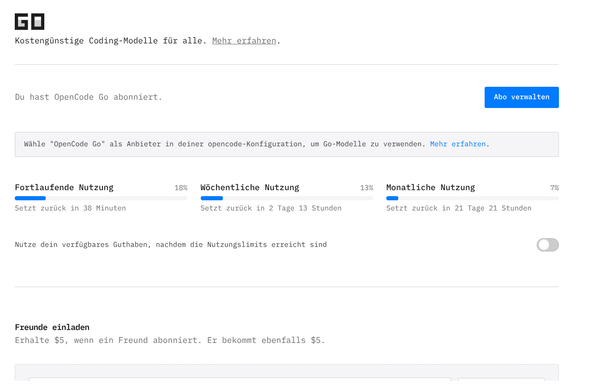
#zwischenbericht #opencode go nach einer woche 1/3
habe zu beginn nur #minimaxm27 benuztz - und mich gewunder ob die nutzungsangabe überhaupt funktioniert
war die ganz zeit bei 0%
👇
#gevibeopt #proxmox 2/x
was bringt dir das jetzt? dein #ai agent in proxmox ve?
ich habe angefange rum zu spielen mit #minimaxm27
der kleine start prompt (agents.md) hat immer ausgereicht das die ki bescheid wusste - zu beginn hab ich readme.md noch mit gesendet - mittlweile mach ich das nicht mehr
man kann alles über cli machen: neue vms erstellen - einstellung in vms ändern - aber auch andere dinge im hintergrund... einfach per prompt: "lade die aktuelle ubuntu iso runter und leg sie mir in den ordern damit ich das im dropdown menü habe bei neuinstallation" und zack ich hatte alles da
klingt alles noch relativ einfach - aber ich habe mir viel zeit gespart bei der inbetriebnahme
erste vm
da #windows unumgänglich ist (software/infrastruktur/users) als erstes #server 2025 installiert
soll bis zu 10 personen über rdp zulassen - bissel software drauf installieren und fertig ist unser terminalserver
ich haben schon beim erstellen der vm über #opencode hinweise bekommen... denk an lizenzen =)
#zwischenbericht #opencode go nach einer woche 1/3
habe zu beginn nur #minimaxm27 benuztz - und mich gewunder ob die nutzungsangabe überhaupt funktioniert
war die ganz zeit bei 0%
👇
MiniMax M2.7 API Review
We tested MiniMax M2.7's API in 3 real-world scenarios, revealing surprising results and areas for improvement.

MiniMax M2.7 Chinese Frontier AI: The $0.30 Model That Just Matched Opus 4.6
The release of MiniMax M2.7 (March 18, 2026) has fundamentally changed the conversation around AI development. We are no longer just watching humans build better tools; we are watching tools build themselves !
The Breakthrough: Recursive Self-Evolution
The headline claim—that M2.7 “built itself”—is technically a slight exaggeration, but the reality is arguably more impressive. MiniMax utilized a process called Recursive Self-Optimization (RSO).
Instead of humans manually labeling every data point and tweaking every hyperparameter, MiniMax researchers deployed an earlier version of the model to act as a lead researcher. This “Agentic Researcher” handled 30% to 50% of the reinforcement learning (RL) workflow, including:
Log-Analysis & Debugging: Identifying why specific training runs failed.
Synthetic Data Generation: Creating targeted training sets to bridge its own logic gaps.
Harness Optimization: Improving the very code and environment used to train it.
The result? A staggering 30% gain in performance on internal benchmarks without a proportional increase in human labor or compute hours.
🇨🇳🧠 #MiniMaxM27 #AISingularity #GPT5 #Tech #MachineLearning #OpenClaw #MiniMax #CodingAI #MiniMax
 airanked
 TKHUNT
 nbloglinks