Panorama de Leeuw XII plaatst Aktie Notenkraker in context van zijn tijd

Hoe nuttig en noodzakelijk was de beruchte Aktie Notenkraker op 17 november 1969? Die vraag beantwoordde ik gisteren op de Concertzender in de twaalfde aflevering van Panorama de Leeuw, een kroniek van de hedendaagse muziek in Nederland aan de hand van mijn biografie Reinbert de Leeuw, mens of melodie. Net als in mijn boek plaats ik in de radio-uitzendingen het leven van De Leeuw en diens kompanen in de context van zijn tijd.

Zo belichtte ik in aflevering XI uitvoerig het studentenoproer in Tilburg in oktober 1969, dat succesvoller was dan de hierop geïnspireerde Aktie Notenkraker. Dankzij de opstand in Tilburg ging het Brabants Orkest vaker muziek van levende componisten uitvoeren. Dat geldt niet voor het Concertgebouworkest, waarop ‘de Notenkrakers’ het op 17 november 1969 gemunt hadden. Hierna presenteerde het orkest namelijk eerder minder dan meer moderne noten.

Minder vreemd dan het lijkt, want van oudsher had het Amsterdamse orkest veel aandacht besteed aan avant-gardisten, wier muziek hierna echter steeds vaker door gespecialiseerde ensembles werd uitgevoerd. De Aktie Notenkraker was des te opmerkelijker aangezien het orkest daarvoor al geregeld muziek van Reinberts kompanen Louis Andriessen, Peter Schat en Jan van Vlijmen op de lessenaars had gezet. Sterker nog, op de dag van het protest gaf Andriessen een opdracht voor een blokfluitconcert terug. Hoewel de Aktie Notenkraker in wezen nut noch noodzaak had, ging deze de muzikale annalen in als baanbrekend.

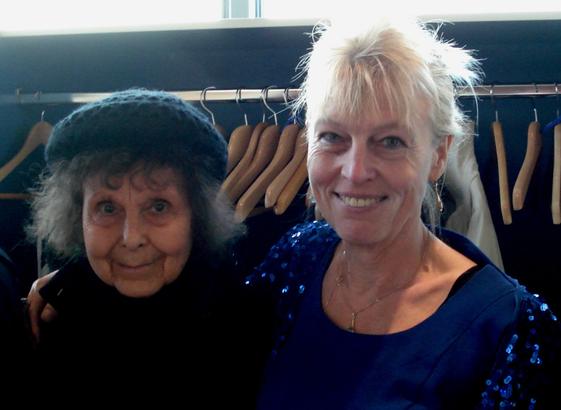
Met Sofia Goebaidoelina na afloop van de viering van haar 80e verjaardag in het Muziekgebouw aan ‘t IJ, 23 oktober 2011

Het toeval wil dat ik op 1 oktober in het Muziekgebouw aan ‘t IJ de eerste les verzorgde van mijn nieuwe cursus hedendaagse muziek, bij een concert van het Asko|Schönberg o.l.v. Reinbert de Leeuw. Thema van de les was ‘De Russen’, want Reinbert dirigeerde onder anderen twee stukken van Sofia Goebaidoelina en Galina Oestvolskaja. Deze powerladies hebben ook veel betekend voor mijn carrière. Ik schreef erover voor Cultuurpers.

Ook de rest van de maand was ik druk met nieuwe muziek. Zo interviewde ik Giya Kantsjeli op 18 september over zijn stuk Dixi, tijdens de inleiding op een concert van het Radio Filharmonisch Orkest en het Groot Omroepkoor in het AVROTROSVrijdagconcert. Ik maakte voor de live uitzending op Radio 4 ook een reportage van een repetitie van dit grootse werk.

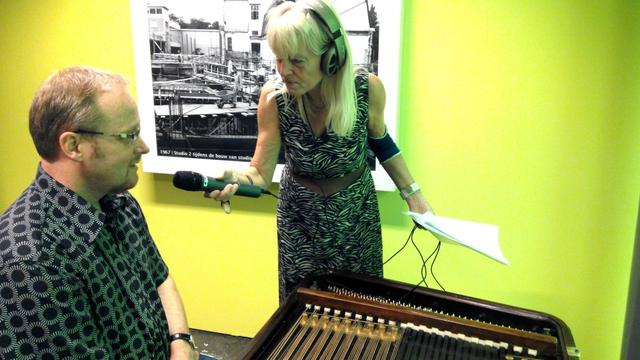
Met Dirk Luijmes in Muziekcentrum van de Omroep 24-9-2015

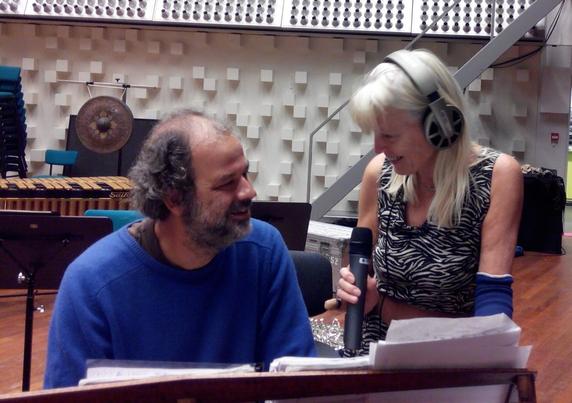
Een week later speelde het collectief Ludwig een concert in deze radioserie onder de titel ‘Met psalmenpomp en hakkebord’, waarover ik ook een voorbeschouwing schreef. Voor Radio 4 sprak ik met Dirk Luijmes over het harmonium (psalmenpomp”) en met Jan Rokyta over de cimbalom (‘hakkebord’). Luijmes soleerde in het First Harmonium Concerto van Martijn Padding; Rokyta schitterde in het stuk da capo van Peter Eötvös en het Cimbalom Concerto van Florian Maier.

Met Jan Rokyta in Muziekcentrum van de Omroep 24-9-2015

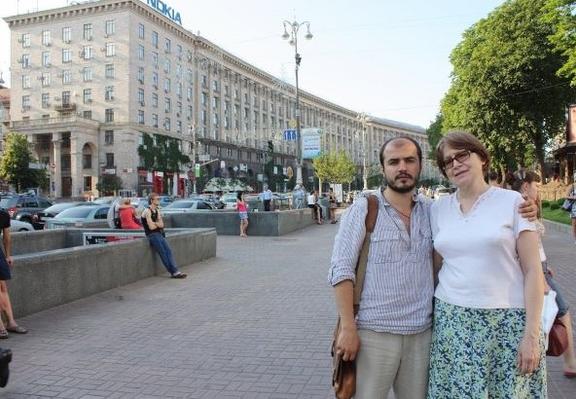
Afgelopen vrijdag 2 oktober was ik de hele dag in touw voor een portret van de Oekraïense componist Valentin Silvestrov, wiens Zevende Symfonie die avond zijn Nederlandse première beleefde in het AVROTROSVrijdagconcert. Een bijzondere ervaring, want de 77-jarige componist verlaat zelden zijn flatje in Kiev en spreekt alleen Russisch. Gelukkig vond ik een begenadigde tolk in jonge, de eveneens Oekraïense componist Maxim Shalygin, die tegenwoordig in Den Haag woont.

Silvestrov bleek een ongelooflijke spraakwaterval en het monteren van al die verschillende talen (Russisch – Engels – Nederlands) was een hels karwei, maar het is me gelukt; ik kreeg veel complimenten voor mijn portret.

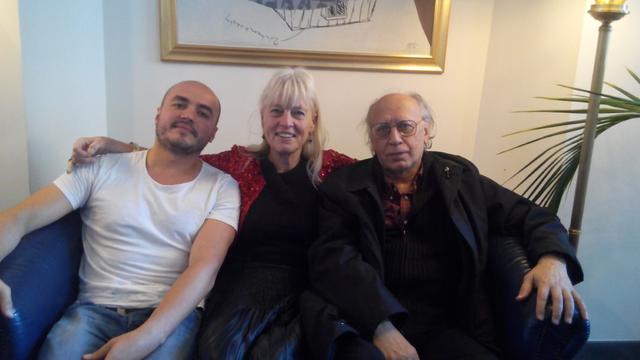
Met Maxim Shalygin & Valentin Silvestrov in Hotel Karel V Utrecht 2-10-2015

Het concert was een groot succes, met een minutenlange ovatie voor een dankbare Silvestrov, die te bescheiden was om het podium te beklimmen en het applaus vanuit de zaal ontving. Bijzonder was dat ook Giya Kantsjeli naar TivoliVredenburg gekomen was; hij is een goede vriend van Silvestrov.

Met Giya Kantsjeli – slagwerker Konstantin Napolov & Maxim Shalygin na afloop van het concert met Silvestrov in TivoliVredenburg, 2-10-2015

Een stuk jonger is de Grieks-Nederlandse componist Calliope Tsoupaki, over wier nieuwe opera Mariken in de tuin der lusten ik al in mijn vorige twee updates berichtte. Ik schreef voor het muziekblad Luister een interview met haar en publiceerde gisteren nog eens vier vragen die ik haar stelde.

#AktieNotenkraker #AVRPTROSVrijdagconcert #BrabantsOrkest #CalliopeTsoupaki #CollectiefLudwig #Concertgebouworkest #Concertzender #Cultuurpers #DirkLuijmes #FlorianMaier #GalinaOestvolslaka #GiyaKantsjeli #GrootOmroepkoor #JanRokyta #KonstantinNapolov #MarikenInDeTuinDerLusten #MartijnPadding #MaximShalygin #mensOfMelodiePanoramaDeLeeuw #PeterEötvös #PierreBoulez #RadioFilharmonischOrkest #ReinbertDeLeeuw #SofiaGoebaidoelina #TheaDerks #ValentinSilvestrov
De 5 concerten die je niet wilt missen in Gaudeamus Muziekweek

Liefst 175 partituren van componisten uit 28 landen moest de driekoppige jury van de Gaudeamus Muziekweek beoordelen. Vijf van de inzenders werden genomineerd en strijden om de felbegeerde Gaudeamus Award, die zondag 11 september wordt uitgereikt na afloop van het slotconcert in Cloud Nine in muziektempel TivoliVredenburg in Utrecht.

Het nieuwemuziekfestival leverde tot nu toe interessante prijswinnaars op als Unsuk Chin, Michel van der Aa en Anna Korsun. Ook dit jaar biedt het festival weer een keur aan evenementen. Hierbij een selectie van vijf concerten die je niet mag missen.

Woensdag 7 september: openingsconcert in TivoliVredenburg

Michel van der Aa: Up Close

In 1999 won hij de Gaudeamus Award met zijn slagwerkkwartet Between en sindsdien maakte Michel van der Aa een glanzende carrière. Eerder dit jaar gooide hij nog hoge ogen met zijn nieuwste opera Blank Out, maar eerder al wist hij publiek en pers voor zich in te nemen met zijn Celloconcert Up Close, waarin een solocelliste een dialoog aangaat met haar oudere evenbeeld op video, bijgestaan door een strijkorkest.

Van der Aa componeerde dit zinsbegoochelende werk voor Amsterdam Sinfonietta en zijn solocelliste, en won er in 2013 een Grawemeyer Award mee. Zij tekenen ook dit keer voor de uitvoering. Naast Up Close Van der Aa staan al even fraaie werken op het programma van Kate Moore, Maxim Shalygin, Hugo Morales en Jörg Widmann.

Donderdag 8 september: A Night Out with Modelo62

Ensemble Modelo62

Het Haagse ensemble Modelo62 breekt in Theater Kikker een lans voor multidisciplinaire muziek van drie voor de Gaudeamus Award genomineerde composities. Anthony Vine slaat een brug tussen hedendaagse muziek, beeldende kunst en dans. Voor For Agnes Martin liet hij zich inspireren door de rechtlijnige schilderijen van de gelijknamige kunstenares.

Vines From a Forest of Standing Mirrors is beïnvloed door een grillige choreografie van Maguy Marin. Genomineerde James O’Callaghan laat in AMONG AM A muziek en omgevingsgeluid met elkaar versmelten. Drie jonge makers nemen het publiek tot slot mee op een zintuiglijke beleving waarin geluid, licht, visuals én geur met elkaar versmelten.

Vrijdag 9 september: Great Expectations

Silbersee (c) Anna van Kooij

Twee jaar geleden won Anna Korsun de Gaudeamus Award met zinnenstrelende koorwerken, waarin zij op een natuurlijke wijze technieken uit de oude muziek verbindt aan nieuwe compositietechnieken. Het avontuurlijke operagezelschap Silbersee presenteert nu haar nieuwste compositie, Ulenflucht in de intieme ambiance van de Pieterskerk.

Korsuns compositie wordt geflankeerd door Madhye II van Shih-Wei Lo, een van de vijf genomineerden. In dit werk voor zes stemmen en computermuziek bewerkt de Taiwanese componist opgenomen geluiden live tot een virtueel koor Benieuwd of hij Ulenflucht van Korsun naar de kroon gaat steken.

Zaterdag 10 september: Elektronische muziek in Nederland, Tera de Marez Oyensprijs

Tera de Marez Oyens in haar studio

Precies twintig jaar geleden overleed Tera de Marez Oyens (1932-1996), een van de pioniers op het gebied van elektronische muziek in Nederland. Haar sterfdag wordt in TivoliVredenburg herdacht met een seminar over de ontwikkeling van gecomponeerde elektronische muziek in ons land.

Drie experts laten hierover hun licht schijnen en uiteraard komt ook elektronische muziek tot klinken, onder andere in een performance van Gunnar Gunssteinsson. ’s Middags presenteren zes jonge makers zich aan het publiek in het New Makers New Music programma. Na afloop krijgt een van hen de Tera de Marez Oyensprijs uitgereikt.

Zondag 11 september: Thieves, bekendmaking winnaar Gaudeamus Award

Het zeskoppige ensemble Looptail presenteert in Cloud Nine van TivoliVredenburg het stuk Thieves, dat in nauwe samenspraak met componist en theatermaker Thanasis Deligiannis tot stand kwam. Hun interactieve muziekperformance gaat over het geluid van dieven in de nacht en over de emoties van hun slachtoffers. Ook het publiek wordt erbij betrokken.

Thieves beleeft zijn wereldpremière tijdens dit slotconcert van de Muziekweek. Na afloop wordt de winnaar bekendgemaakt van de Gaudeamus Award. Hij – helaas is dit jaar niet één vrouw genomineerd – gaat naar huis met een geldbedrag van € 5000, bedoeld voor een nieuwe compositie die in een volgende aflevering zal worden uitgevoerd.

#AnnaKorsun #GaudeamusMuziekweek #KateMoore #Looptail #MaximShalygin #MichelVanDerAa #TheaDerks

Cellist Maya Fridman: ‘The best thing about making music is communicating with my audience’.

Maya Fridman, photo Brendon Heinst

The cellist Maya Fridman was born in 1989 in Moscow, where she developed into a child prodigy. Already while studying at the Schnittke College she won the first prize of the International Festival of Slavic Music. In 2010 she moved to the Netherlands, where she graduated Cum Laude from the Conservatory of Amsterdam six years later.

Fridman naturally juxtaposes contemporary compositions with major works from the last century, moving us with her emotionally charged playing. For two seasons she is ‘musician in residence’ at Gaudeamus. On 26 April she will present the world premiere of Canti d’inizio e fine in Kunststruimte KuuB in Utrecht.

This seven-part composition for solo cello and vocals was created in close collaboration with the Ukrainian-Dutch composer Maxim Shalygin. Fridman: ‘The title Canti d’inizio e fine refers to the cycle of birth, life and death, the underlying theme. Later Maxim also involved images of the Holocaust. That’s a tough subject, all the more so because both of my parents are Jewish. Each movement reflects on a different life situation or crisis, the music is very dramatic and psychological.’

Catharsis

She first heard Shalygin’s music in 2016, during a network meeting of music publisher Donemus. ‘I was immediately attracted to his ideas and asked him to compose a solo piece for me on the spot. His music is very profound and touches me deeply. It makes me think, and makes me experience my life differently. It’s hard to describe precisely, but it transforms and purifies me. It sometimes literally feels like a catharsis.’

For Canti d’inizio e fine they initially corresponded by e-mail, but in the last few months they have met regularly. ‘We work intensively together to find the right sound for every note. It’s great to be able to communicate directly with a composer.’ Despite their close cooperation, however, Fridman does not consider herself a co-composer. ‘Maxim writes the notes, I interpret them. I do sometimes make suggestions for a different interpretation, though. Sometimes he accepts these, sometimes he doesn’t, at other times we arrive at something completely different.’

Trembling cello

When I interview her a week before the premiere, they are still busy working on the finishing touches of the piece. ‘Maxim uses very varied techniques, each of the seven movements has a different approach. The first one is slow and lyrical and sounds a bit like weeping, as if something fragile comes to life.’

‘In the second movement there’s a lot of ricochet, where I bounce my bow on the strings. Here you shouldn’t actually hear a cello, it should sound like a trembling voice. That was quite a challenge, because I had to learn how to create that effect with a traditional way of playing.’

In the following section Shalygin uses Arabic tinted decorations. Fridman: ‘There are also very fast crescendi and decrescendi on one note, it reminds me a little of choral singing. In the fourth part I don’t use a bow at all, it consists only of pizzicati. It is Maxim’s intention to make the cello sound like a bass guitar here.’

In the next movement, sound researcher Shalygin uses a so-called BACH bow, that has a curve so that all four strings can be played simultaneously. I still have to practice that’, Fridman laughs. ‘But this challenge is exactly what attracts me in working with Maxim, I learn to push my own limits.’

Todesfuge Paul Celan

Also exciting is the epilogue, in which Fridman must not only play but also sing. Only this movement bears a title, Todesfuge, after Paul Celan’s poem of the same name. Fridman: ‘Although I regularly sing and play simultaneously this is a lot more challenging, because Maxim makes higher demands on my voice than, for example, Louis Andriessen in La voce.

‘Cello and voice are completely equal. Sometimes they merge, at other times there is more counterpoint. Maxim moreover looks for the extremes, my melodic lines range from extremely high to very low. I am not a trained singer and have taken vocal lessons especially for this purpose.’

In Todesfuge, Celan describes the atrocities and death in a concentration camp. Fridman: ‘Very moving, every time I practice this it makes me want to cry.’ Yet she is not afraid of being overwhelmed by her emotions during the concert. ‘I have lived with this piece for months now, I get up with it and go to bed with it, it grows inside me.’

‘It is precisely because of my personal involvement that I can get the message across even more forcefully. ‘I find this the most attractive in making music: communicating with my audience.’

PS On 26 April only the first five movements were performed. On Sunday 9 September the integral cycle will be premièred in MerkAz at 2 pm.

Maya Fridman plays La voce Louis Andriessen

#CantiDInizioEFine #Gaudeamus #KunstruimteKuuB #LouisAndriessen #MaximShalygin #MayaFridman

Maya Fridman (2)

Contemporary Classical - Thea Derks

Maya Fridman: Prokofiev’s Fiery Angel with hardrock attitude

Abandoned Building. Toned Image, cd-cover The Fiery Angel.

The Russian-Dutch Maya Fridman (Moscow, 1989) plays classical and contemporary music as well as rock, jazz, folk and flamenco. Communication with the audience is her most important goal, so why limit herself to a particular style or genre? The website of the Dutch Cello Biennale rightly describes her as a ‘musical centipede’. In 2016 she was much lauded for her contribution to the music theatre production The Master & Margarita.

Recently she was selected as a finalist for the Dutch Classical Talent Award 2018-19. At Gaudeamus, Foundation for Contemporary Music, she is ‘music pioneer in residence’. As such she played and sang the premiere of Canti d’inizio e fine by Maxim Shalygin last April. The Ukrainian-Dutch composer wrote this Holocaust-inspired composition especially for her.

Fridman once more shows her versatility on her latest cd, The Fiery Angel, for cello and piano. The title refers to Prokofiev’s opera The Fiery Angel that he based on the novel of the same name by Valeri Bryusov. In five acts we follow the fate of the young Renata. As a child she fell in love with the ‘fiery angel’ Madiel, whom she thinks to recognize in Count Heinrich. After a passionate relationship Heinrich abandons her, after which Renata is tormented by demons. Knight Ruprecht tries in vain to save her; eventually she dies at the stake.

Reducing over two hours of music for orchestra and soloists to a version for cello and piano seems quite an unfeasible enterprise. Fridman acknowledges this in the cd booklet. ‘While working on the first part, it still felt like an impossible task.’ She felt trapped in the ‘delirium of Renata’, which prevented her from thinking clearly. But as time went on, the music was so compelling that she completed its arrangement like a madwoman. ‘It seemed as if the radiant image of the angel was fleeting from my hands, just as in Renata’s case’, she writes.

For Fridman, the essence of the story lies in the fusion of ecstasy and suffering. By her death at the stake, Renata sacrifices her own being in order to unite with the angel. Fridman has striven to capture this theme in her arrangement. ‘This music requires dissolution to exist, and faith to surrender. It is the celebration of the Symbolists’ idea that physical reality is nothing nut a distorted echo of another realm.’ High-flown words that Dutch people are wary of, but which are self-evident to Russians.

Fridman reduced the original opera to just under half an hour of music. In four ‘chapters’ she closely follows the original story. The dedication with which she shapes Renata’s obsession sparks from every note. Aggressive, percussive sounds depict her internal ordeal; lyrical, more reflective passages express her longing for love. Fridman plays with a hardrock attitude,  at times she seems to literally wish to shatter her cello. On the gothic cd-cover she poses in a black leather suit, like an angel with wings of fire.

Chapter I opens with strongly accentuated strokes of the cello and boisterous piano chords: the fiery angel knocks at the door. Renata’s anxiety is reflected in shaky flageolets and hesitant piano notes. Sultry piano chords and gently flowing lines of the cello capture the emerging love between her and Ruprecht. However, the idyll is soon disturbed by motoric rhythms and furious strokes of the bow on the cello.

When Ruprecht and Renata go in search of Heinrich, jumpy, expectant solo cello passages alternate with impressionistic piano tinkling and black despair. A loud knock on the body of the cello makes one’s hair stand on end: Heinrich does not (yet) show himself, but ominously makes himself heard. In chapter III he rejects Renata once more, whereupon she asks Ruprecht to kill him in a duel. Angry strokes and repeated, bouncing double stops of the cello are accompanied by an orgy of battering piano sounds.

In the fourth and last movement, Renata seeks refuge in a monastery. Melancholic sighing sounds from the cello and rippling piano runs create the illusion of regained peace. But instead of having been cured, Renata infects the nuns with her delusions. Fridman creates frightening whistling tones, makes her instrument sound like an accordion, and dances a short tango. A series of furious figurations of both instruments is suddenly smothered in a loud, droning cymbal: Renata ends up in the fire.

Fridman and her pianist Artem Belogurov cannot be accused of coquetry. They both play as if their lives depend on it. That Fridman’s intonation sometimes falls prey to her passionate performance is of no real consequence. Like Rostropovich she puts eloquence above perfection.

In the upcoming Gaudeamus Music Week she will present Me, Peer Gynt, a cross-disciplinary production she developed together with pianist Tomoko Mukaiyama. Something to look out for.

#ArtemBelogurov #GaudeamusMusicWeek #MaximShalygin #MayaFridman #SergeiProkofiev #TheFieryAngel #TomokoMukaiyama

Abandoned Building

Contemporary Classical - Thea Derks

#Corona-classics 2: Maxim Shalygin: growling & screeching saxophones on CD ‘Todos los fuegos el fuego’

A rainy day in #corona quarantine seems the ideal moment to listen to a CD about fire. So I slide Todos los fuegos el fuego by the Ukrainian-Dutch composer Maxim Shalygin into my laptop.

‘All fires the fire’ is named after the collection of eight short stories by Julio Cortázar. The CD also  contains eight pieces, which together form a suite for the exceptional line-up of saxophone octet.

Maxim Shalygin composed it in 2019 for the Amstel Quartet and the Keuris Quartet, who also recorded it.

Since you’re here: due to the corona lockdown my income has dwindled to virtualy nill. Your support is welcome, however small the amount. Thanks, Thea! 

Transfer to NL82 INGB 0004261694, TJM Derks Amsterdam or through PayPal (friends option).

Shalygin (Kamianske 1985) studied composition at the conservatories of St. Petersburg, Kiev and The Hague. Since 2011 he has lived in the Netherlands, and four years later I met him personally. He helped me out when I went to interview his compatriot Valentin Silvestrov for Radio 4 and learnt that the reclusive composer only speaks Russian. Shalygin gratefully seized the opportunity to meet his idol. We had a very animated conversation, in which Silvestrov’s loquaciousness was matched by Shalygin’s enthusiastic interpretation.

Exploring boundaries

As a matter of course I hereafter immersed myself in Shalygin’s own music. This is characterized by a great intensity and a zest for exploring boundaries. He challenges musicians to conjure sounds from their instruments that they never suspected existed. Shalygin’s work often has a spiritual slant, making him a kindred spirit of Silvestrov.

In 2017, during the Gaudeamus Music Week, I was captivated by his Lacrimosa, composed for seven violins. A year later he composed the impressive cycle Canti d’inizio e fine for the intrepid cellist Maya Fridman. In this cycle he not only asks her to fiercely flog her instrument, but to simultaneously sing.

Todos los fuegos el fuego also presents a wide range of playing techniques. Thus Shalygin tries to create a musical equivalent of the storytelling techniques with which Cortázar shapes his magical-realistic world. The Argentine author himself described his prose as incantatoria, that has the double meaning of ‘enchantment’ (in the sense of a magic spell) and ‘chant’ (as in song, singing). This concept refers both to the hypnotic atmosphere in Cortázar’s work, and to the care he dedicated to constructing his sentences. His syntax arose partly intuitively, from delays and accelerations that express the underlying emotion or atmosphere rather than the message itself.

Shifting layers

This is exactly how Shalygin goes about in Todos los fuegos el fuego. All eight pieces consist of different layers that slide over, under and through each other in ever changing formations and tempi. The pace is usually low, with elongated lines meandering through the space without any recognisable metre – there is no such thing as thumping along with the beat. Nor loudly singing along for that matter. Shalygin does not write Ohrwurms, but concentrates on contrasts between slow movements in one register versus faster motifs in the other. Like a shaman he draws attention to the sound itself and invites us to listen to our inner self.

International Combustion Engine opens with sustained tones that are slowly layered on top of each other, cautiously ornamented with languid trills. A melody built from small steps in the upper voices is interspersed with fierce growls in the lower registers. Death of a Mosasaur has a more narrative nature. A wistful motif of one step up, one step down followed by a jump up wanders desolately through the various registers. Gradually an unwieldy pulse develops, as if a waddling Mosasaur is approaching. A soprano sax blasts out piercing, staccato cries like morse-signs. This apparent cry for help is smothered in low roars and ends in abrupt silence.

Incantation

The other movements also abound in overlapping and repetitive patterns, sudden interruptions, decelerations and accelerations. Tones mysteriously swell up out of nowhere, are played with audible breath or with tongue-slaps that create ear-splitting attacks. At other times, the saxophonists make their lips vibrate while playing, like a softly snorting horse. Spring, Breaking creates an intoxicating atmosphere with subtly pulsating sounds, Endless Mordent is a study in eruptive grace notes.

In Ashes in Birth screeching and rhythmically teeming lines gradually advance towards rattling valves that die away into nothingness. But the most beautiful movement is Stairway to Decay, a melancholic lament that is roughly disturbed by ‘out of tune’ sounds, as if decay sets in. The texture gradually becomes more dissonant, while from afar a mumbled prayer develops, like an incantation. When the saxophonists start articulating more clearly, we finally discern the text: ‘Todos los fuegos el fuego’. – Mesmerizing and haunting.

The eight saxophonists effortlessly master the extended techniques in Shalygin’s score. Moreover they are completely attuned to each other: breathing and playing as one living entity they sound like a majestic organ.

– Thanks to Todos los fuegos el fuego the drizzly day was over before I knew it.

#AmstelQuartet #corona #JulioCortázar #KeurisQuartet #MaximShalygin #MayaFridman #TodosLosFuegosElFuego #ValentinSilvestrov

Cover-12-768×1036

Contemporary Classical - Thea Derks

Ukrainian Composer Maxim Shalygin honours Belarusian dissident Maria Kalesnikava in ‘While Combing Your Hair’

In 2011, Maxim Shalygin  (Ukraine, 1985) came to the Netherlands to study composition with Cornelis de Bondt and Diderik Wagenaar at the Royal Conservatoire in The Hague. He never left and has meanwhile acquired a firm position in Dutch musical life with his adventurous pieces.

Commissioned by the AVROTROSVrijdagconcert he composed While Combing Your Hair for the Dutch Radio Choir. Peter Dijkstra will conduct the world premiere in the Jacobi Church in Utrecht on 8 October. The concert will be broadcast live on Radio 4.

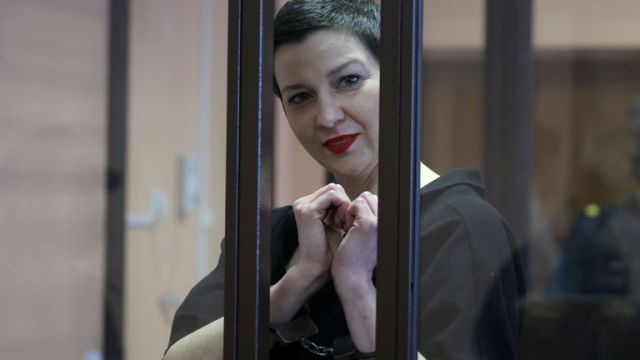
The short piece is an indictment of the repression in Belarus and is dedicated to the musician and dissident Maria Kalesnikava. She was one of the three women who led the resistance against Aleksandr Lukashenko’s dictatorial regime in 2020. She was arrested, but when the authorities wanted to deport her, she demonstratively tore up her passport and was imprisoned. Recently, she was sentenced to 11 years in prison in a closed mock trial.

This was not only a blow to the opposition in Belarus and to Kalesnikava herself, but also a shock for Shalygin: ‘We met several times in Germany and became good friends. She is a warm, honest person, a moving personality. I miss her terribly.’ The composer seized the commission from AVROTROSVrijdagconcert offered him to express his feelings in music.

PERSONAL LETTER TO KALESNIKAVA

He wrote the text for his choral composition himself, which reads both like a lament and an attempt to buck Kalesnikava up. How did he conceive his text and who is actually speaking? Shalygin: ‘It is my personal letter to Maria. At the same time, it is indeed not always clear who is speaking; sometimes we hear voices in our heads.’

The writing process was difficult, says Shalygin: ‘On the one hand, my text is very personal, but at the same time I wanted to convey universal emotions through imagery. After I had finished a first draft, my friend Paul van der Woerd helped me improve it.’

Asked how he translated his poetic words into music, he replies in metaphor: ‘The structure of While Combing Your Hair reminds me of a stream that springs from a small source and rapidly expands into a mountain river, which in turn flows into a calm lake and freezes in it.’

Maxim Shalygin

Beautiful, but what should we expect from this in terms of sound? ‘I usually compose tonal music that sometimes becomes polytonal, or transitions into so-called extended tonality’, says Shalygin.‘I have been researching these techniques for years and have discovered how to develop them musically. Thus, this piece starts tonally and undergoes many modulations across different keys, to end up again in a simple, tonal music with a bright melody.’

VIBRATING BUT CALM CHORD

‘This melody is sung twice, but in a different colour scheme. Then it is incorporated into a polytonal chord that suddenly begins to vibrate.’ The vibration Shalygin refers to arises from the dissonant composition of this final chord (c-des-d-es-e-f-ges-g-as-a-b), in which with the exception of the b-flat all twelve semitones sound simultaneously.

Yet the ending does not evoke tension, but sounds instead very natural and calm, Shalygin emphasises: ‘While Combing Your Hair is my musical letter to Maria Kalesnikava. I want to float on the music and end up in the lakes I have never seen before and hope she can listen to my piece soon, sitting next to me in the concert hall.’

While Combing Your Hair

Wake up from your dream and look up straight to the sea.
Would you be silent, if its color turned suddenly red?
And from the emerald sky hundreds of various animals will start to fall down.
Will you believe the rainbow’s still near,
when at night the seagulls start screaming above all flooded market places,
will you take the hairbrush and start combing your dazzlingly stunning white hair?
The sound of the broken mirrors will freeze in the air:
thousands of silent shards!
And you will see lonely boats in quiet lakes with faces of fish:
praying, trembling and crying in primeval fear.
Let your hand shield your blue eyes
so darkness will be like blood in a world out of golden salt.
Stay in silence, and lift up your sorrowful,
exhausted face to the Sun.
Then flocks of birds will descend to every home,
people will hear them sing in their backyards.
And smiles will suddenly cover their frightened
yet trustful and beautiful souls.

Maxim Shalygin

https://www.youtube.com/watch?v=b6KCMSu5_9Y

Apart from the world premiere of While Combing Your Hair the choir will sing music by Dvorák, Bruckner and others.

Contemporary Classical is named one of the 60 best classical music blogs worldwide
Support, however small, is welcome through PayPal (friends option), or transfer to my bank account: T. Derks, Amsterdam, NL82 INGB 0004 2616 94. Thanks!

#AleksandrLukashenko #AVROTROSVrijdagconcert #MariaKalesnikava #MaximShalygin #WhileCombingYourHair

Maxim Shalygin composes Severade for 9 cellos & sound sculpture: ‘At first I had no idea what to do with all those new instruments’

The Ukrainian-Dutch composer Maxim Shalygin has established himself firmly in our Dutch musical life with his adventurous pieces. Last October, his choral work While Combing Your Hair, dedicated to the Belarusian dissident Maria Kaleshnikava, was a great success.

In September, the Dag in de Branding festival staged the first public performance of Severade, a full-length work for cellist Maya Fridman, Cello8tet Amsterdam and 25 mechanical instruments by Rob van den Broek. Who is he and what is the background of Severade?

Maxim Shalygin (c) Anna Reshetniak

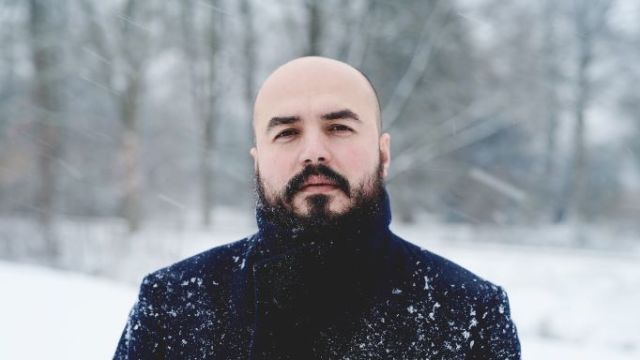
Maxim Shalygin was born in 1985 in Kamianske, a medium-sized town about 450 kilometres southeast of Kyiv. Although he was not born into a musical family, at the age of six he went to the local music school and then to musical college, the preliminary course of the conservatory. There he studied bayan with Alexander Kornev, with piano and conducting as subsidiary subjects.

IRINA IVASHENKO – THE IDEAL MENTOR

In his biography we further read that he studied composition with Irina Ivashenko. But a search for her name on the internet or social media yields no mention at all. Who is she? She was one of the teachers at the music college in Kamianske and I had composition lessons from her from the age of fourteen. – On a voluntary basis, because composition was not on the curriculum. Irina taught me in her spare time and did not charge a penny for it. The last two years before I went to the conservatoire, we met up other almost every day.’ 

She played an important role in his life, Shalygin continues: ‘We became good friends and at one point she dedicated just about all her free time to tutor me. Not only composition, but also harmony, solfeggio, music history, analysis and even art history, poetry and film. She was extremely versatile, it was an incredible time for me. I realise more and more that in those four years she taught me all the important basics. No composition teacher after her taught me as much as she did.’

Maxim Shalygin & Irina Ivashenko, Kyiv 2010 (c) Anna Reshetniak

What made her teaching so special? ‘Besides her broad interest and knowledge of music and culture in general, her way of teaching was remarkable. She had an interesting approach for every subject. For example, to my first lesson in harmony I brought along a tome that everyone at school used. She immediately told me never to bring it again, because we would be studying harmony from music history itself.’

‘For each subject we addressed, she gave examples of the great works from the canon, which she played at the piano – by heart. And after I had played through a few pages of my own new piece, she selected a few bars and explained why I should keep them and discard the rest. Step by step, she thus guided me through my first compositions. Thanks to her, I developed a profound knowledge of musical structure.’

ST. PETERSBURG CONSERVATOIRE  – DISAPPOINTMENT

After completing his training, Shalygin did not move on to the Kyiv Conservatoire, but went to Saint Petersburg instead. ‘This was because Irina considered the Saint Petersburg Conservatoire the best place to study composition. She still had contacts with some of her former teachers and they advised me to attend the class of Boris Tishchenko. But I was very disappointed with the composition department and the education in general. Soon I withdrew to the library. There I listened to recordings and studied scores that were not available in my hometown.’

After a year he returned to Ukraine. In retrospect, his short stay in Saint Petersburg was fruitful, because ‘I realised that it was time to choose my own path. I left in April, before the end of the academic year, and that same summer I was accepted into the Kyiv Conservatoire, where I found the freedom I was looking for.’

‘Here the teaching was aimed at helping you find your own individual voice as a composer, while at the same time you were thoroughly trained in music theory. I still remember the analysis class of Mykola Kovalinas, who had developed his own method. This immensely stimulated my imagination. There were times I would be studying a score for 12 hours a day!’

In 2010, he obtained his master’s degree with the Triple Concerto for violin, cello, piano and orchestra. He then came to the Netherlands, where a year later he completed a second master’s degree in composition with Cornelis de Bondt and Diderik Wagenaar at the Royal Conservatoire. He has been living and working in The Hague ever since. The ties with Ukraine remain warm, however; Ukrainian television followed his trail in The Netherlands for an hour-long documentary that will be broadcast in November 2021.

https://www.youtube.com/watch?v=nLyfjFAp0is

In December, his Severade for 9 cello’s and the newly built sound sculpture will be performed three times. The composition is part of a ‘project for life’ on which Shalygin has been working since 2017. This ever-expanding cycle of full-length compositions for equal instruments is encapsulated under the umbrella title S I M I L A R. Up to now three ‘chapters’ have been completed.

In 2017, Lacrymosa for 7 violins was premiered in the Gaudeamus Music Week; two years later followed by Todos los fuegos el fuego for 8 saxophones; both have been released on CD. In April 2021 Severade, its third movement sounded for the first time in an empty TivoliVredenburg. Chapters four through six are already in the making, for 4 pianos; 5 recorders and 6 percussionists respectively.

SEVERADE – 9 CELLOS AND SOUND SCULPTURE

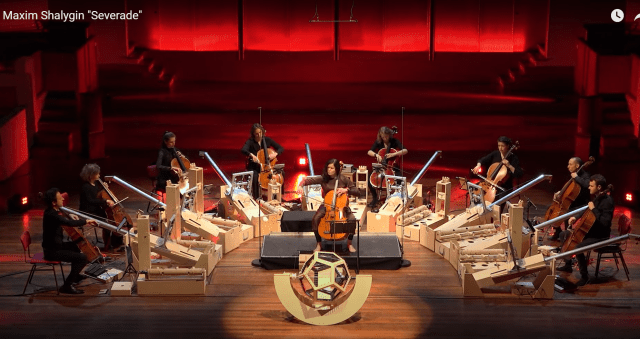
Shalygin composed the 75-minute Severade for Cello Octet Amsterdam and Maya Fridman, for whom he previously composed the ground-breaking Canti d’inizio e fine. Severade is a contraction of ‘sever’, the Russian word for ‘north’ and serenade. Especially for this composition, artist Rob van den Broek developed 25 mechanical wooden instruments, which function as extensions of the acoustic cellos. These are controlled by the nine musicians and together form a spectacular sound sculpture.

The idea for this came about more or less by accident, says Shalygin: ‘Normally I compose for purely acoustic instruments, and this time I had nine cellos in mind. But while I was thinking about my piece, I met Rob and suddenly an idea sprang to mind: maybe we can build an instrument that a cellist can operate while playing.’ That turned out to be easier said than done: ‘If we had known how long and difficult the road would be to reach a satisfactory result, we probably wouldn’t have started our endeavour.’

Cello Octet Amsterdam & Maya Fridman in TivoliVredenburg

‘But once we had jumped in at the deep end, we didn’t want to give up. The entire process of developing, experimenting and trying out took a year and a half. I still remember how I felt when I received the first instruments from Rob. For a day I stared at them in my otherwise empty studio. I had no idea what to do with them, even though it had been my own initiative. But gradually I began to understand how I could use these new instruments in my piece. Once that coin dropped, writing Severade was actually a light and exciting journey.’

Each of the eight tutti cellists plays their own cello as well as a set of three wooden instruments, strung with horsehair strings and tuned differently. These are driven by a (silent) motor, operated by the respective cellist. The most important object is a long, pipe-shaped sound box to the left of the musician, which resembles a rectangular cello. A thick string is rubbed by a wooden wheel, creating mysterious, long-drawn-out bourdon tones.

FAIRYTALE-LIKE RITUAL

Next to it is a rotating wooden tube, whose eight strings are struck by as many mallets, creating tinkling pizzicati. A smaller wooden cylinder with eight thinner strings is plucked by a rotating wheel and creates a loop of ever-changing chords. Soloist Maya Fridman resides on a platform in the centre, like a high priestess. She operates a so-called dodecagon, a twelve-sided kind of lyre. Its walls consist of 150 randomly tuned metal bars which are triggered by an uncontrolled bouncing ping-pong ball.

With his mechanically driven sound sculpture, Shalygin reflects on the development of the cello. He seamlessly blends the sounds of the age-old acoustic instrument with those of a futuristic ‘robot cello’. In the ear-catching, but extremely complex sound fabrics, it is often impossible to distinguish where the music comes from. The constantly resounding drones seem to stop time and create an almost mythical feeling of infinity.

Severade is a sequence of slowly building climaxes and diminuendos sloping down to near-silence. Sonorous chorales of ascending and descending glissandi are juxtaposed with virtuoso layers of titillating pizzicati, angelic flageolets and alienating microtones.

The slow pass, the melancholic, often descending melodic lines and sustained notes create a serene and ritualistic atmosphere, which is reinforced by hauntingly repeated short strokes. The interaction between solo cello and tutti is like one breathing organism. As a listener, you are irrevocably carried away on a nocturnal journey through a fairytale landscape.

With his combination of acoustic and mechanical instruments, Shalygin weaves a convincing blend  out of Slavic emotionality and Western sobriety – precisely the ‘northern serenade’ to which the title Severade refers.

https://www.youtube.com/watch?v=b6KCMSu5_9Y

Severade can be heard 3 times in December 2021
1 Dec: De Vereeniging Nijmegen
2 Dec: Muziekgebouw aan ‘t IJ Amsterdam

(During the introduction I will speak with Shalygin and Van den Broek)
3 Dec: 12 TivoliVredenburg Utrecht

Update 27 November: unfortunately all concerts have been cancelled because of the new corona measures.

#CelloOctetAmsterdam #MaximShalygin #MayaFridman #RobVanDenBroek #Severade

Gaudeamus Muziekweek: de piep-knor definitief voorbij?

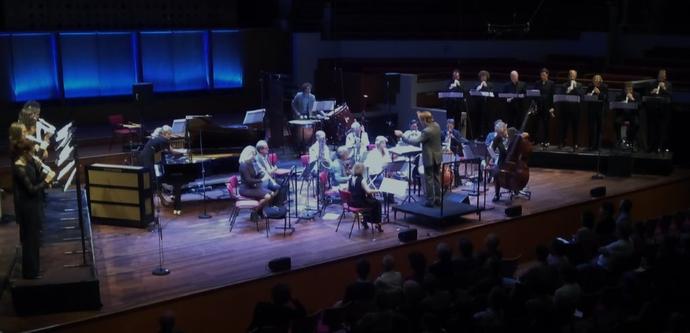
De Gaudeamus Muziekweek lijkt het stadium van doorwrochte, maar publieksonvriendelijke ‘piep-knor’ definitief achter zich te hebben gelaten. Het gerenommeerde festival voor nieuwe muziek brengt in vijf dagen tijd 129 composities uit 32 landen. Asko|Schönberg en Cappella Amsterdam trapten woensdag 6 september af met een bonte variëteit aan stijlen. Hiermee was het openingsconcert een graadmeter van wat modernemuziekliefhebbers tot en met zondag kunnen verwachten.

De voor de Gaudeamus Award genomineerde Sky Macklay (VS, 1988) schildert in White/Waves met ruis- en sisklanken een imposant beeld van machtige oceaangolven. Jan-Peter de Graaff haakt in Rimpelingen voor cello en ensemble onbekommerd aan bij traditionele harmonieën en melodieën. De Rus Alexander Khubeev, winnaar van Gaudeamus Award 2015 kiest in The Codex of Thoughtcrimes juist voor het andere uiterste.

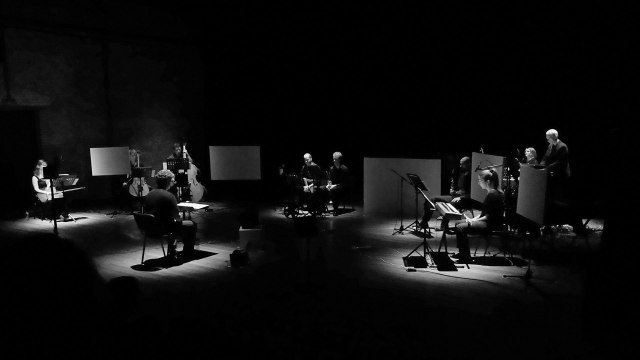
Bas Wiegers dirigeert Asko|Schönberg & Cappella Amsterdan in The Codex of Thoughtcrimes. TivoliVredenburg 6-9-2017

Bijna geen instrument klinkt zoals we het gewend zijn en de zangers uiten hun ‘gedachten die door anderen als misdaden worden gezien’ door wc-rollen. Het vervormde gekreun en gepiep lijkt wel wat op de manier waarop walvissen met elkaar communiceren. Gaandeweg ga je snakken naar een ‘gewone’ toon. Muzikaal is dit Russische Carnaval des animaux misschien niet helemaal overtuigend, maar geestig en aansprekend is het wel.

Timbre en eenvoud

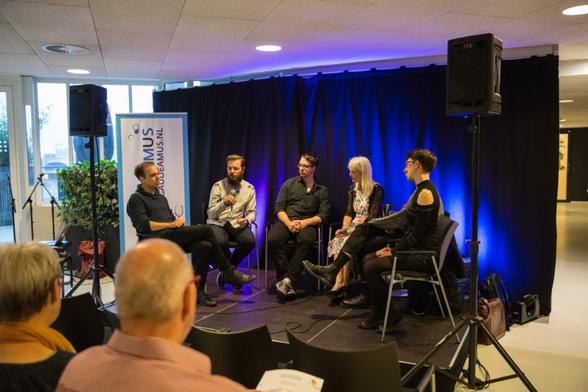
Voorafgaand aan dit concert sprak ik met de vijf genomineerden, Sky MacKlay; Ethan Braun (VS, 1987); Ivan Vukosavljevic (Servië, 1986); Aart Strootman, (Nederland, 1987) en Chaz Underriner (VS, 1987). Hoe verschillend de jonge muziekpioniers ook zijn, zij delen een fascinatie voor timbre en werken graag met een minimum aan materiaal.

In Brauns Discipline produceren vier gitaren in dezelfde, afwijkende stemming, een complex weefsel aan boventonen. Ivan Vukosavljevic bouwt in Atlas Slave een hypnotiserende klankwereld vanuit een met strijkstok bespeelde gitaar. MacKlay presenteert in Many Many Cadences voor strijkkwartet een geleidelijk in glissandi uiteenvallende reeks cadensen.

Gaudeamus 6-9-2017 Ivan Vukosavljevic – Aart Strootman – Chaz Underriner – Thea Derks – Ethan Braun (hidden) – Sky MacKlay (c) Herre Vermeer

Herwaardering muziektraditie

Tijdens de concerten op donderdag van de Australische cellist Alistair Sung en ensemble IEMA bleek hoezeer jonge componisten de muziektraditie weer omarmen. De Amerikaanse Caroline Shaw (1982) baseerde In manus tuas voor cello solo op het gelijknamige motet van Thomas Tallis. Zij verweeft sonore flarden oude muziek organisch met moderne, meer industriële klanken. Het stuk werd stijlvol uitgevoerd door Sung.

De Japanse Yukiko Watanabe (1983) deconstrueert Bachs Goldberg Variationen in Nue voor piano en ensemble. De pianist vertolkt – hortend en stotend – het origineel, als een schim gevolgd door een koto en een onder de vleugel gezeten klarinettiste. Een slagwerker bespeelt een bloempot en projecteert vergeelde vakantiekiekjes. – Een mooi zinnebeeld van onze langzaam vervagende herinneringen, aan Bachs muziek en ons eigen verleden.

De Schotste Genevieve Murphy (1988) figureerde zelf als verteller annex zangeres in Squeeze Machine, geïnspireerd op het leven van haar autistische broer. In dit theatrale stuk debiteert zij met uitgestreken gezicht surrealistische teksten over de door angst en eenzaamheid gekwelde ‘Artuur’. Diens in zichzelf gekeerde personage wordt geregeld opgeschrikt door lawaaiige opnames uit een overvolle kroeg, waar accordeon- en doedelzakmuziek wordt gespeeld. Het vermakelijke stuk werd perfect en in opperste concentratie uitgevoerd door het IEMA Ensemble, een academie voor jonge musici van Ensemble Modern.

Genevieve Murphy performing ‘Squeeze Machine’ with IEMA Ensemble, Theater Kikker 7-9-2017

Apocalyptische smeekbedes

Klapstuk van de donderdag was de wereldpremière van Lacrimosa voor zeven violen van de Oekraïens-Nederlandse componist Maxim Shalygin (1985). Hij had zich altijd afgevraagd waarom het traditionele Requiem maar één lacrimosa bevat, de smeekbede van zondaars om mededogen en eeuwige rust. ‘In mijn beleving is dit deel het magische brandpunt waarin alle belangrijke ideeën samenkomen’, schrijft hij in een eigen toelichting. ‘Misschien daarom is het steevast ook het mooiste deel: vol gevoelens van pijn en catharsis. Langzaam maar zeker vormde zich bij mij het plan ook zelf een soort requiem te componeren.’

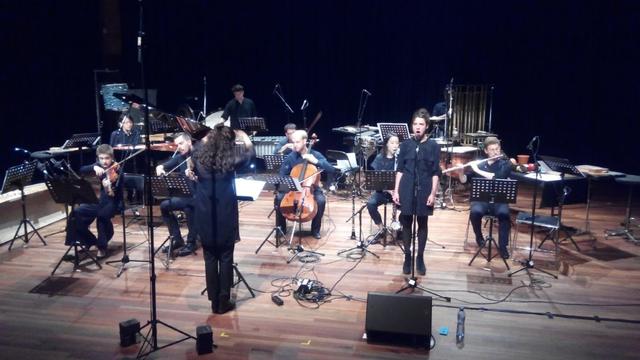
Dat werd Lacrimosa, or 13 Magic Songs. Shalygin dirigeerde zelf de zeven violisten van het mede door hem opgerichte ensemble Shapeshift. Lichtvoetige, elkaar innig omstrengelende motieven (‘Light’), omineus gezoem (‘Insects’) en verwoed over de snaren kolkende arpeggio’s (‘Stream’) worden afgewisseld met momenten van pure, etherische schoonheid (‘Lullaby’), driftige pizzizati (‘Rain’), gierende glissandi (‘Sirens’) en furieus wapengekletter (‘Prayers’).

Shapeshift & Maxim Shalygin, TivoliVredenburg 7-9-2017 (c) Herre Vermeer

Shalygin voert ons door een scala aan emoties, waarin gevoelens van wanhoop, vrees en woede overheersen; de apocalyps is nooit ver weg. De op blote voeten spelende musici leken met hun woest bewegende lijven en armen soms onder hun zware taak te bezwijken. Hun totale overgave droeg sterk bij aan een enerverende luisterervaring.

Lacrimosa werd gecomponeerd in opdracht van de Gaudeamus Muziekweek. Het festival heeft de afgelopen jaren het accent verschoven naar communicatieve muziek en merkbaar meer aansluiting gevonden bij een algemeen publiek; de concerten van Sung en IEMA waren goeddeels uitverkocht.

Of met Shalygins intense, tot het hart sprekende Lacrimosa voorgoed een punt wordt gezet achter de academische ‘piep-knor’, zal nog moeten blijken, maar de teerling is geworpen. Na afloop van het concert werd het publiek gevraagd een cd-uitgave van Lacrimosa werk te helpen realiseren via Voordekunst. Mijn advies: doen!

De Gaudeamus Muziekweek loopt nog tot en met zondag 10 september. Dan wordt ook de winnaar van de Gaudeamus Award 2017 bekengemaakt.

#AartStrootman #AlexanderKhubeev #CarolineShaw #ChazUnderriner #GaudeamusMuziekweek #GenevieveMurphy #IvanVukosavljevic #MaximShalygin #SkyMacklay #YukikoWatanabe