Composer Heather Pinkham messages extraterrestrials: ‘Seek and you will find you are not alone in this world’
Pianist and composer Heather Pinkham wants to connect people. During the covid pandemic, she organised Music for Empty Spaces at Muziekgebouw aan het IJ. On 3 October, her piano concerto Nowhere No-When will have its Dutch premiere at De Doelen in Rotterdam. It will be repeated in the Amsterdam Concertgebouw the day after.
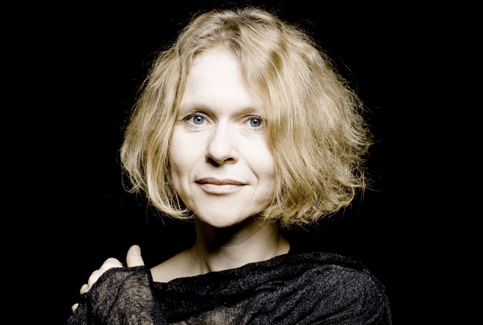
Heather Pinkham (C) Heather Pinkham
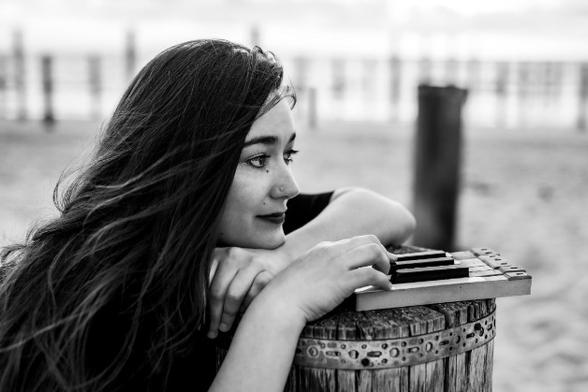
We meet at the Ysbreeker, former temple of new music in Amsterdam. Heather Pinkham (1989) lives in Hilversum, but is in town to give piano lessons. She holds master’s degrees in piano, Italian, musicology and composition, has toured Eastern Europe as a choir accompanist, sings herself and is currently pursuing a master’s degree in Media Composition. In her daily practice, she gives solo recitals, teaches piano and plays with ensembles and orchestras. In addition, she composes for renowned musicians such as Vincent van Amsterdam, Maya Fridman and Ralph van Raat – who, not coincidentally, is also her life partner.
Dizzying array of skills
It is almost dizzying to read through all her different roles. How should we categorise her? Pinkham: ‘The piano has always been central to everything I do, so I think that comes first. Even when I compose, I start at the piano, or I play something on the MIDI keyboard. In terms of my career, I see myself first and foremost as a pianist-composer. The other things I do mainly because I enjoy them. For example, I still sing, but purely as a hobby.’
She grew up in an artistic family in Mendocino, a coastal town in California: ‘It’s 155 miles north of San Francisco and only has a thousand inhabitants. There wasn’t much to do there – except enjoy the beautiful nature. Our house was in the middle of a forest, surrounded by giant sequoias. My father was a photographer, painter and digital artist, my mother had her own business. She imported Tibetan-Indian meditation accessories, such as singing bowls, and sold them to other companies. Unfortunately, she passed away a year and a half ago, my father died three years before. I do have an older brother, who is a specialist in information technology.’
Home-schooled
The siblings did not attend primary school: ‘My parents were a bit hippie-ish, and for the first eight years, our mother taught us; we only had separate teachers for science and maths. We took their lessons with a group of children who were also home-schooled. Every two months, we had to go to the town of Boonville to have our learning assessed and to check that we were at the right level. Because we didn’t go to school, we had a lot of time to do fun things. I went horse riding and my brother and I often played football, did fencing and karate, and took lessons in ceramics, drawing and painting.
Her parents were great music lovers, says Pinkham: ‘They were both big fans of Keith Jarrett. My father had broad tastes; he loved such diverse bands and artists as The Beatles, Dire Straits, Bob Dylan, Kraftwerk, Fleetwood Mac and Enya. My mother was particularly fond of Irish folk music, ragtime and folk. However, she was quite sensitive to noise, so there was little music played at home. But when we went swimming together, we sang the folk song You are my sunshine at the top of our voices, and during road trips we often listened to The Beatles or Paul Simon.’
Love at first listen
At the home of one of her girlfriends, there is a piano: ‘I was about six years old and played it a little: it was love at first listen and I asked my mother for piano lessons. It was a difficult time for me, for my parents had just divorced, and now I think I became interested in the piano because I wanted to express something that I couldn’t put into words.’
https://youtu.be/0AIXI40-OBY
‘My mother first bought a keyboard because she wanted to be sure I was serious. I improvised pieces and eventually we got a Kawai upright piano. My father came back home when I was about nine and moved into the basement; my parents remained good friends after their divorce. When I played the piano, he often came to listen. Later, my parents told me that I had already composed a melody when I was eighteen months old.’
She gets a nice piano teacher, who takes her to classical concerts at the annual Mendocino Music Festival. ‘One day, I heard a pianist playing with the festival orchestra there. I was deeply impressed by how he connected with the orchestra and how powerful their ensemble sounded. Wow, he’s doing what I dream of doing, I thought, and I knew: one day I want to be there myself! The nice thing is that Ralph and I have performed there together in the last two editions.’
Berkeley
However, in 2007 she did not enrol at a conservatoire, but at the University of California in Berkeley: ‘My mother wanted to make sure I had something to fall back on if things didn’t work out. And my piano teacher had lost her love of music due to the strict teaching methods at the conservatory and wanted to protect me from the same disappointment. Fortunately, in the United States, in addition to pure conservatories, there are also music programmes that are integrated into the university, which is why I went to Berkeley. Moreover, you can take two subjects at the same time, so I also studied Italian, thinking that I could always become a translator.’
In 2008, she even moved to Italy for a year, where she continued her double degree at the University of Padua. ‘I spoke Italian quite well, but that has faded a bit, I’m trying to pick it up again now.’ Was there a big difference between the teaching in Padua and Berkeley? Pinkham: ‘Absolutely, the teachers were stricter in Italy. They offered much less freedom in how you wanted to interpret certain things and also what you wanted to play. Berkeley was also quite conservative – music history pretty much ended with Debussy –, but in Padua it stopped even earlier.’
https://youtu.be/dVhWo8XvPyc
Lacking role models
It’s surprising that contemporary music was mainly absent in Berkeley. Pinkham sighs: ‘Indeed, composers such as Steve Reich or Terry Riley weren’t discussed, let alone female composers like Ann Southam, whose work really touched and influenced me. Even John Adams was not on the curriculum, even though he lives in Berkeley and is the most performed orchestral composer in America. This was partly due to one of the teachers, Richard Taruskin. He took offence at some of Adams’ pieces, particularly his opera The Death of Klinghoffer.
That Pinkham decided to study composition at the advanced age of twenty-seven, is mainly thanks to her partner Ralph van Raat, whom she met by chance after a trip through the Netherlands: ‘On the return flight, he sat next to me and we got talking. After eight hours, we still hadn’t finished talking, and now we’ve been together for ten years. I was always writing songs, accompanying myself on the ukulele, like a singer-songwriter. One day Ralph said: why don’t you start composing? It had never occurred to me that I could become a composer; I simply had no role models. It was only when Ralph suggested it that I thought, maybe I could do it.’
She takes private lessons with Anthony Fiumara and follows him to Tilburg when he becomes a teacher at Fontys University of Applied Sciences there in 2018. ‘I was able to start my master’s degree right away. Anthony was a great tutor. Like my first piano teacher, he was very encouraging and gentle. I really needed that – I was trying something new, after all. He was very open to all possible styles, which was nice because I don’t want to pin myself down to one style. I admired his enormous knowledge of repertoire. When I brought something in, he often said: ah, that reminds me of this or that composer – simply off the top of his head.’
Covid pandemic
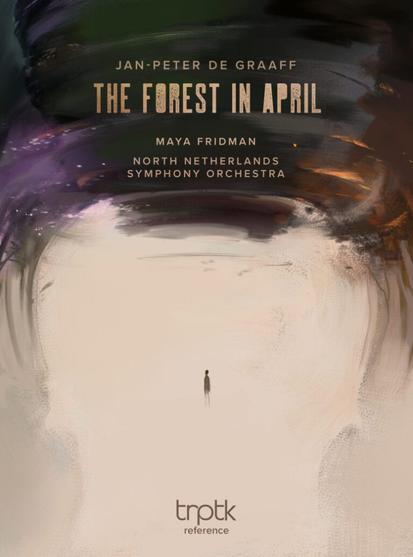
She obtains her master’s degree in composition in 2020. That same year, the covid pandemic largely shuts down concert life. She doesn’t let this discourage her, but organises the concert Music for Empty Spaces. Twelve composers – ranging from Jacob ter Veldhuis to Aspasia Nasopoulou and Bianca Bongers – write a short piece for as many soloists, in which they express their experience of home isolation through music. She herself composes Days Blur for cellist Maya Fridman: ‘In her, I recognise my own love for diverse styles, extended techniques and singing. So I wrote a piece that is somewhere between a song and a contemporary composition.’
With her project, she wants to create connection: ‘The pandemic caused such a sudden break in the bond between people, which I found very sad.’ Could her desire for connection have something to do with her parents’ divorce? ‘I do think that experience influenced my composing; it was a very turbulent time for me.’ During the pandemic, she also composed Crooked Still for solo piano, in which she evokes feelings of uncertainty and confusion with the help of extended techniques and an unclear tonal centre. ‘The title refers to the fact that everything was still crooked at that moment.’
The sadness she felt at the death of her parents also found its way into her music: ‘I wrote the song I am not there for my father, for the soprano Elisabeth Hetherington and Tibetan singing bowls.’ Is this also a subdued tribute to her mother? Her eyes fill with tears: ‘Yes, a little bit for both of them. It was originally only for my father, but my mother died just before the premiere, which was very sad. I also wrote a composition for two pianos for my father, in which I quote Within You, Without You by the Beatles. Now I’m working on a piece for my mother, who loved ragtime; I’m going to use a quote from You Are My Sunshine.’
Extraterrestrial life
In October, Ralph van Raat will perform the Dutch premiere of her piano concerto Nowhere No-When with the Rotterdam Philharmonic Orchestra. Why this title? ‘When I wrote the concerto in 2019, I was interested in the concept of intelligent extraterrestrial life. It is the title of an article about the Fermi paradox, named after the Italian scientist Enrico Fermi, who at one point wondered: what are we actually talking about? The chance that life exists in the universe is much greater than the chance that it does not, yet we have no evidence of intelligent life. If it exists, we should have made contact with it, but this is not the case. Why not? That is the paradox. ‘One of the answers is that intelligent extraterrestrial life has never existed. It is nowhere, so there is no when, either.’
‘I wrote Nowhere No-When based on the idea: what if it really doesn’t exist? Then we are alone in the universe, a lonely feeling… all the more so because no one will come to save us. By chance, I came across a NASA recording of light waves, whose frequencies and intensity they had converted into sound. It has seven or eight rhythms and a kind of small bass line. I used that as the basis for the beginning, and it is taken up by the timpani and the piano.’
https://youtu.be/SR-_BSGbyoY
NASA recording
It sounds as if there are also electronics involved. ‘Well,’ says Pinkham, ‘the NASA recording sounds integral and I repeat it several times in a loop. You could call that electronic, but otherwise it’s purely acoustic. In the first part, the piano goes in all directions, searching for that intelligent life, and towards the end it sends out a kind of radio signal.’
‘The second movement revolves more around the question: what if we are alone? That lonely thought is reflected in an almost floating solo part for the piano. Later, a form of acceptance emerges, that we may have to try a little harder to solve the problems we have, because no one is coming to save us.’
Is it true that she has included a message to extraterrestrials? ‘Yes, in that lonely solo passage I have incorporated the code language Cicada 3301. This is based on a kind of internet puzzle that people try to solve via all kinds of websites. Someone concluded that coded messages were being sent via the music on those sites. The code is based on diphthongs, each representing a different letter.’ And what does it spell out? ‘Seek and you will find you are not alone in this world.’
A comforting thought, Pinkham agrees: ‘This also has to do with my parents. After their divorce, they never dated again, and as they grew older, my mother started to feel somewhat lonely. But they still had each other, which forms the basis of that comforting message.’
This article was first published in the Sept-Oct issue of the Dutch music magazine De Nieuwe Muze
#AnthonyFiumara #HeatherPinkham #JohnAdams #MayaFridman #NowhereNoWhen #RalphVanRaat
 Contemporary Classical - Thea Derks