〝In contrast to a Dislike count, the Misleading count provides normative information on the accuracy of the message. […] Using normative cues seems to be more effective in polarized contexts (e.g. US voters compared with UK voters) and for posts on polarizing issues (e.g. immigration) compared with non-polarizing issues (e.g. infrastructure).〞
https://royalsocietypublishing.org/doi/full/10.1098/rstb.2023.0040

#socialMedia #malinfo #propaganda #infops #polarization #politics #interventions
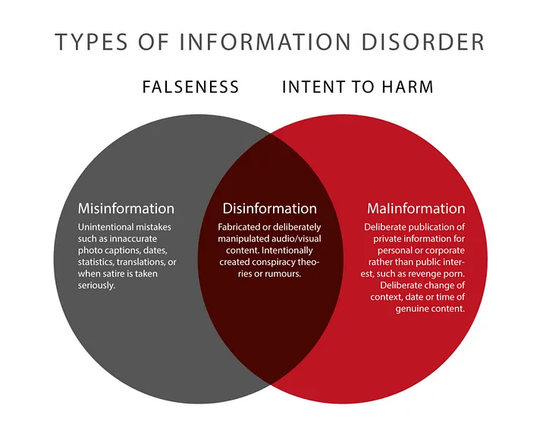
Inspired by @selenamarie's post, I'm adding missing information to @cward1e's #InfoDisorder typology: #MisInfo, #DisInfo, and #MalInfo need to be joined with what we might call "#SansInfo". Info gaps are not just unrealized, but can be part of the structure. We see it in #AI and #LLMs https://social.coop/@selenamarie@fiasco.social/110238567400963556
selena deckelmann (@[email protected])

How will we ensure that ML models are equitable? Data gaps are a major problem. A board member of Wikimedia Foundation, Rosie Stephenson-Goodknight, has referred to this as a third pillar along side disinformation and misinformation -- missing information. This essay describes some of the equity challenges: https://meta.wikimedia.org/wiki/User:Isaac_(WMF)/Content_tagging/Data_gaps

Fiasco.social