 PsychoticSheep
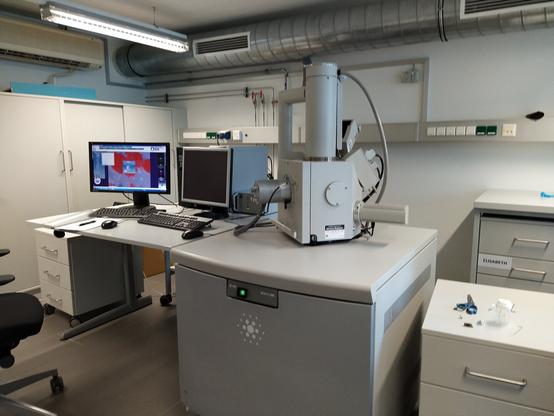
Another photo from my training that I found, this time not from organic chemistry but from inorganic chemistry! Working with the scanning electron microscope.
A scanning electron microscope (SEM) uses a focused electron beam instead of light to image surfaces at the nanometer scale.
Three types:
SEM: The electron beam scans the surface while detectors capture topography and material contrast.
TEM: Electrons transmit through thin samples, revealing atomic scale details inside the material.
STEM: A combination of both, enabling imaging and chemical analysis at the atomic level.
Measurements include microstructure, phase composition, grain size, crack patterns, often combined with mechanical or magnetic properties.
The task was to create a compact table for five samples including microstructure (optical microscope + SEM), hardness, crack resistance parameter, magnetic saturation (Tm³/kg), and coercive field (kA/m), a pure data summary without comments.
#SEM #ScanningElectronMicroscope #MaterialsScience #InorganicChemistry #Microstructure #ElectronMicroscopy #LabLife #Research #TEM #STEM #MaterialCharacterization #HardnessTesting #MagneticProperties #ScienceTraining
A scanning electron microscope (SEM) uses a focused electron beam instead of light to image surfaces at the nanometer scale.
Three types:
SEM: The electron beam scans the surface while detectors capture topography and material contrast.
TEM: Electrons transmit through thin samples, revealing atomic scale details inside the material.
STEM: A combination of both, enabling imaging and chemical analysis at the atomic level.
Measurements include microstructure, phase composition, grain size, crack patterns, often combined with mechanical or magnetic properties.
The task was to create a compact table for five samples including microstructure (optical microscope + SEM), hardness, crack resistance parameter, magnetic saturation (Tm³/kg), and coercive field (kA/m), a pure data summary without comments.
#SEM #ScanningElectronMicroscope #MaterialsScience #InorganicChemistry #Microstructure #ElectronMicroscopy #LabLife #Research #TEM #STEM #MaterialCharacterization #HardnessTesting #MagneticProperties #ScienceTraining
 Steve Dustcircle 🌹
 Phys.org