Making Effective, Affordable Water Level Monitors

Water wells are simple things, but that doesn’t mean they are maintenance-free. It can be important to monitor water levels in a well, and that gets complicated when the well is remote. Comme…

Hackaday
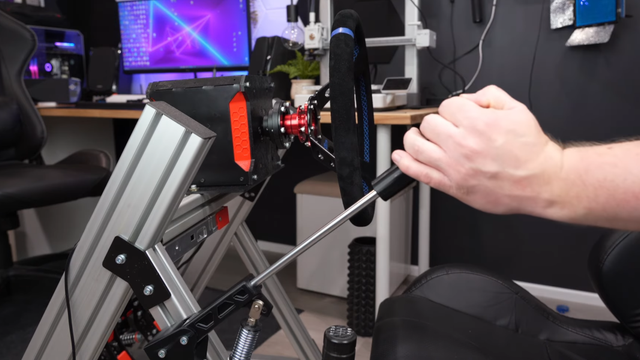
Driving Sim Handbrake Based On Load Cell

Simulator-style video games are designed to scale in complexity, allowing players to engage at anything from a casual level to highly detailed, realistic simulation. Microsoft Flight Simulator, for…

Hackaday
Are you in need of precise weight measurements for your machines or industrial setup? Let us introduce you to the ultimate solution: Bending Beam Load Cells
Know more: https://zurl.co/Fmgmt
#LoadCell #BendingBeam #ForceMeasurement #smidmart
Need precise weight readings?
Bending Beam Load Cells are compact, tough, and super accurate
—ideal for industrial, food, or lab use.
Where would you use one? A, B, or C?
Tell us! https://zurl.co/57NPt
#smidmart #LoadCell #IndustrialTech#WeighingSolutions #SmartWeighing
RC Car Gets Force Feedback Steering

Remote-controlled cars can get incredibly fast and complex (and expensive) the farther into the hobby you get. So much so that a lot of things that are missing from the experience of driving a real…

Hackaday

So the #Prusa #Mk4 5.0.0a4 firmware supports #inputshaping. It built a benchy in just over half of the time (38m) as without input shaping (67m). But the result had significant defects.

Useful for drafts? Maybe.

I suspect #Octoprint was not a problem before but rather my lack of the 5.0.0 firmware when using a GCO sliced for input shaping.

The #loadcell is a nice feature. The exact problem my #Mk3 was recently encountering (nozzle collision with sheet) should not be possible with the #Mk4!

Raspberry Pi Test Stand Tells You Which Glues to Use

Not all glues are created equal; or rather, not every glue is good for every application. But how is one to know which glue to use in which kinds of joints? The answer to that is not always clear, but solid numbers on the comparative strength of different glues are a great place to start.

To quantify what can ordinarily be a somewhat subjective process, there's probably no one better than woodworker and hacker [Matthias Wandel], equipped as he is with his DIY strength-tester. Using its stepper-driven power to blast apart glued lap joints, [Matthias] measured the yield point of the various adhesives using a strain gauge connected to a Raspberry Pi.

His first round of tests had some interesting results, including the usually vaunted construction adhesive ending up in a distant last place. Also performing poorly, at least relative to its reputation and the mess it can cause, was the polyurethane-based Gorilla Glue. A surprise standout in overall strength was hot glue, although that seemed to have a sort of plastic yield mode. Ever the careful empiricist, [Matthias] repeated his tests using hardwoods, with remarkably different results; it seems that glues really perform better with denser wood. He also repeated a few tests to make sure every adhesive got a fair shake. Check out the video below for the final results.

It's always good to see experiments like this that put what we often take for granted to the test. [John] over at the Project Farm channel on YouTube does this kind of stuff too, and even did a head-to-head test of epoxy adhesives.

#mischacks #adhesive #glue #loadcell #materialstesting #raspberrypi #stepper #straingauge #strength

Raspberry Pi Test Stand Tells You Which Glues To Use

Not all glues are created equal; or rather, not every glue is good for every application. But how is one to know which glue to use in which kinds of joints? The answer to that is not always clear, …

Hackaday

LEGO Cup Holder Helps You to Stay Hydrated

Eat more fruit, exercise more, drink more fluids; early January is traditionally the time to implement New Year's resolutions. Most of the common ones simply require willpower, but if it's staying hydrated that you're targeting, then some help is available. [Pepijn de Vos] designed a LEGO cup holder and an accompanying desktop app that tell you exactly how much water you've had so far, making it easier to get to those eight glasses a day.

The basic idea is simple: the cup holder contains a load cell that senses the weight of your drinking vessel. If the weight decreases, then a message is sent to your PC detailing the amount lost. If the weight increases, then the glass must have been refilled and the previous weight is disregarded. This way, the app simply needs to add up all the amounts reported, without having to compensate for the weight of the empty glass.

The tricky bit was integrating a load cell into the LEGO structure. It required some fiddling with Flex System hoses to ensure the platform's weight rested only on the load cell, while still being stable enough to safely hold a full glass of water. The load cell is read out through an amplifier and A/D converter, while the USB communication is handled by a Teensy 3.

[Pepijn] modified an existing GNOME desktop widget to display a cup icon and the total volume consumed, which seems to work pretty smoothly judging from the video embedded below. All the code and even a complete set of LEGO build instructions are available on the project's Github page. If simply monitoring your fluid intake isn't enough of a nudge for you, then check out this device that floods your desk if you don't drink enough.

#homehacks #drinkingwater #lego #loadcell

LEGO Cup Holder Helps You To Stay Hydrated

Eat more fruit, exercise more, drink more fluids; early January is traditionally the time to implement New Year’s resolutions. Most of the common ones simply require willpower, but if it&#821…

Hackaday