Goddard The Robot Dog Brought To Life

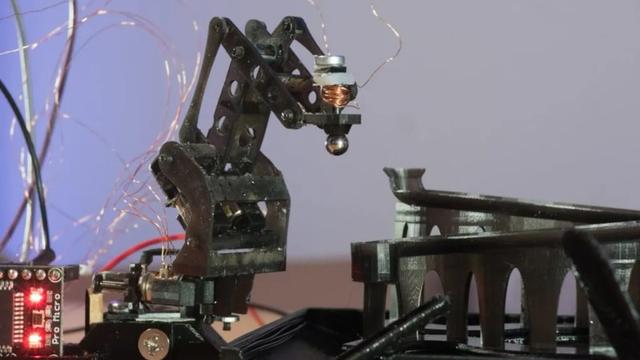
There’s not much more nostalgic for many than good ole’ Jimmy Neutron. This was true for [Kiara], who saw the gorgeous pupper Goddard and wanted him for herself. Of course, there was no solution ot…

Hackaday

"Discover Electric Motors Online, a Family Run Business with over 30 years of experience in the Electric motor and automation industries.

For more information, contact EMO.

02476 980833
01273 752292
01253 375634
[email protected]
www.electric-motors.online

#ElectricMotors #automation #pumpprotection #motor #electricmotor #inverter #vsd #vfd #singlephasemotor #threephasemotor #plc #hmi #servo #gearbox #linear #linearactuator #actuator #controller #indicator #tecmotors #tec

The Sunchronizer Keeps Your Solar Panel Aligned

In the past few years, the price-per-watt for solar panels has dropped dramatically. This has led to a number of downstream effects beyond simple cost savings. For example, many commercial solar fa…

Hackaday
Möbius Tank’s Twisty Treads Became Bendy

[James Bruton]’s unusual Möbius Tank has gotten a little more unusual with the ability to bend itself, which allows it to perform turns even though it is a single-track vehicle. The Möbius Ta…

Hackaday
Homebrew Linear Actuators Improved

[Harrison Low] published some 3D-printed linear actuators, which generated a lot of interest. He got a lot of advice from people on the Internet, and he took it to heart. The result: an improved ve…

Hackaday

Domino Row Goes with the Flow

Around here, we're always excited about a new actuator design. Linear actuators are particularly hard to make cheap, fast, and good, so it's even better when something new that we can build ourselves slides onto the scene.

Researchers at U Penn's Pikul Research Group took inspiration from the cascade of falling dominoes for an innovative take on linear motion. This article on IEEE Spectrum describes the similarity of the sequential tipping-over with the peristaltic motion of biological systems, including you, swallowing right now.

The motion propagation in falling dominoes, called a Soliton Wave, can be harnessed to push an object at the front of the wave, just like a surfer. See the videos after the break for examples of simple setups that any of us could recreate with laser-cut or 3D printed parts. Maybe you won't be using them to help a robot swallow (a terrifying idea that the article suggests), but you might need a conveyor or a novel way to help a device crawl like a shrimp. The paper is behind a paywall on IEEE, though you readers likely see enough in the videos to get started, and we can't wait to see where your dominoes will lead us next.

#hardware #robotshacks #dominoes #ieee #linearactuator #research #servo #soliton #upenn #universityofpennsylvania

Domino Row Goes With The Flow

Around here, we’re always excited about a new actuator design. Linear actuators are particularly hard to make cheap, fast, and good, so it’s even better when something new that we can b…

Hackaday

Sisyphean Ball Race Robot Toils Gracefully, Magnetically

Aren't ball races and marble runs fun? Wouldn't they be so much more enjoyable if you didn't have to climb back up the ladder each time, as it were, and reset the thing? [Johannes] wrote in to tell us about a wee robot with the Sisyphean task of setting a ball bearing on a simple but fun course, collecting it from the end, and airlifting it back to the start of the track.

[Johannes] built this 'bot to test small-scale resin printing strength as well as the longevity of some tiny linear actuators from Ali that may or may not be available at a moment's notice. The point was to see how these little guys fared when connected directly to an Arduino or other microcontroller, rather than going the safer route with a motor driver of some kind.

Some things worked well, like the c-clips that keep the axles together, and using quick pulses to release the magnetically-linked ball from the gripper. Other aspects didn't work out so well. Tiny resin parts do not respond well to force, for starters. And then there's the actuators themselves. The connections are fragile and the motors are weak, but they vary wildly in quality from piece to piece, so YMMV. Some lose steps, and others occasionally seize. But you wouldn't know any of that from the graceful movement capture in the video below. Although it appears to be automated, the bot is under remote control because of the motor issues.

Not into ball runs? There are other Sisyphean tasks available, such as moving sand around in the name of meditation.

#arduinohacks #robotshacks #arduino #ballrace #fnmagnets #linearactuator #marblerun #sisyphus

Sisyphean Ball Race Robot Toils Gracefully, Magnetically

Aren’t ball races and marble runs fun? Wouldn’t they be so much more enjoyable if you didn’t have to climb back up the ladder each time, as it were, and reset the thing? [Johannes…

Hackaday

3D Printed Linear Actuator Is Cheap and Strong

Motors are all well and good for moving things, but they're all about the round-and-round. Sometimes, you need to move something back and forth, and for that a linear actuator will do the trick. While they can be readily sourced for under $50 online, [Michael Rechtin] genuinely felt like reinventing the wheel, and managed to whip up a 3D-printed design that costs under 20 bucks.

The basic design is simple, consisting of a small motor which is geared down through several stages using simple spur gears. The last gear in the train is tasked with turning a lead screw which drives the arm of the linear actuator back and forward.

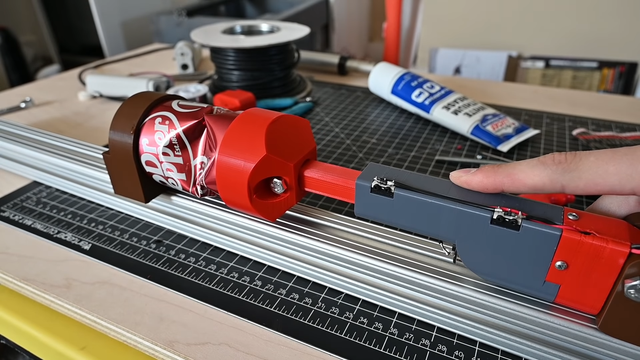
For simplicity, [Michael] used a 24V brushed DC gearmotor for its low cost and the fact it already has a step-down gearbox integrated into the design. It's paired with a couple more 3D-printed spur gears to provide even more torque. Instead of a fancy lead screw, the build instead just uses a quarter-inch bolt sourced from Home Depot, which can be had much cheaper. This pushes a 3D-printed arm back and forth thanks to a nut stuck in the arm. It's all wrapped up in a neat-and-tidy 3D-printed housing. The design is able to push with a force of roughly 220 lbs. For a more practical idea of its strength, it can readily crush an empty soda can.

The video on the design is great, showing how important features like limit switches are added, and how the wiring can be neatly hidden away inside the housing. We've seen [Michael's] work before, too, like strength testing various types of 3D printed gears. Video after the break.

[Thanks to Sebastian for the tip!]

#3dprinterhacks #linearactuator

3D Printed Linear Actuator Is Cheap And Strong

Motors are all well and good for moving things, but they’re all about the round-and-round. Sometimes, you need to move something back and forth, and for that a linear actuator will do the tri…

Hackaday

Swing Gate Motors Come To Help For Opening A Giant Servery Window

[Martin Roberts] wrote to us, telling us about a build that his company, [Ocean View Workshop], was tasked with. Creating a four meter wide window able to open vertically is no small feat, and it had to be custom-built because the local company building such windows wasn't comfortable working with anything other than aluminum -- insufficient for the window's scale. With massive weight of the glass alone, structural requirements for supporting it, and the mechanical loads to be applied, some careful planning was in order.

To start with, this window had to be motorized, as an average person wouldn't be capable of pulling it upwards. Not satisfied with the linear actuator choice available, they went to a hardware store and found some swing gate actuators that, in workshop tests, proved themselves to be more than capable of handling way over the weight required. In fact, they were capable of lifting [Martin] himself off the ground without much hassle.

Note the jack helping hold the panel in place.

From there, it was time to figure out the mechanical parts -- building a strong enough frame for the window, welding the frame, figuring out the mounting and leverage intricacies, gauging the loads to be handled and adding gas struts. The nitty-gritty of the mechanical bit is covered quite well in the 14-minute video that [Ocean View Workshop] published, embedded below, so we won't repeat it. Instead, our focus is on the swing gate-intended hardware reuse part that [Martin] shared with us in his letter.

The swing gate controller's built-in features, like adjustable limit switch support, soft start/stop and configurable overload/stall protection, proved themselves to be instrumental for smoothness and safety of the window's operation. As for the automation part of it, they interfaced the motor controller with one of the numerous Sonoff devices tied into a Home Assistant-based system, and then even integrated it with Amazon Alexa, adding a 2001: A Space Odyssey Easter egg while at it. In other words, the motorized swing gate hardware and this servery window build turned out to be a perfect match for each other.

We appreciate the ingenuity and hope that the spirit of this story can guide other hackers in similar situations, tasked with building things beyond the scope of what local companies have the toolkit for. [Martin] says he already can think of a few more unintended applications for these - an extra heavy-duty adjustable workbench or a height-adjustable king bed. Limiting availability of linear actuators is somewhat of a pain point, to the point where people build and even 3D print their own, for loads big and small.

#hardware #mischacks #linearactuator #linearactuators #repurposing #swinggate

Swing Gate Motors Come To Help For Opening A Giant Servery Window

[Martin Roberts] wrote to us, telling us about a build that his company, [Ocean View Workshop], was tasked with. Creating a four meter wide window able to open vertically is no small feat, and it h…

Hackaday