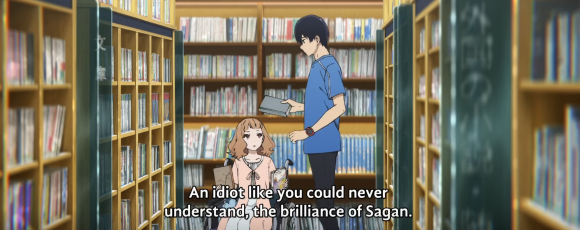
Josee, a sea of books, and reading to library patrons
Josee (in the wheelchair) tells her caretaker that he doesn’t know the brilliance of Sagan and implies that he is missing out
When I began watching Josee, the Tiger and the Fish, a 98-minute romantic comedy film, I had no idea how central libraries, and librarians, would be to the story. I knew already that there was a librarian in the film, but I wasn’t sure how vital her role would be the story. In this post, I’ll relate scenes in the film to other fictional examples and other topics.
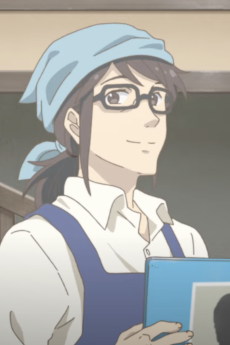
More than 30 minutes into the film, Josee (voiced by Kaya Kiyohara), a physically disabled girl who uses a wheelchair, goes to the public library with her caretaker, Tsuneo Suzukawa (voiced by Taishi Nakagawa). She is amazed by the sea of books. She finds some books by Françoise Sagan, an author she likes, and the librarian, Kana Kishimoto (voiced by Lynn), happily asks if she is a fan, with Josee quietly admitting what book she likes. Not long after, Kana also asks if Tsuneo is her boyfriend, causing her to blush, as she is embarrassed, as the librarian sees the romantic sparks between Tsuneo and Josee. They check out the books. Interestingly, the librarian, Kana, is 24, just like Jose’s, and they quickly become friends, waving to one another.
Before moving onto the rest of the film, one aspect that struck me was how personable Kana’s character was. Compared to many of the other librarians I have profiled on here, either those of Asian descent, or those with the common hair bun, she is a good representation of a library worker in Osaka. In some ways, I see a parallel to Isomura, a library curator in Let’s Make a Mug Too!, who is just as helpful to the protagonists. The difference is that she is much more than an information provider, but is atypical, in her character type, because she becomes friends with the protagonist and ventures outside the library, making her an important part of the film.
Even positive depictions of librarians are often stuck inside the library and are never shown outside the walls of the institution. Some exceptions include Kaisa in Hilda, many of the student librarians in anime. Whether you see the film as having “little fresh” when it comes to disability, criticize it for being primarily through the perspective of her caretaker, praise it for its perspective on disability, Kana remains a key part of the film, something which reviewers appear to miss, for the most part, except to note that she doesn’t exist in the manga. [1] However, the review in Anime Feminist, by Zeldaru notes that when Josee goes to the library she has the “opportunity to become part of a fully public community” and she is able to see, for the first time, people coming together “with a similar purpose”, resulting in her befriending Kana, allowing her to “pursue her burgeoning interest in art”!
The fact that Kana is welcoming of Josee indicates the openness of the library to all patrons, including those which are physically disabled. Kana also helps Josee realize her feelings for Tsuneo after Josee said that she didn’t need him. She even encourages Josee to read The Little Mermaid to children in the library, but she is nervous, and kids leave. Although the reading doesn’t go well, Kana encourages her to display her art online and she is nervous and embarrassed by that. She later tells Tsuneo about her reading to the children and how she did it badly. She says she wants to try harder and be an illustrator.
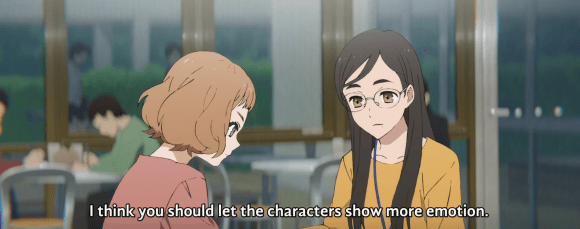
There are so many scenes I could have shown here, either one at minutes 40-41, and the key scene beginning at 1 hr 15 minutes, but this seemed like one of the best ones, as in this scene, more than 1 hr and 15 minutes into the film, Kana is helping Josee write a story. Right before this, she brings library books to her, presumably about writing.
This isn’t all that Kana does in the film. She helps Josee work with Kana to write a love story so as to convince Tsuneo to stay with his dream. Not long after, Josee is reading a story to those in the library, which she wrote to cheer up Tseuno. The story is her personal adaptation of a Little Mermaid, which had references to what happened in her relationship with her caretaker. It is something that gets him out of his funk and he claps at the end,after crying during the story. After everyone claps, and blushes at the praise, and smiles. This gives the caretaker the motivation to begin physical therapy so he can walk again. She watches him day after day as he gets better.
Although some have said that this story is “uncomfortably close” to the story where a disabled person teaches an able-bodied person an “important lesson”, I tend to side with what Anime Feminist says about it, that she is trying to inspire Tsuneo “and those around her,” assembling the community she built, even organizing a picture book reading time for her book with help of Kana. This reveals her “devotion to art and to community” and it is a difference between her first reading at the library as Josee is more “confident in her work and herself and everyone is enraptured, highlighting her growth.” [2]
Later on, Tsuneo asks Kana about Josee but she isn’t at the library and hasn’t seen her. They later reunite in the end and kiss. In a scene during the credits, the librarian tearfully embraces Josee. She appears to help her by teaching her computer skills. It is also shown that the book Josee made is used by the librarian to read to children. As a result, Kana has a more fully rounded characterization than is the case for other characters. As the film’s director, Kotaro Tamura, stated, Kana was added to the film to give character development for Josee:
…I figured out the themes that would be appropriate for a feature-length film…I thought that Josee’s only way to connect with society is through Tsuneo. That’s where Josee in this film starts off at as well. But because she starts to go out more because of Tsuneo, she makes a friend named Kana. Though it’s not a huge leap, she’s able to become a bit more sociable.
However, I would argue that Kana is much more of a character than that, through facilitating reading like the librarians in the Witches Crest Library in Somali and the Forest Spirit but not as directly as Amity Blight in The Owl House, to give two examples. As an aside, Kana’s voice actress, Lynn, is very talented, known for leading roles in Keijo!!!!!!!!, Fuuka, Engage Kiss, and Mobile Suit Gundam: The Witch from Mercury, along with other roles in Märchen Mädchen, Ms. Vampire Who Lives in My Neighborhood, Kandagawa Jet Girls, Manaria Friends, The Aquatope on White Sand, and Oshi no Ko, to name a few.
In the future, I would like to compare this film to the original short story by Tanabe or 2003 Japanese live-action film of the same name, noting how libraries are portrayed. With that, this post comes to a close. Until next time. As always, comments are welcome.
© 2023-2024 Burkely Hermann. All rights reserved.
Notes
[1] Osmond, Andrew. “Josee, the Tiger and the Fish fails to make a splash with a rote teen romance,” BFI, Aug. 11, 2021; Clarke, Cath. “Josee, the Tiger and the Fish review – beautiful-looking anime takes a trip to the zoo,” The Guardian, Aug. 12, 2021; Cassidy, Tom. “Josee, the Tiger and the Fish,” Common Sense Media, Jul. 29, 2022; joyousmenma93, “Firechick’s Manga Reviews: Josee, The Tiger, and The Fish,” Livejournal, Sept. 22, 2022.
[2] Zeldaru. “Overcoming Barriers: Mobility limitation; ‘inspirational’ disability; and Josee, the Tiger, and the Fish,” Anime Feminist, Aug. 26, 2022.
#AmityBlight #AnimeFeminist #atypicalLibrarians #disabledPatrons #femaleLibrarians #Hilda #informationProvider #Isomura #JapaneseLibrarians #JoseeTheTigerAndTheFish #Kaisa #LetSMakeAMugToo #LibrariansOfColor #libraryPatrons #MärchenMädchen #MsVampire #reading #SomaliAndTheForestSpirit #students #TheOwlHouse #voiceActors #wheelchairs
 Anime Animals アニメの動物
 Pop Culture Library Review
 Arcadiagt5
 AWanderingSorcerer