#PhD thesis on #LandUseConflicts submitted! đŸ„ł

For a sneak peek, 4 of its 5 papers are already published:

#SystematicMapping of land use conflict lit: https://doi.org/10.1080/08941920.2023.2199380
Stocktaking of land use conflicts and their nature: https://doi.org/10.3390/land11050602
Urban-rural conflicts: https://doi.org/10.3390/land10070726
Conflict dynamics: https://doi.org/10.1016/j.landusepol.2023.106918

In case you are also about to submit, some lessons learned in thread >>>

@phdstudents
@phdlife
@geography
@politicalscience
@sociology

On my way to #aesop2024 conference in Paris to present the last paper of my PhD on escalation processes in #LandUseConflicts. Is anyone else attending?
#EnvironmentalPlanning #LandUsePlanning
@geography
The semester is already well under way and I was too busy to do so earlier. However, still proud to announce I am leading a student research group this semester, funded by #BerlinUAlliance. Together with students from all 3 Berlin universities, we're investigating #LandUseConflicts and the motivations behind #protests, applying a creative #photovoice method. Already loving the input and ideas from the students and super excited to see first results in a couple weeks!
#PhDLife @academicchatter

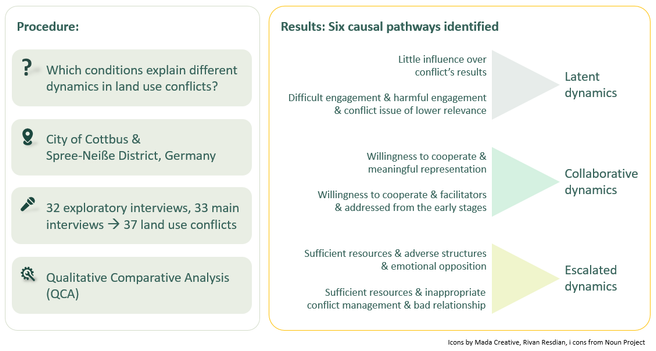
Very proud to share my newly published paper on #ConflictDynamics đŸ„ł We used #QualitativeComparativeAnalysis (#QCA) to determine which conditions explain latent, collaborative, or escalated dynamics in #LandUseConflicts (and how to get people to work together more often in these conflicts). It's the centerpiece of my PhD project. Feels amazing to have this milestone finished 😊

https://authors.elsevier.com/a/1hqYnyDvMPnl8

#LandUse #conflict #collaboration

@ZALF_leibniz @geography @politicalscience @sociology

Great session on #LandScarcity and #LandUseConflicts at the GfÖ conference in Leipzig this week. I was wondering if my social science work would fit in an #ecology conference but it was such a fruitful interdisciplinary exchange, with presenters from economics and even philosophy providing new perspectives!
#gfoe2023

#callforpapers

In September, Leipzig hosts the Annual Meeting of the Ecological Society (Jahrestagung der Gesellschaft fĂŒr Ökologie, GfÖ): https://gfoe-conference.de/.

One of the sessions will focus on the interplay of #LandUseConflicts and #natureconservation. If you are doing related research, please consider submitting an abstract to this session (number 19): https://gfoe-conference.de/index.php?cat=callforpapers

The deadline for abstracts and early-bird registration is 15 May 2023!

@geography

52nd GfÖ Annual Meeting 2023 September 12 to 16, 2023 in Leipzig, Germany

New paper for my #PhD published! đŸ„ł

A #SystematicMapping of scientific literature on #LandUseConflicts, providing an overview of current research clusters and gaps and a conceptual discussion: https://doi.org/10.1080/08941920.2023.2199380

It comes with my 1st ever #DataPublication: Searchable database of land use #conflict literature: https://doi.org/10.5281/zenodo.7389768

Very labour-intensive but I learned so much. Thoughts & feedback welcome!

#SystematicReview #LandUse @geography @sociology @politicalscience
@ZALF_leibniz

Taking Stock of Land Use Conflict Research: A Systematic Map with Special Focus on Conceptual Approaches

The literature on land use conflicts has significantly increased in number in recent years, and keeping track has become challenging. Moreover, “land use conflict” is a rather fuzzy concept; a cohe...

Taylor & Francis

Proud to announce I will be hosting a session on #LandUseConflicts at this year's #EUGEO conference in Barcelona, together with my colleague Dr. Larissa Koch. đŸ„ł

The #CallForPapers is open until March 31st: https://www.eugeobcn23.eu/sessions/?id=1209
Would appreciate some sharing - looking forward to exciting contributions!

@geography @politicalscience @sociology #conflict #landuse #ConflictManagement

Sessions

Taking the opportunity at the end of the year to share my personal research highlight of 2022: First paper for my PhD published đŸ„ł
https://www.mdpi.com/2073-445X/11/5/602
We provide a broad, cross-sectoral overview of #LandUseConflicts in our study region (Schwerin, Germany) and analyze the impact of these #conflicts on local land use actors' daily experience.
Let me know if you have any thoughts on it or work on a similar topic - would love to connect!
#LandUse
@geography @politicalscience @sociology
“It Is a Total Drama”: Land Use Conflicts in Local Land Use Actors’ Experience

As land is limited, conflicts between land uses, and, consequently, conflicts between land users about land use inevitably arise. However, how these land use conflicts affect local land use actors has remained underexplored. The objective of this paper is to provide a broad, cross-sectoral overview of land use conflicts as perceived by local land use actors and to explore the actors’ experiences with these conflicts. We conducted 32 semistructured interviews with key land use actors (mayors, local agencies, interest groups, local boards, businesses) in the urban-rural fringe region of Schwerin, Germany. We then applied a qualitative text analysis to identify the region’s most relevant conflicts across all land use sectors (agriculture, settlement, infrastructure, forestry, conservation, tourism, industry, etc.) and their impacts on local actors’ daily experiences. The results show that local actors are aware of many diverse land use conflicts, most frequently regarding land uses for housing, environmental/species conservation, and traffic. Moreover, local actors report these conflicts as relevant to their daily work, and many perceive the conflicts as a strain. Conflicts impede land management processes; they tie up resources, are often perceived as complex, and can be experienced as highly stressful—as summed up in an interviewee’s conclusion: “It is a total drama”. Thus, land use conflicts play an important and mostly negative role in the experiences of land use actors. These findings fill current gaps in the literature on land use conflicts regarding the types of conflicts about which actors are aware and the consequences of these conflicts. The results also underline the relevance of addressing conflicts in land use planning and governance, the need for appropriate conflict management, and the necessity of providing local actors with sufficient resources to deal with land use conflicts. The paper further identifies some starting points so conflicts can enhance rather than impede communal life in rural areas.

MDPI