 Matt BW
Snapped this a while back. I could feel the age in this little vignette and just had grab a shot. Ya know, for posterity. Visually I really like the geometry in the lines of the walls, phones, paint, and counters.

Snapped this a while back. I could feel the age in this little vignette and just had grab a shot. Ya know, for posterity. Visually I really like the geometry in the lines of the walls, phones, paint, and counters.
Very useful #TestNumbers (for #UK #IE #USA #CA and #MX ) for testing all kinds of #telephones (from your #mobilephone to #VOIP and even any remaining #landlines) - they provide the same level of tests that #Openreach and other telcos have access to, you can check if #DTMF is working well and that #codecs or poor #network conditions aren't mangling the audio..
#SpaceX gets #FCC approval to launch 7,500 more #Starlink #satellites😱
by Anthony Ha
Sat, January 10, 2026
Excerpt: "The Federal Communications Commission announced Friday that it has given SpaceX approval to launch another 7,500 of its second-generation Starlink satellites, for a total of 15,000 satellites worldwide.
"Beyond simply allowing SpaceX to launch more satellites and expand its high-speed internet coverage, the FCC says its decision also means Starlink satellites can operate across five frequencies to provide direct-to-cell connectivity outside the United States, along with supplemental coverage in the U.S.
"Reuters reports that SpaceX had requested approval for an additional 15,000 satellites, but the FCC said it would 'defer authorization of the remaining 14,988 proposed Gen2 Starlink satellites.'
"SpaceX must launch 50% of the approved Starlink satellites by December 1, 2028, and the remaining 50% by December 2031, the FCC says."
Read more:
https://tech.yahoo.com/science/articles/spacex-gets-fcc-approval-launch-221121996.html
#KesslerSyndrome #SpaceDebris #KesslerEffect #LEO
#DarkSkies #Satellites #SpaceTrash #Landlines #SpacePollution
This will guarantee #KesslerSyndrome sooner than later!😱
As #SpaceX Works Toward 50K #Starlink Satellites, #China Eyes Deploying 200K
China's Institute of Radio Spectrum Utilization and Technological Innovation submits filings for two constellations, each of which could support 96,714 satellites, for a total of 193,428.
Michael Kan, January 12, 2026
Excerpt: "To counter China, the FCC has been expediting and streamlining its satellite approvals. This includes clearing SpaceX to operate another 7,500 satellites for its second-generation constellation. The regulator has also approved plans to operate Starlink satellites at lower orbits, from 340km to 485km. Currently, Starlink has over 9,400 orbiting satellites."
#SpaceDebris #KesslerEffect #LEO
#DarkSkies #Satellites #SpaceTrash #Landlines #SpacePollution
Well, I think this is a hyperbole -- there will still be coax (axe/coax?) and fiber and good ol' landlines. Of course, #ElonMusk is trying to cut subsidies to those projects to divert money to #Starlink access!
#KesslerSyndrome: Space debris may create a future with no internet, TV, or mobile phone
By Quamrul Haider, 19 January 2025
Excerpt: "If, indeed, satellites collide or go offline because of overcrowded LEO, critical services like internet, navigation (GPS), weather forecasts, cell phones, television and other space-based technologies could fail. Needless to say, this will cause widespread disruption to modern life. Imagine life without social media!"
#KesslerEffect #Starlink #LEO #DarkSkies #Satellites #SpaceTrash #Landlines #SpacePollution
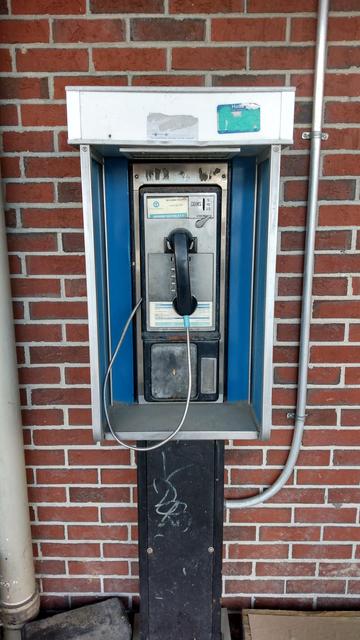
I came across this outside the local grocery store. And yes, there was a dial tone, despite the rust!
Record #SolarSuperstorm shrank Earth’s plasma shield 78%, #GPS at risk
Story by Alexander Clark, 12/1/2025
Excerpt: "Why this storm is a warning shot for the #SatelliteEconomy
"Even without a total collapse of the magnetosphere, the recent superstorm delivered a clear warning to the satellite industry. Constellations in low Earth orbit [#LEO], such as #SpaceX’s #Starlink or #OneWeb, already have to contend with atmospheric drag and radiation, but they usually operate well inside the magnetosphere’s protection. When the plasma shield shrinks, those satellites face a double challenge: increased drag from a heated upper atmosphere and a more hostile radiation environment that can degrade electronics and solar panels. The event that compressed Earth’s shield by nearly 80 percent effectively stress-tested the assumptions behind the rapid expansion of commercial space infrastructure, a point underscored in analyses of how a solar storm can threaten satellites when the magnetosphere is squeezed.
"For operators of navigation, communications, and Earth observation satellites in higher orbits, the implications are even more direct. Many of these spacecraft were designed based on historical records of geomagnetic storms that did not include such extreme compression of the magnetosphere, which means their shielding, redundancy, and fault management systems may not fully account for the conditions seen in this event. As I look at the trajectory of the satellite economy, with thousands of new platforms planned for launch in the coming years, the lesson is clear: space weather resilience can no longer be treated as a niche concern. It has to be built into hardware design, constellation architecture, and operational playbooks from the start, or the next superstorm could turn a profitable orbital network into a liability overnight.
"Preparing for the next superstorm in a crowded sky
"The recent compression of Earth’s plasma shield did not trigger the kind of global blackout or navigation collapse that worst-case scenarios envision, but it came close enough to expose the seams in current preparedness. Space weather forecasting has improved, yet the lead times and confidence levels are still limited, especially for the most extreme events. To protect GPS, power grids, and other critical systems, operators need not just alerts that a storm is coming but actionable guidance on how severe the magnetospheric compression is likely to be, which orbits will be most exposed, and how long the elevated risk will last, insights that depend on the kind of multi-satellite observations and modeling showcased in the reconstruction of this storm.
"As I weigh the evidence, the path forward looks less like a single technological fix and more like a layered strategy. That means hardening satellites and ground infrastructure against radiation and induced currents, building redundancy into navigation and timing systems so that GPS is not a single point of failure, and integrating space weather scenarios into everything from grid planning to aviation routing. It also means improving public communication so that when the next superstorm hits, people understand both the seriousness of a 78 percent shrinkage of Earth’s plasma shield and the practical steps being taken to manage the risk. The recent event was a vivid reminder that our digital civilization is built inside a magnetic cocoon that can flex and falter, and that planning for those moments is no longer optional."
#SolarSuperstorm #SolarFlares #Magnetosphere #MagnetosphericCompression #Satellites #SpaceIndustry #DarkSkies #SpaceJunk #InternetOutages #KesslerSyndrome #CarringtonEvent #SystemVulnerabilities #ConnectedGrids #TechDisruption #DisruptiveTechnology
#Landlines #TechVulnerability
New Design Trend: People #Downgrading 'Smart' #Homes to #Analog 'Dumb' Homes, Some with #Landlines and Offline #Appliances
#smarthome #dumbHome #privacy #surveillance

"People are creating 'dumb homes,'" the VP of research at the Global Wellness Institute, tells the web site Axios. Some are swapping NASA-style setups for old-fashioned buttons, switches and knobs. Others are designing digital detox corners — all part of a bigger "analog wellness" movement...
 Adison verlice
 Alex@rtnVFRmedia Suffolk UK
 DoomsdaysCW

 N-gated Hacker News
 PrivacyDigest