 sabamirza
LAES officer increases holdings after acquiring 20,000 SEALSQ Corp shares during recent filing.
#LAES #SEALSQ #InsiderBuying #StockMarket
https://meyka.com/blog/laes-sealsq-corp-officer-acquires-20000-shares-may-12-2026-1205/
LAES officer increases holdings after acquiring 20,000 SEALSQ Corp shares during recent filing.
#LAES #SEALSQ #InsiderBuying #StockMarket
https://meyka.com/blog/laes-sealsq-corp-officer-acquires-20000-shares-may-12-2026-1205/
Weekly Update from the Open Journal of Astrophysics – 18/04/2026
It is Saturday morning, and therefore time for yet another update of activity at the Open Journal of Astrophysics. Since the last update we have published a further six papers, bringing the number in Volume 9 (2026) to 82 and the total so far published by OJAp up to 530.
I will continue to include the posts made on our Mastodon account (on Fediscience) to encourage you to visit it. Mastodon is a really excellent service, and a more than adequate replacement for X/Twitter (which nobody should be using); these announcements also show the DOI for each paper.
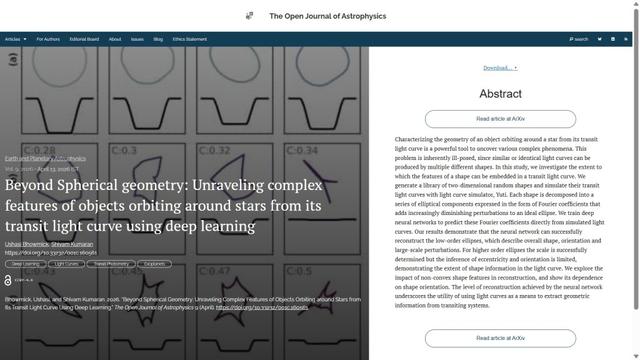
The first paper to report this week is “Beyond Spherical geometry: Unraveling complex features of objects orbiting around stars from its transit light curve using deep learning” by Ushasi Bhowmick & Shivam Kumaran (Indian Space Research Institute, Ahmedabad, India). This study uses deep neural networks to predict the shape of objects orbiting stars based on their transit light curves, demonstrating the potential to extract geometric information from these systems. It was published on Monday 13th April in the folder Earth and Planetary Astrophysics and the overlay can be seen here:
You can find the officially accepted version on arXiv here and the announcement on Fediverse here:
https://fediscience.org/@OJ_Astro/116395992732332356
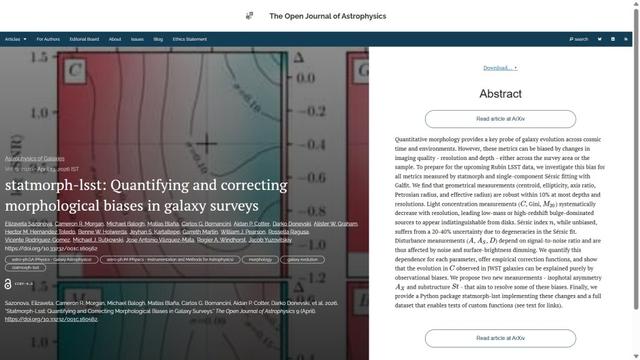
The second paper for this week, also published on Monday 13th April but in the folder Astrophysics of Galaxies, is “statmorph-lsst: Quantifying and correcting morphological biases in galaxy surveys” by Elizaveta Sazonova (U. Waterloo, Canada) and an international cast of 18 others. This paper presents an investigation of potential biases in quantitative morphology metrics used in galaxy evolution studies, proposing two new measurements to resolve biases, and provides a related Python package (statmorph-lsst), which can be found here on github.
The overlay for this one is here:
The official version of the paper can be found on arXiv here and the Fediverse announcement here:
https://fediscience.org/@OJ_Astro/116396069424189312
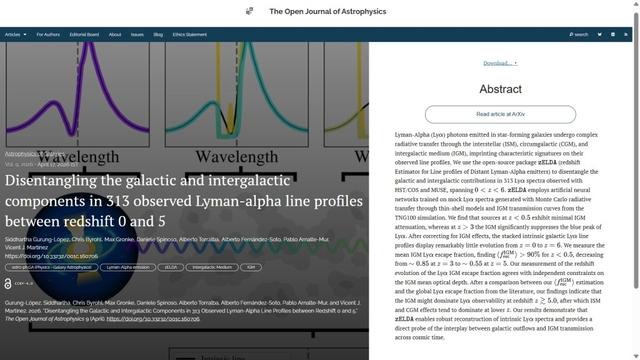
Next one up, the third paper of the week, one of four published on Friday 17th April, is “Disentangling the galactic and intergalactic components in 313 observed Lyman-alpha line profiles between redshift 0 and 5” by Siddhartha Gurung-López (Universitat de València, Spain) and 7 others based in Spain and Germany. Published in the folder Astrophysics of Galaxies, this paper uses the zELDA package to analyze Lyman-alpha photons from star-forming galaxies, revealing IGM effects dominate Lyman-alpha observability at high redshifts, while galactic outflows become more important at lower z.
The overlay for this one is here:
The final, accepted version can be found on arXiv here and the Mastodon announcement is here:
https://fediscience.org/@OJ_Astro/116418831864134501
The fourth paper this week, also published on Friday 17th April is “Using Symbolic Regression to Emulate the Radial Fourier Transform of the Sérsic Profile for Fast, Accurate and Differentiable Galaxy Profile Fitting” by Tim B. Miller (Northwestern University, USA) and Imad Pasha (Yale University, USA). This one is published in the folder Instrumentation and Methods for Astrophysics: it develops an emulator for galaxy profile fitting in Fourier space, improving speed by 2.5 times with minimal accuracy loss, aiding in managing increasing data flow.
The overlay is here:
The finally accepted version of this paper can be found here and the Mastodon announcement follows:
https://fediscience.org/@OJ_Astro/116418855010158656
The fifth paper for this week is “The THESAN project: Lyman-alpha emitters as probes of ionized bubble sizes” by Meredith Neyer (MIT, USA) and 6 others based in the USA, Colombia, Canada, Japan and UK. The study uses THESAN simulations to explore how Lyman-alpha emitters (LAEs) trace ionized bubble sizes during the Epoch of Reionization, providing a framework for interpreting LAE surveys. This was published on Friday 17th April in the folder Astrophysics of Galaxies.
The overlay for this one is here:
You can find the authorized version of this paper on arXiv here and the Fediverse announcement is here:
https://fediscience.org/@OJ_Astro/116418887225003954
The sixth and final paper for this week is “Closed-Form Statistical Relations Between Projected Separation, Semimajor Axis, Companion Mass, and Host Acceleration” by Timothy D Brandt (Space Telescope Science Institute, USA). This was published on Friday 17th April in the folder Solar and Stellar Astrophysics. In this paper the author derives statistical relationships between radial velocity, a companion’s mass, and projected separation, useful for calculations requiring derivatives. The results are verified with empirical comparisons to existing literature.
The overlay for this one is here:
You can find the officially-accepted version on arXiv here and the Mastodon announcement here:
https://fediscience.org/@OJ_Astro/116418938017199814
And that concludes this week’s update. I’ll do another one at the end of next week.
P.S. Just a reminder, for those of you into LinkedIn, that we now have a page there.
#arXiv250303824v4 #arXiv250820266v2 #arXiv250914875v2 #arXiv251018946v2 #arXiv251109644v2 #arXiv260114688v2 #AstrophysicsOfGalaxies #binaryStars #ComputationalAstrophysics #CosmologyAndNonGalacticAstrophysics #DiamondOpenAccess #DiamondOpenAccessPublishing #EarthAndPlanetaryAstrophysics #EpochOfReionization #galaxyFormation #GalaxyMorphology #galaxyProfiles #InstrumentationAndMethodsForAstrophysics #IntergalacticMedium #Ionization #LAEs #lightCurves #LSST #LymanAlphaEmitters #OpenAccess #OpenAccessPublishing #Orbits #SérsicProfile #SolarAndStellarAstrophysics #statmorphLsst #stellarHalos #strongGravitationalLensing #THESAN #zELDA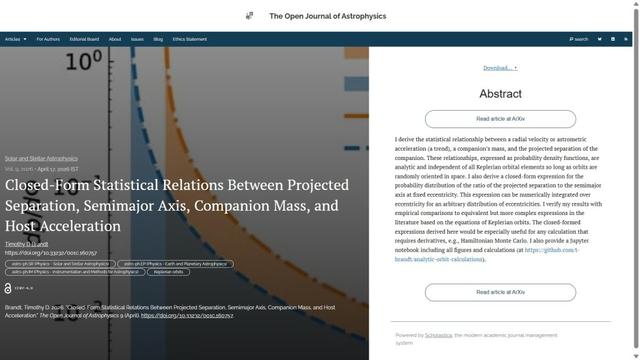
[Abbreviated] We investigate the dependence of Lyman-$α$ emitter (LAE) clustering on Lyman-$α$ luminosity. We use 1030 LAEs from the MUSE-Wide survey, 679 LAEs from MUSE-Deep, and 367 LAEs from the to-date deepest ever spectroscopic survey, the MUSE Extremely Deep Field. All objects have spectroscopic redshifts of $3<z<6$ and cover a large dynamic range of Ly$α$ luminosities: $40.15<\log (L_{\rm{Ly}α}/[\rm{erg \:s}^{-1}])<43.35$. We apply the Adelberger et al. K-estimator as the clustering statistic and fit the measurements with state-of-the-art halo occupation distribution (HOD) models. From the three main data sets, we find that the large-scale bias factor, the minimum mass to host one central LAE, $M_{\rm{min}}$, and (on average) one satellite LAE, $M_1$, increase weakly with an increasing line luminosity. The satellite fractions are $\lesssim10$% ($\lesssim20$%) at $1σ$ ($3σ$) confidence level, supporting a scenario in which DMHs typically host one single LAE. We next bisected the three main samples into disjoint subsets to thoroughly explore the dependence of the clustering properties on $L_{\rm{Ly}α}$. We report a strong ($8σ$) clustering dependence on $L_{\rm{Ly}α}$, where the highest luminosity LAE subsample ($\log(L_{\rm{Ly}α}/[\rm{erg \:s}^{-1}])\approx42.53$) clusters more strongly ($b_{\rm{high}}=3.13^{+0.08}_{-0.15}$) and resides in more massive DMHs ($\log(M_{\rm{h}}/[h^{-1}\rm{M}_{\odot}])=11.43^{+0.04}_{-0.10}$) than the lowest luminosity one ($\log(L_{\rm{Ly}α}/[\rm{erg \:s}^{-1}])\approx40.97$), which presents a bias of $b_{\rm{low}}=1.79^{+0.08}_{-0.06}$ and occupies $\log(M_{\rm{h}}/[h^{-1}\rm{M}_{\odot}])=10.00^{+0.12}_{-0.09}$ halos. We discuss the implications of these results for evolving Ly$α$ luminosity functions, halo mass dependent Ly$α$ escape fractions, and incomplete reionization signatures.
WINNER! 🚀🚀🚀
phelas wins Best CleanTech startup at Gobal EnergyTech Awards by Publicis Sapient. 🏆
We are grateful for the recognition that all climate tech innovators receive. The urgency of this topic was discussed long enough – now is the time to act!💥
#GlobalEnergyTechAwards2022 #publicissapient #BestCleanTech #winner #energystorage #liquidair #innovation #startup #phelas #cleantechnology #renewable #liquidairenergystorage #longdurationenergystorage #laes #renewableenergy #sustainable


 In the Dark
 ERROR 404 ▼
 Trending Stocks 📈
 KeithDPatch
 Pᵉtɘr Wᵉil8acher
 phelas