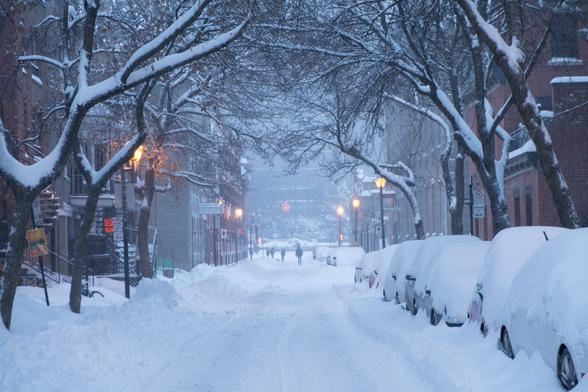
The Road Is Peppered with Rock Salt Alternatives
Every winter, millions of tons of rock salt is sprinkled across roads in the US, mostly in the Midwest and Northeast regions. It's a cheap and effective way to prevent accidents. Rock salt is chemically the same as the stuff that sits next to the pepper, except it isn't as finely ground, and it doesn't have sodium or potassium iodine added to it to prevent goiters. Both table salt and rock salt melt ice by lowering the freezing point of water. So does sugar.
Much of what we salt the Earth with every winter comes from underground networks of salt crystal that formed when various ancient seas dried up. As natural as it may be, rock salt is bad for the environment. For one thing, chloride is forever, and can't easily be decoupled from the soil and water it taints when it washes away. Rock salt also corrodes concrete, makes its way into the groundwater, and is bad for pets. Worst of all, its efficacy drops along with the temperature. At 15° F (-9° C), rock salt loses more than 86% of its melting power.
Disposable Detroit
All this salt is not great for cars, either -- it's bad for the paint and eats up the frame. In the saltiest parts of the US, aka The Salt Belt, cars only last a handful of years before they become Flintstones mobiles. Well, not really, but salt is terrible for the brake lines and most of the undercarriage. Consumer woes aside, there's a real environmental impact to manufacturing all these disposable cars to meet the demand.
But the problem is that we need to use salt, or at something like it. Even though millions of people are staying home a whole lot more, the trucking industry still relies on salted highways and local roads. So if you like stocked grocery stores and stuff arriving from the Bezos Barn in a timely fashion, you can see the problem. So what are the alternatives? Are there any?
Adding Abrasives
A handful of chicken grit. Image via Omelet
Freezing point depressants aren't the only solution, but they're usually a large part of it. For years, plenty of jurisdictions supplemented salt with sand until it started clogging the sewer pipes. One of the modern alternatives to salting the streets willy-nilly is to meter out usage based on road temperature readings. Another trick is to distribute a liquid salt solution instead, which works faster and won't bounce into the gutter.
As far as eco-friendly alternatives go, some individuals use abrasives on their sidewalks and driveways like kitty litter, coffee grounds, or chicken grit, which is a mixture of shells and small pebbles that helps their digestion. But of course, all of these are just traction agents -- they don't melt the ice. Although when it comes to your property, unless there's a layer of ice under the snow, some kind of traction agent will probably suffice after shoveling or snow-blowing.
Of course, these would likely cause the same problems as sand if used on a large enough scale, especially coffee grounds. So even though these may be better for the environment, they come with their own set of problems.
Brine is Fine, Sort Of
Cheeses take in the light after their brine bath. Image via Recycle Reminders
Several years ago, we heard that Wisconsin was using cheese brine on their roads, and not only is it true, it works at much lower temperatures than salt. But how does the average Joe source his cheese brine for home use? We're not sure. Fortunately, other food by-products work too, like sugar beet juice and pickle juice.
But some of those have their problems, too. Sugar beet juice still requires salt to work -- the point is to make a goo that won't run off into the gutters as readily. The problem is that the organic material can deplete the oxygen in rivers, lakes, and streams.
Possibly the worst brine of all comes from fracking, an already controversial practice. This radioactive runoff has already been used in places like Pennsylvania. Road salt is starting to look pretty good, no?
Is There a Nicer De-Icer?
But there is one that's sort of better than salt: potassium acetate. It contains no chloride and is biodegradable, but it has that oxygen-lowering problem and has been proven harmful to aquatic insects. Potassium acetate is more effective as a preventive measure, as it keeps ice from bonding to surfaces. It's roughly three times as expensive as rock salt, but a little goes a long way, so the cost is nearly even. Another preventive treatment known as calcium magnesium acetate is environmentally friendly, but it's only as effective as rock salt when the temperature plummets.
So, what's the answer? We suppose change begins at home, so consider the contents when you go to buy de-icer, or try making your own. Whatever you do, do it sparingly.
[Main and thumbnail images via Shawn Dearn on [Unsplash]](https://unsplash.com/s/photos/winter?utm_source=unsplash&utm_medium=referral&utm_content=creditCopyText)
#chemistryhacks #hackadaycolumns #transportationhacks #calciummagnesiumacetate #chickengrit #coffeegrounds #deicer #kittylitter #roadsalt #sodiumchloride
 Karl Ostendorf
 N-gated Hacker News
 David Boles
 Shantell Powell
 AI6YR Ben
 Black White Blue in the South
 Bill Kimler for SC House 13
 Slavery is violence
 Emmie12750
 hackaday unofficial