Statistical Physics with R: Ising Model with Monte Carlo
https://github.com/msuzen/isingLenzMC
#HackerNews #StatisticalPhysics #R #IsingModel #MonteCarlo #GitHub #DataScience
We are pleased to announce a second lecture from Dr. Marcello Dalmonte (ICTP) on the intricacies of statistical mechanics and phase transitions in the context of data mining the many-body problem. In this part, Marcello discusses essential concepts of the partition function, emphasizing efficient sampling strategies via Markov chains and Monte Carlo simulations. He specifically addresses the challenge of critical slowing down near phase transitions and introduces cluster algorithms as a powerful tool for effective sampling at criticality. Using the illustrative example of a three-site Ising model, Dr. Dalmonte demonstrates how temperature impacts the intrinsic dimensionality of feature spaces, providing valuable insights into many-body systems.
🎥 Don't miss this #OpenAccess opportunity to watch the lecture for free and engage in discussions with the Enabla community, including Marcello himself: https://enabla.com/pub/325/about
The first lecture of the same series was announced earlier: https://mathstodon.xyz/@enabla/113163357376577315
#StatisticalMechanics #UnsupervisedLearning #machine_learning #MonteCarlo #PhaseTransitions #IsingModel #OpenScience
Emergent Equilibrium in All-Optical Single Quantum-Trajectory Ising Machines
https://arxiv.org/abs/2412.12768
#physics #ising #isingmodel #isingmachines #quantumphysics #quantum
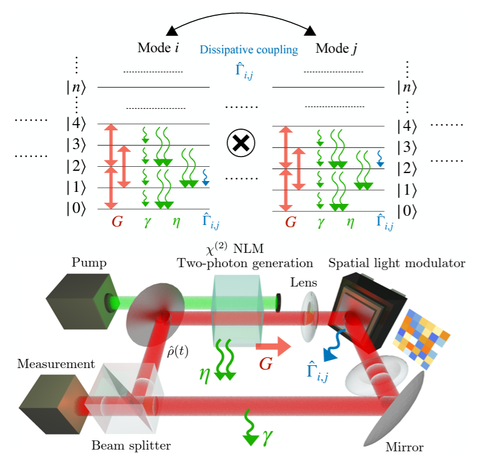
We investigate the dynamics of multi-mode optical systems driven by two-photon processes and subject to non-local losses, incorporating quantum noise at the Gaussian level. Our findings show that the statistics from a single Gaussian quantum trajectory exhibit emergent thermal equilibrium governed by an Ising Hamiltonian encoded in the dissipative coupling between modes. The driving strength sets the system's effective temperature relative to the oscillation threshold. Given the ultra-short time scales typical of all-optical devices, our study demonstrates that such multi-mode optical systems can operate as ultra-fast Boltzmann samplers, paving the way toward the realization of efficient hardware for combinatorial optimization, with promising applications in machine learning and beyond.
We investigate the dynamics of multi-mode optical systems driven by two-photon processes and subject to non-local losses, incorporating quantum noise at the Gaussian level. Our findings show that the statistics retrieved from a single Gaussian quantum trajectory exhibits emergent thermal equilibrium governed by an Ising Hamiltonian, encoded in the dissipative coupling between modes. The system's effective temperature is set by the driving strength relative to the oscillation threshold. Given the ultra-short time scales typical of all-optical devices, our study demonstrates that such multi-mode optical systems can operate as ultra-fast Boltzmann samplers, paving the way towards the realization of efficient hardware for combinatorial optimization, with promising applications in machine learning and beyond.
"Ising on the Cake" a blog post by John Peach about the Ising model, including various further references.
Read it at https://buff.ly/4h9aAkc
Heterogeneity extends criticality
https://www.frontiersin.org/articles/10.3389/fcpxs.2023.1111486/full
#complexity #phaseTransitions #criticality #IsingModel #randomBooleanNetworks
Criticality has been proposed as a mechanism for the emergence of complexity, life, and computation, as it exhibits a balance between order and chaos. In classic models of complex systems where structure and dynamics are considered homogeneous, criticality is restricted to phase transitions, leading either to robust (ordered) or fragile (chaotic) phases for most of the parameter space. Many real-world complex systems, however, are not homogeneous. Some elements change in time faster than others, with slower elements (usually the most relevant) providing robustness, and faster ones being adaptive. Structural patterns of connectivity are also typically heterogeneous, characterized by few elements with many interactions and most elements with only a few. Here we take a few traditionally homogeneous dynamical models and explore their heterogeneous versions, finding evidence that heterogeneity extends criticality. Thus, parameter fine-tuning is not necessary to reach a phase transition and obtain the benefits of (homogeneous) criticality. Simply adding heterogeneity can extend criticality, making the search/evolution of complex systems faster and more reliable. Our results add theoretical support for the ubiquitous presence of heterogeneity in physical, biological, social, and technological systems, as natural selection can exploit heterogeneity to evolve complexity “for free”. In artificial systems and biological design, heterogeneity may also be used to extend the parameter r...
Last activities in my course of #NumericalMethods, the #MonteCarlo method applied to: (1) the 2D #IsingModel on a lattice with different boundary conditions, and (2) the #PottsModel for \( q=3 \) in a 2D lattice with periodic boundary conditions.
My #fortran codes are still the fastest!