An aorta to insulin producing cell sensor for internal state in Drosophila
The cellular circuits through which the internal state of an organism is sensed and relayed to the brain, and through which they bring about appropriate physiological and behavioral responses, remain largely unelucidated. Using whole-animal electron microscopy reconstruction of a Drosophila larva, we previously identified an Aorta sensory organ whose somata lie on the periphery of the brain, with dendritic arborizations in the wall of the anterior aorta, and whose axons project to the protocerebrum and synapse onto the insulin-producing cells (IPCs). Here we characterize the full anatomy and connectivity of this sensory organ. We show that the aorta sensory neurons make their strongest direct synaptic contacts onto IPCs and the neurosecretory cells producing Dromyosuppressin (DMS), with only weaker direct contacts to diuretic hormone 44 (DH44). They also make direct contacts to the enteric serotonergic neurons modulating swallowing (Se0ens), and to two single mushroom body neurons, DAN-j1 and MBON-d3, of the learning and memory center of Drosophila. Calcium imaging shows that the neurons are activated by fructose, and optogenetic manipulation reveals that their activity influences peptide content in IPCs, DH44 and DMS cells. Polysynaptic paths to the brain run through two morphologically distinct interneuron families. One, formed by the Hugin protocerebral neurons, targets the neuroendocrine system and is associated with bitter taste and pathogen induced feeding suppression. The other, formed by the BAmas projection neurons, targets dopaminergic input neurons and output neurons of the mushroom body. The Aorta sensory pathway therefore couples internal hemolymph state to two parallel central systems, endocrine state control and mushroom body-associated value updating, and provides a candidate substrate for a metabolic memory through which post-ingestive state is fed back into future feeding choice.
### Competing Interest Statement
The authors have declared no competing interest.
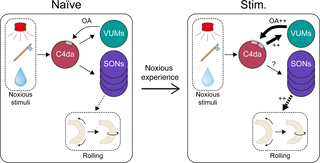
A positive feedback loop between sensory and octopaminergic neurons underlies nociceptive plasticity in Drosophila larvae
Author summary The ability to adapt behavior based on past encounters with danger is a fundamental survival trait. Repeated exposure to harmful or painful stimulus often leads animal respond more strongly over time, process known as sensitization. Although sensitization is critical for avoiding future threats, the neural circuitry that allows experience to fine-tune sensitivity is not fully understood. In this study, we used fruit fly (Drosophila) larvae to investigate how repeated noxious stimuli alter behavior. We found that after multiple exposures, larvae are much more likely to perform a characteristic escape rolling behavior, and they do so with greater intensity. This increased sensitivity arises from changes within the pain-sensing neurons themselves, which stay “on alert” and increase their activity. We identified the neuromodulator octopamine and its receptor, OAMB, as key regulators of this process. Our results reveal that specific set of feedback neurons amplifies pain signalling through positive feedback loop. Together, these finding provide insight into how neuromodulator feedback circuits enable nervous system to adapt behavioral response to environmental threats.
Quantifying Drosophila Feeding Behavior Using flyPAD and optoPAD
Quantifying feeding behavior with high temporal and spatial precision is critical for understanding how internal state, sensory cues, and neural activity shape food intake and dietary choice. Here, we describe a detailed protocol for performing consumption and dietary choice assays in Drosophila using the flyPAD/optoPAD system. This method enables simultaneous measurement of feeding events across multiple arenas while allowing precise control of gustatory stimuli and optogenetic stimulation. We provide step-by-step instructions for assay food preparation, flyPAD arena setup, data acquisition, and downstream data organization with suggested analyses. This approach is suitable for studying consumption, nutrient preference, learning, and state-dependent modulation of feeding behaviors, and can be readily adapted for optogenetic manipulations and comparative choice assays.
Highlights
### Competing Interest Statement
The authors have declared no competing interest.
National Institute of General Medical Sciences, R35GM147504

Frontiers | Sleep regulation in Drosophila: a review of neural circuits and genetics
Sleep in Drosophila melanogaster is regulated by a complex and distributed network of neural circuits that are influenced by factors such as internal state, ...
A state-dependent neural circuit resolves approach-avoidance conflicts
To survive, animals must balance opportunity and risk, yet how internal motivational state biases this trade-off remains poorly understood. Here we show that hunger gates nociceptive avoidance in Drosophila to enable food approach under conflict. Using a behavioural assay in which flies must cross an electric shock barrier to reach food, we find that starvation promotes shock tolerance only when food-related olfactory cues are present. This state- and context-dependent behavioural shift is mediated by a defined neuromodulatory circuit. Leucokinin neurons encode hunger and convey this information to PV5K1 lateral horn output neurons, which integrate internal state signals with food odour cues and suppress shock-responsive FB2B neurons in the ventral fan-shaped body. Accordingly, electric shock-evoked activity in FB2B neurons is suppressed in starved flies exposed to food cues. These findings identify a circuit mechanism by which motivational state gates aversive processing to bias action selection towards goal-directed behaviour.
### Competing Interest Statement
The authors have declared no competing interest.
BBSRC to C.R, BB/W016249/1, BB/S009299/1
The Leverhulme Trut to C.R, RPG-2023-009
DFG under Germanys Excellence Strategy to L.S, EXC-2049, 390688087
Emmy Noether Programme to L/S, 495407463
MIBTP BBSRC to M.B, BB/T00746X/1
Hunger Recruits a Parallel Circuit Encoding Alcohol Reward
Internal states like hunger, pain, thirst and arousal can bias behavior by affecting sensory and memory processing. Internal states are critical to understand in the context of alcohol addiction because they influence cravings, reinstatement, and relapse. Norepinephrine plays a key role in both hunger and alcohol-induced arousal and preference, but the circuit-level mechanisms through which it modulates the influence of hunger on alcohol preference are not well understood. We sought to address this using intersectional genetic tools for manipulating neurons expressing octopamine, the invertebrate analogue of vertebrate norepinephrine. We identified a single octopamine neuron required for ethanol seeking only when Drosophila are food-deprived. Hunger increased baseline activity in this neuron, making it more responsive to an odor cue previously paired with ethanol. A combination of genetic and connectome analyses revealed that synaptic partners of this octopaminergic neuron form a functional module that acts on Drosophila memory circuitry. Thus, we show that hunger recruits a parallel circuit that drives learned ethanol preference, providing a neuronal framework through which internal state influences the expression of memory for ethanol-associated cues.
### Competing Interest Statement
The authors have declared no competing interest.
National Institute on Alcohol Abuse and Alcoholism, R01AA024434
National Institute of Neurological Disorders and Stroke, F99NS118741
National Institute of General Medical Sciences, R01GM115510
National Institute on Deafness and Other Communication Disorders, R01DC017146, R01DC020703
Howard Hughes Medical Institute, https://ror.org/006w34k90, Gilliam award to K.M.N.
Hubert & Richard Hanlon Trust
Carney Institute for Brain Science at Brown University, Innovation Award to G.B.
📰 "A positive feedback loop between sensory and octopaminergic neurons underlies nociceptive plasticity in Drosophila larvae"
https://www.biorxiv.org/content/10.1101/2025.07.17.665309v1?rss=1 #InternalState #Drosophila #Behaviour #Sensory #LarvaYour word, is one of the most powerful forces of nature.
Listen to yours to find out what you really think.
And speak them wisely to pave the path before you in gold.
#psychozoicera #mindset #lawoftheuniverse #lawofcorrespondence #internalstate #guidinglight #lifesjourney #manifestation #manifest #visualize #dreamlife
 flypapers
 Psychozoic Era