The RESISTORS were not countercultural
The Spectrum IEEE article “How the RESISTORS Put Computing into 1960s Counter-culture“[1] is disingenuous.
I'm tired of self-congratulatory mythologising in the historiography of computing. It's of a piece with the trope of plucky boys (it’s always boys) building computers in their parents’ garage, as little Davids taking down Goliath IBM. It's myth-making.
We cannot escape or elide the fact that these were all kids from highly privileged backgrounds:
Several members had parents employed at nearby technology companies, such as AT&T and RCA. Others, such as Nat Kuhn, had parents who worked at Princeton University. Kuhn’s father was Thomas Kuhn, a historian and author of The Structure of Scientific Revolutions (1962), the landmark book that introduced “paradigm shift” into the vernacular.[1]
The group had access to ”Princeton University Computer Lab where the university allowed the kids to use their very large computers as long as they could learn how.”[2] “On a couple of occasions… I drove them to the Digital Equipment Company (DEC) in Maynard, Mass. where they participated with Claude in fairly professional meetings.“[2]
That’s quite a perk, as a secondary school student. Where are these people now? Can you guess?
"Chuck Ehrlich [was] one of the original RESISTORS and later [a] venture capitalist"[2]; Jean Hunter is professor emerita of biological and environmental engineering at Cornell[3]; Cynthia Dwork is Gordon McKay Professor of Computer Science at Harvard University[4]; John Levine is described as an author, but in fact among other C-suite roles he "co-founded Segue Software" and "continued as a director of the corporation and an informal consultant until the company was sold to Borland Software in early 2006"[6]. Leonard Bosack co-founded Cisco Systems. Fifteen years ago his personal fortune was estimated at $200 million[7]. Steve Kirsch sold search engine Infoseek to Disney for $1.7B in 1999 and is an anti-vaxxer[5].
The RESISTORS themselves tell a different story about how non-sexist, non-homophobic and anti-racist they were and are: “There were a few girls who came from time to time, but I was never quite sure whether it was the computers or the boys who were the attraction.”[2]
About Kagan, the articles states “Kagan was gay, a fact that the teens (and their parents) were aware of but which, by all accounts, bothered no one.“[1] (my emphasis) but RESISTOR Bob Levine says:
[Claude Kagan] lived alone but had had a companion who died under questionable circumstances. What the parents really wanted to know was if it was safe to have their teenage boys interacting with Claude? […] As for Claude's dealing with the boys, there was not even a hint of anything improper.”[4]
Joseph Tulloch, the only named Black member of the group, later finds work as a programmer.[1] That's it. He doesn't get to bootstrap his technical expertise, nor even capitalise on the valuable network of privilege from his involvement with the group, to become a founder, or a CEO, or a professor, or a venture capitalist. I wonder why. Maybe he didn’t want it enough, right?
Their mentor Kagan, framed as a kind of fatherly farmer-tinkerer, with his barn full of donkeys and old computers, in fact had a "BA in Mechanical Engineering, a BA in Electrical Engineering, and an MSc in Civil Engineering" and among other high-stakes technical work had been "... involved in final setup and testing of Missile Range communications system". He was at the centre of the Cold War military-industrial complex.
The article starts with a garbled story about the RESISTORS breaking a strike at a computer convention which we’re supposed to consider contributes to their countercultural credentials. I don't consider strike-breaking to be countercultural - quite the opposite. There’s a less muddled telling of the story about the strike-breaking kids, published by the RESISTORS themselves:
I also recall a computer conference in Atlantic City where they had obtained some space to demonstrate their PDP-8. As the conference started, the telephone workers went on strike so that all the exhibitors who depended on the phones to demonstrate their equipment were blocked – but not the R.E.S.I.S.T.O.R.S. They quickly ran a pair of wires from the PDP-8 and clipped them to a nearby pay phone so they could communicate with another computer back at the barn. They were the only exhibitor who had anything working, and were mobbed. I think it also made the local papers. Claude was very proud of them.
1/2
#computerhistory #capital #power #privilege #siliconvalley #historiography #mythmaking #billionaires #intergenerationalwealth
[1] https://spectrum.ieee.org/teenage-hackers
[2] https://www.resistors.org/index.php/History_of_the_R.E.S.I.S.T.O.R.S.
[3] https://cals.cornell.edu/people/jean-hunter
[4] https://dwork.seas.harvard.edu/
[5] https://www.ebsco.com/research-starters/biography/steve-kirsch
[6] https://www.johnlevine.com/about.phtml
[7] https://en.wikipedia.org/wiki/Leonard_Bosack
 Dave á Jus
 Amin Girasol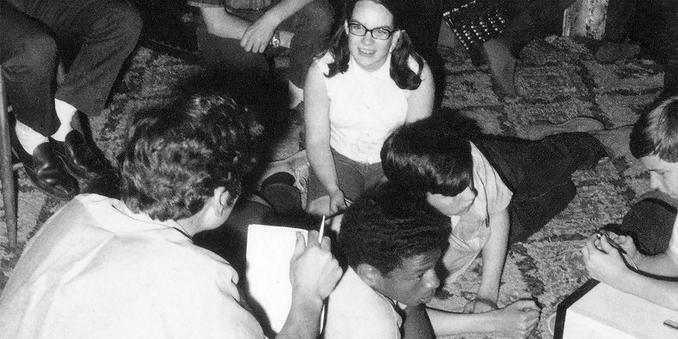
 CV3.com
 Nonilex
 Longreads
 Mojo ♻️
 Lyle Solla-Yates
 Joachim (he/him, white)
 MidsouthMouth.OctaviaKeats