
New paper. With Ekaterina Vasileva, Liubov Tupikina, Dmitry Fedorov, Daniil Musatov, Andrei Raigorodskii and Stefano Boccaletti.

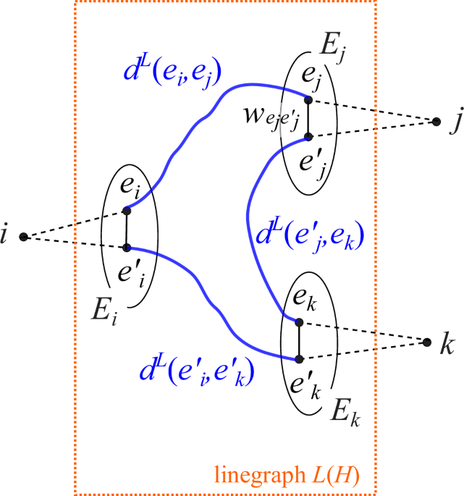
The naive generalization of the concept of distance to hypergraphs is equivalent to applying a clique-projection approximation. However, this is known to induce loss of information, especially in networks where the higher-order interactions are very important. To fix this problem,we introduce a new definition of distance on weighted higher-order networks, which includes the case of unweighted hypergraphs and classic graph distance as particular cases, and allows one to account for different meanings associated to the weights. We also show what difference this makes in analyses of real-world data.

https://www.nature.com/articles/s42005-026-02592-w

#mathematics #physics #graphtheory #graphs #hypergraphs #higherordernetworks #networkscience #networks
Distances in weighted higher-order networks - Communications Physics

The concept of distance in graphs and hypergraphs faces challenges when extended to weighted hypergraphs due to potential inconsistencies. The authors propose a well-defined distance measure for weighted hypergraphs and demonstrate its applicability on real-world datasets, showing that the use of the measure may help to avoid the information loss typically arising when standard approaches are used.
Nature

New paper, with Zerong Guo, Zonghua Liu, Shuguang Guan, Stefano Boccaletti and Jie Zhou.

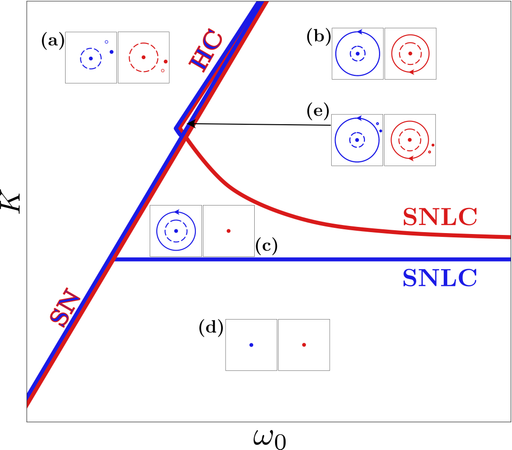
Everyone knows about chimera states. We show a new mechanism for the emergence of chimeras that is specific of higher-order interactions. Interestingly, this mechanism is somewhat analogous to what happens in some proteins with intrinsic disorder (which we showed a couple of years ago), so we called it intrinsic frustration.

#mathematics #physics #science #HigherOrderNetworks #synchronization #DynamicalSystems #ChimeraStates #chimeras #frustration #IntrinsicDisorder

New paper, with Kirill Kovalenko, Gonzalo Contreras, Stefano Boccaletti and Rubén Sánchez.

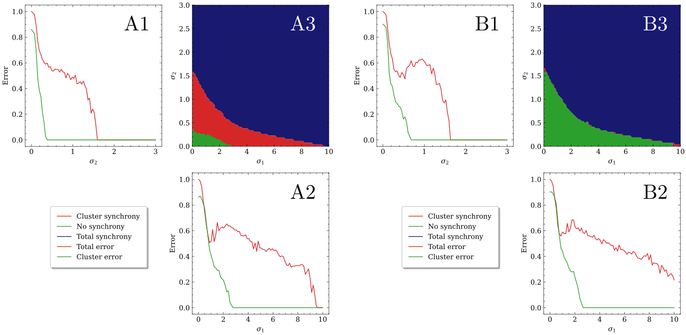
People have noticed that, in higher-order networks, synchronization is often explosive, and that cluster synchronization happens very rarely, if ever. We explain why, by showing that symultaneous dynamical equitability across layers or interaction orders is necessary and sufficient for cluster synchronization, except if the coupling functions depend linearly on each other. Since the probability of randomly satisfying this condition is exceedingly low, cluster synchronization is precluded in such networks.

https://www.nature.com/articles/s42005-026-02543-5

#mathematics #physics #science #networks #complexity #HigherOrderNetworks #MultiplexNetworks #synchronization #dynamicalsystems #graphs #graphtheory #equitability #ClusterSynchronization #ExplosiveSynchronization

🎙️ Interview with Christian Bick

Discover the vision behind BeyondTheEdge from our Principal Investigator, Christian Bick, in this insightful interview on Network Pages.

📖 Read more here: https://www.networkpages.nl/beyondtheedge-kicks-off/

#BeyondTheEdge #HigherOrderNetworks #NetworkScience 🚀

BeyondTheEdge Kicks Off – The Network Pages

In November 2024, the Kick-Off meeting for BeyondTheEdge: Higher-Order Networks and Dynamics took place at Vrije Universiteit (VU) Amsterdam. The event marked the official start of the project, read an interview with Christian Bick, Principal Investigator and Project Coordinator of BeyondtheEdge.