Tata Steel begins new project at Port Talbot in £1.25bn green plan

The company says the state‑of‑the‑art facility will replace ageing equipment and prepare hot rolled steel for downstream processes. The line cleans and treats steel before it is cold rolled and coated, supplying other Tata operations at Trostre, Llanwern and Shotton.

A turning point for Tata’s operations

Mills Programme Manager Andrew McGregor called the groundbreaking a turning point.

“This is a fundamental asset that is required for us to have a sustainable UK business going forward,” he said.

“Our current assets are at the end of their operational life, and without this replacement pickle line, we wouldn’t be able to process many of the steels required for our downstream businesses and directly for our customers.”

McGregor also praised the project team for months of preparatory work, from diverting cables to clearing the bay, which has allowed demolition crews to move in.

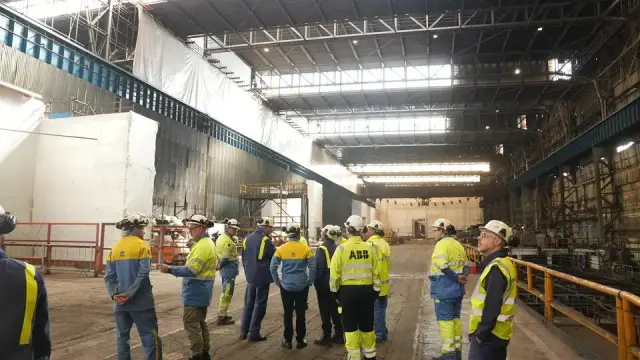
Tata Steel executives, including Pramod Agrawal and Rajesh Nair, inspect the cleared bay inside Port Talbot steelworks where the new pickle line will be built.(Image: Tata Steel)

One year after the blast furnaces fell silent

The investment comes less than a year after the closure of Port Talbot’s blast furnaces, which brought significant job losses and uncertainty for the town. Tata insists the pickle line is a sign of renewal, but unions and community leaders have warned that the transition to electric arc furnace production will still mean a smaller workforce.

The new pickle line is scheduled to be in place by 2026, ahead of the planned commissioning of a 3.2 million‑tonne electric arc furnace in 2027/28. Tata says the EAF will melt UK‑sourced scrap steel and form the centrepiece of its decarbonisation strategy.

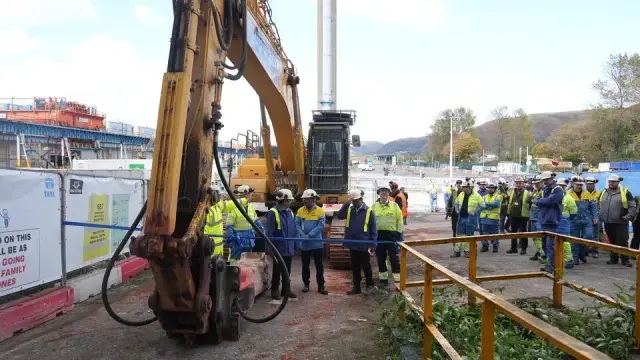
Project leaders and contractors gather in hi‑vis at Port Talbot steelworks as demolition begins for the new pickle line, alongside heavy machinery on site.(Image: Tata Steel)

Local firms in the frame

Construction of the pickle line is being led by Sir Robert McAlpine, with regional firms including Darlow Lloyd & Sons, Andrew Scott Ltd and Systems Group also involved.

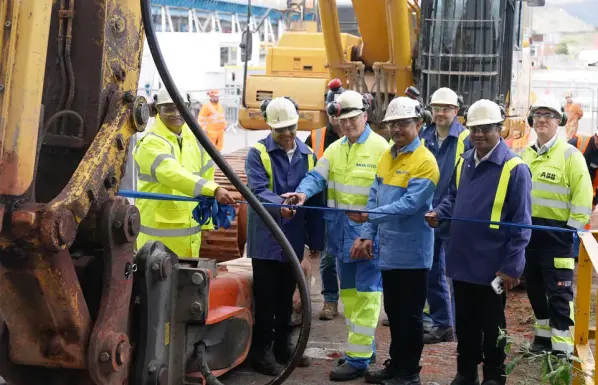
At the official ceremony, Tata Steel board member Pramod Agrawal cut the ribbon alongside senior executives.

Pramod Agrawal, Tata Steel board member, during his visit to Port Talbot to mark the start of the new pickle line project.(Image: Tata Steel)

Optimism tempered by caution

For Port Talbot, the start of work on the pickle line is another reminder of the site’s changing role. Neath Port Talbot Council leader Steve Hunt recently described the past year as “seismic” for the town, but said projects such as the pickle line and the Celtic Freeport offered reasons for optimism.

Campaigners, however, remain cautious. They argue that while new investment is welcome, the loss of traditional steelmaking has left deep scars and that promises of a “green future” must be matched by secure jobs and long‑term commitments.

Related articles

#AndrewScottLtd #blastFurnace #DarlowLloydSons #electricArcFurnace #GreenSteelmaking #industry #manufacturing #PickleLine #PortTalbot #PortTalbotSteelworks #PramodAgrawal #SirRobertMcAlpine #SystemsGroup #TataSteel
This marks a significant milestone in the journey to produce greener steel in Port Talbot.

When it is commissioned from the end of 2027, the electric arc furnace (EAF) will reduce the site’s steelmaking carbon emissions by 90%, equivalent to 5 million tonnes of CO₂ a year.

Tenova will supply an EAF with an annual capacity of 3 million tonnes of steel – similar to the output of the site’s blast furnaces – by melting scrap steel sourced from the UK.

The use of scrap will also significantly reduce the UK’s reliance on imported iron ore, strengthening the resilience of the UK’s manufacturing supply chains.

New ladle metallurgy furnaces, also supplied by Tenova, will then refine the molten steel to make more complex grades required by manufacturers in the UK and other countries.

Mr T V Narendran, CEO and MD of Tata Steel Limited, who joined the signing of the contract in Port Talbot following the project’s Board-level approval, said:

“This landmark agreement will enable us to transform our steelmaking site that will not only support the UK’s decarbonisation journey but also provide economic development opportunities for South Wales.

“Today marks an important milestone in making low-CO₂ steelmaking a reality in Port Talbot as well as reducing the UK’s carbon emissions and supporting our customers with their own carbon reduction targets.”

The agreement has been made possible by the £1.25 billion joint investment by Tata Steel and the UK Government, with Tata Steel investing £750 million and the government up to £500 million.

UK Business and Trade Secretary Jonathan Reynolds said:

“This partnership follows in the footsteps of an improved deal between the Government and Tata Steel and is further proof of our commitment to a bright future for UK steelmaking.

“Technology like the furnaces made by Tenova is critical to decarbonising the industry, unlocking its potential to provide skilled jobs, and creating economic stability for future generations of steelworkers in South Wales.

“Our upcoming steel strategy will provide further certainty for the sector as we set out our plan for its long-term growth and viability, backed by up to £2.5 billion for steel.”

Paolo Argenta, Executive Vice President for the Tenova Upstream Business Unit, said:

“We are working with Tata Steel UK at an unprecedented level of transparency and cooperation, and we are confident this will lead to a successful project implementation.

“Tenova’s global collaboration with Tata Steel, including projects in other regions of the world, further reinforces our strong partnership.”

Welsh Secretary Jo Stevens said:

“This agreement is an important step towards a secure long-term future for steelmaking in Port Talbot.

“As the transition to greener steelmaking begins, we have also quickly released millions of pounds of funding from the Port Talbot Transition Board which is supporting businesses and workers in Port Talbot and across South Wales.

“This government is determined to back workers and businesses in our Welsh steel industry whatever happens.”  

Detailed engineering is now ongoing, and other equipment orders will soon be placed separately for the Hot Strip Mill and Casters life extension, new Pickle Line, cranes, and for construction management and civil engineering.

Tata Steel has completed public consultation on the planning application and is working closely with the authorities to submit the application in November 2024, with a view to commencing large-scale site work around July 2025.

[Lead image: Tata Steel]

https://swanseabaynews.com/2024/10/20/tata-steel-signs-contract-for-green-steelmaking-technology/

#GreenSteelmaking #TataSteel #Tenova

Sustainable solutions for the metals and the mining industries | Tenova

Tenova is the leading partner for metals industry green transition. From DRI to EAF, reheating furnaces to cold mills, processing lines and roll grinders

In our recent study, we evaluated potential breakthrough technologies for #greensteelmaking, analysing their market readiness, cost and CO2 emission reduction potential. In this new series, we present them in three groups: hydrogen-based, direct electrification and CCS-based primary steel production. 3/x
With more than 70% of global #blastfurnace capacity requiring reinvestments by 2030, there is a window of opportunity to accelerate investments in key low-carbon technologies and kickstart the transformation towards #greensteelmaking. 2/x
With the #steelsector responsible for as much as 8% of global CO2 emissions, the race is on to kickstart the transformation towards #greensteelmaking. We examined 8 technologies that could be used to replace the current coal-and CO2-intensive blast furnace route. 1/6