Sailor’s Eyeball (Valonia ventricosa): The World’s Largest Single-Celled Organism
Quick Facts: Sailor’s Eyeball
Scientific Name
Valonia ventricosa
Common Names
Sailor’s Eyeball, Sea Grape, Bubble Algae
Class
Green Algae (Chlorophyceae)
Size
Up to 5cm (Golf ball size)
Location
Tropical zones (Caribbean, Indo-Pacific)
Key Feature
It is a
single massive cell
The Biological Anomaly
Spotting a Sailor’s Eyeball is a unique experience because you are looking at a freak of nature. Unlike most marine plants that are made of millions of microscopic cells, the Valonia ventricosa is a single, massive cell.
This unique biology creates its signature metallic shine. Because there are no internal cell walls to scatter light, the entire organism reflects the blue ocean water like a polished mirror. It is essentially a living, liquid-filled balloon.
https://youtu.be/p11XgD3pu5s
Field Observation: Sint Eustatius
I filmed this particular specimen off the coast of Sint Eustatius in the Caribbean. Unlike many that are firmly wedged into the reef, this one was drifting and bouncing freely among the seagrass.
Watching it roll with the gentle surge highlights just how delicate it is. It really does behave like a fluid-filled balloon, completely at the mercy of the current. It’s a rare opportunity to see one fully exposed like this, rather than hidden inside a dark crevice.
Camera Gear & Settings
-
Camera: Panasonic GH5
-
Lens: LUMIX G Series 14-42mm
-
Housing: Nauticam
-
Audio: Original composition (Logic Pro X)
FAQ: Is the Sailor’s Eyeball Dangerous?
No. The Sailor’s Eyeball is not dangerous to divers or humans. It is not venomous and does not sting.
However, divers should avoid squeezing them. Because the organism is a single cell, “popping” it releases thousands of spores into the water column. In some conditions, this can cause the algae to spread rapidly and overgrow surrounding coral.
 𝙹𝚞𝚜𝚝 𝙹𝚎𝚜𝚜
 Ryan Hodnett
 Amelia Cervera 🧬
 ScubaHankNYC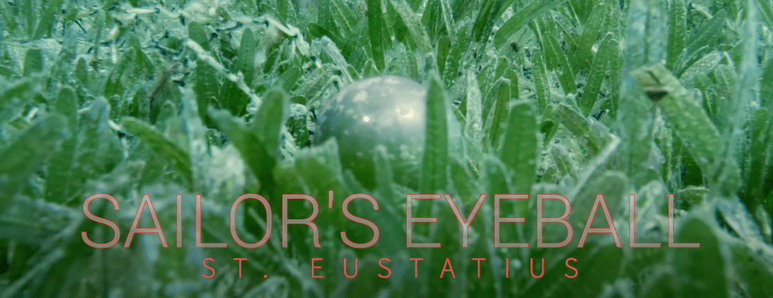
 Rasta
Rasta
 Matt Willemsen
 Lukas VFN 🇪🇺

 Michiel van Wessem
 Phys.org
 Universität Jena