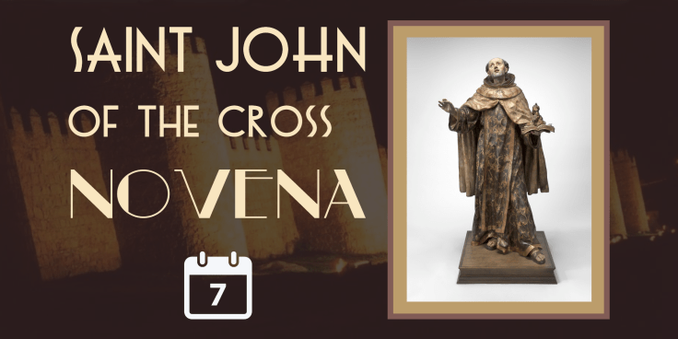
St. John of the Cross Novena, Day 7: Humility

Reading

To be taken with love for a soul, God does not look on its greatness, but on the greatness of its humility.

Sayings of Light and Love, 103

Scripture

Have mercy on me, God, in your kindness.
In your compassion blot out my offense.
O wash me more and more from my guilt
and cleanse me from my sin.

My offenses truly I know them;
my sin is always before me
Against you, you alone, have I sinned;
what is evil in your sight I have done.

That you may be justified when you give sentence
and be without reproach when you judge,
O see, in guilt I was born,
a sinner was I conceived.

Indeed you love truth in the heart;
then in the secret of my heart teach me wisdom.
O purify me, then I shall be clean;
O wash me, I shall be whiter than snow.

Make me hear rejoicing and gladness,
that the bones you have crushed may revive.
From my sins turn away your face
and blot out all my guilt.

A pure heart create for me, O God,
put a steadfast spirit within me.
Do not cast me away from your presence,
nor deprive me of your holy spirit.

Give me again the joy of your help;
with a spirit of fervor sustain me,
that I may teach transgressors your ways
and sinners may return to you.

O rescue me, God, my helper,
and my tongue shall ring out your goodness.
O Lord, open my lips
and my mouth shall declare your praise.

For in sacrifice you take no delight,
burnt offering from me you would refuse,
my sacrifice, a contrite spirit,
a humbled, contrite heart you will not spurn.

In your goodness, show favor to Zion:
rebuild the walls of Jerusalem.
Then you will be pleased with lawful sacrifice,
holocausts offered on your altar.

Psalm 51

Meditation

“O sweetest love of God, so little known, whoever has found this rich mine is at rest!” (Sayings, 16) This is the song of St. John of the Cross, his canticle of love distilled down to its very essence. 

God truly loves us, St. John reminds us through his letters. He tells us that God cannot fit in hearts that are occupied with distractions, that are attached to people, places, or things that mean more to us than God himself. God only fits in hearts that have been emptied to make room for him.

It seems that nada—nothingness within us—isn’t so far-fetched after all. Cleansing our souls is like the necessary spiritual housekeeping that must be done prior to any Nativity moment in our spiritual lives; without that soul-cleansing, that housecleaning in our hearts, there will always be a NO VACANCY light shining outside the inn within. How can God find space to squeeze in here?

St. Edith Stein says that the moment we reach the realization that we need to clean house is the moment when we are on the threshold of making the greatest spiritual progress. Recalling the spiritual sense of dryness, darkness, and emptiness that we mentioned in the meditation for our sixth day of this novena, Edith offers this reflection on the state of the soul in her final masterpiece, The Science of the Cross (SC):

She [the soul] is put into total darkness and emptiness. Absolutely nothing that might give her a hold is left to her anymore except faith. Faith sets Christ before her eyes: the poor, humiliated, crucified one, who is abandoned on the cross even by his heavenly Father. In his poverty and abandonment, she rediscovers herself. Dryness, distaste, and affliction are the “purely spiritual cross” that is handed to her. If she accepts it she experiences that it is an easy yoke and a light burden. It becomes a staff for her that will quickly lead her up the mountain. (SC 10)

Accepting the dryness we experience in prayer, the distaste, the affliction, these are all signs that we actually are clearing out space for God within. 

When she realizes that Christ, in his extreme humiliation and annihilation on the cross, achieved the greatest result, the reconciliation and union of mankind with God, there awakens in her the understanding that for her, also, annihilation, the “living death by crucifixion of all that is sensory as well as spiritual” leads to union with God. (SC 10)

And by the way, there is a little voice in Dijon, France who takes up the refrain: it is St Elizabeth of the Trinity, singing so sweetly in the pages of her Last Retreat (LR):

If my interior city (cf. Rev. 21) is to have some similarity and likeness to that “of the King of eternal ages” (I Tim 1:17) and to receive this great illumination from God, I must extinguish every other light and, as in the holy city, the Lamb must be “its only light.”

Here faith, the beautiful light of faith appears. It alone should light my way as I go to meet the Bridegroom. The psalmist sings the He “hides Himself in darkness” (Ps 17:12), then in another place he seems to contradict himself by saying that “light surrounds Him like a cloak” (Ps 103:2). What stands out for me in this apparent contradiction is that I must immerse myself in “the sacred darkness” by putting all my powers in darkness and emptiness; then I will meet my Master, and “the light that surrounds Him like a cloak” will envelop me also, for He wants His bride to be luminous with His light, His light alone, “which is the glory of God.” (LR 4)

So there it is: the challenge, the call is to accept, welcome, embrace and—so to speak—hide in the dark and empty spaces within us, not running to another distraction, another attachment, another new idol in our lives to fill up that interior void. It is at the point when we feel (and know) the emptiness within, the void that we are creating and/or that God is helping us to create so that we can spend time and focus on him—whether that is accepting a loss of some sort of attachment, or purposefully choosing to give up a distracting activity in order to spend more time going to daily Mass, making time for daily Scripture reading, or praying the Liturgy of the Hours, or the rosary, or going to Eucharistic adoration, or practicing silent mental prayer instead of (name your distraction here).

At this point when we have a hunger and a thirst for God that is so strong and powerful that we are willing to sacrifice and say, “all for you and nothing for me” (Sayings 111), we also find ourselves crying out to God, “but I can’t do this alone, by myself!” When we are ready to give up and have reached the point of abandon, we’ve reached the most crucial moment of all because…

That is the truth.

“I never sought anything but the truth,” St. Thérèse said in the hours before her death (Yellow Notebook, 30 September).

St. Teresa set the benchmark in the Interior Castle: “To be humble is to walk in truth” (IC VI, 10:7)

And how will we know when we’re meeting the benchmark for St. John of the Cross?

The humble are those who hide in their own nothingness and know how to abandon themselves to God (Sayings 163).

Prayer

O St. John of the Cross
You were endowed by our Lord with the spirit of self-denial
and a love of the cross.
Obtain for us the grace to follow your example
that we may come to the eternal vision of the glory of God.

O Saint of Christ’s redeeming cross
the road of life is dark and long.
Teach us always to be resigned to God’s holy will
in all the circumstances of our lives
and grant us the special favor
which we now ask of you.

Mention your request

Above all, obtain for us the grace of final perseverance,
a holy and happy death and everlasting life with you
and all the saints in heaven.
Amen.

Let’s continue in prayer

Day 1 — Self-trust
Day 2 — Self-giving
Day 3 — Cleansing
Day 4 — Walking in love
Day 5 — Trust
Day 6 — Prayer
Day 7 — Humility
Day 8 — Eternal Silence
Day 9 — Silent love

Bust of St. John of the Cross
17th c. French
Oil on canvas, no date
Carmel of Pontoise
© Ministère de la Culture (France), Médiathèque de l’architecture et du patrimoine, Diffusion RMN-GP. Used by permission.
Latin inscription upper left: QVID TIBI PRO LABOR
Latin inscription at base: PATI. ET. CONTEMNI. PROTE

 The novena prayer was composed from approved sources by Professor Michael Ogunu, a member of the Discalced Carmelite Secular Order in Nigeria.

John of the Cross, St 1991, The Collected Works of St. John of the Cross, rev. edn, Kavanaugh, K & Rodriguez, O (trans.), ICS Publications, Washington DC.

Teresa of Avila, St 1985, The Collected Works of St. Teresa of Avila, Kavanaugh, K & Rodriguez, O (trans.), ICS Publications, Washington DC.

Stein, E 2002, The Science of the Cross, The Collected Works of Edith Stein, Book 6, translated from the German by Koeppel, J, ICS Publications, Washington D.C.

Elizabeth of the Trinity, S 2014, I Have Found God, The Complete Works of Elizabeth of the Trinity Volume 1: Major spiritual writings, translated from the French by Kane, A, ICS Publications, Washington DC.

All scripture references in this novena are from the New Revised Standard Version Bible: Catholic Edition, copyright © 1989, 1993 the Division of Christian Education of the National Council of the Churches of Christ in the United States of America as accessed from the Bible Gateway website.

Don’t become discouraged and give up prayer, says St. John of the Cross. We offer varying novenas to Our Lady of Mount Carmel, as well as novenas to St. Teresa of Avila, St. John of the Cross, St. Thérèse of Lisieux, Sts. Louis and Zélie Martin, St. Elizabeth of the Trinity, and St. Joseph.

Let us unite in prayer

#abandonment #darkness #drynessInPrayer #edithStein #elizabethCatez #godsLove #humble #humility #icsPublications #interiorCastle #johnOfTheCross #lastConversations #lastRetreat #letter #letters #love #loveOfGod #nada #nothingness #novena #sabeth #sanJuanDeLaCruz #santaTeresaDeJesus #sayingsOfLightAndLove #selfEmptying #stEdithStein #stElizabethOfTheTrinity #stJohnOfTheCross #stTeresa #stTeresaBenedictaOfTheCross #stTeresaOfAvila #stTeresaOfJesus #stTherese #stThereseOfLisieux #stThereseOfTheChildJesus #teresa #theScienceOfTheCross #truth

Grace Like Fire (Christian Music)

YouTube
Grace Unfailing (Christian Music)

YouTube
- YouTube

Enjoy the videos and music you love, upload original content, and share it all with friends, family, and the world on YouTube.

- YouTube

Enjoy the videos and music you love, upload original content, and share it all with friends, family, and the world on YouTube.

Discover the unshakable foundation of your faith — where God’s righteousness meets His unconditional love. Build your spiritual life on solid ground, not on shifting sands. #CoreOfFaith #FoundationsInChrist #FaithThatLasts #GodsLove #SpiritualGrowth
https://www.drjmosleyiilifeasgodintended.com/the-core-of-faith-what-believer-builds/
Stand Firm in Faith (Christian Music)

YouTube

“It’s easier to love the idol than to love Him. The path is narrow, and few find it because they are afraid. We have made God into an idol to fear because we made ourselves to be worthless. The object of God's love has been manipulated to be contemptible.”
― RJ Blizzard

#Bot #Quote #GodSLoveAndGrace #GodSLove #IdolatryOfGod #Idols #NarrowPath #Religion

God Is CLOSE To The BROKENHEARTED | Spiritual Hope - Psalm 34:18
Find assurance and comfort in Psalm 34:18—the Lord is near to those who are brokenhearted. Explore how God’s compassionate presence heals and restores in life’s darkest seasons. More details… https://spiritualkhazaana.com/web-stories/god-is-close-to-the-brokenhearted/
#Brokenhearted #Psalm34 #GodIsNear #SpiritualHope #DivineHealing #Faith #ComfortInPain #Restoration #ChristianEncouragement #GodsLove

“Salvation will come”

https://youtu.be/4oGRuMJnviE

“‘Dear Lord God, I wish to preach in your honor. I wish to speak about you, glorify you, praise your name. Although I can’t do this well of myself, I pray that you may make it good.’”[1]

Introduction

It’s mid-November, and we’re coming to the close of our liturgical year. It’s been a long year. Our socio-political landscape is marked by tumult and chaos, no matter what voting party you ascribe to. The ups and downs, the wins and losses, the intermingling of hope and despair are exhausting. We’re tossed about on the waves caused by those who tromp about leaving bodies in the wake, those who have more power, more money, more authority, more status than we do; we’re left wondering if we, the ones being represented, actually matter in this battle for who has the most toys (read: money, weapons, prestige, etc.). It’s hard to feel the ground under our feet when truth feels downright elusive; anyone else feel more and more skepticism toward anyone claiming to tell the truth? A diet of chaos and tumult with a big glass of skepticism never nourishes and always depletes. Humans are not meant to run on fumes for so long.

I don’t know about you, but I’m existentially and physically fatigued.

And that’s not even including our own personal lives and the things that have come and gone. Over the course of a year, we gain a lot, that is true. However, over the course of a year, we lose a lot, too. Some of us have lost family members, partners, and friends, acquaintances and colleagues. Whether to the cold hands of death or the firey fingers of derisive and divisive ideologies demanding cult-like adoration and adherence, there are people who were in our lives at the start of the year who are no longer darkening our doorways. Sadness, sorrow, grief, and regret are pretty wretched snacks; none of which actually satisfy our hunger and only leave a really bad, lingering aftertaste.

I don’t know about you, but I think I really need an intervention, a divine intervention, a good-news intervention. I need a light to pierce this darkness threatening to consume me, you, us, God’s beloved. I need to be interrupted and divorced from the dominant narratives of fear and anger. I need to be relocated in something new, something firm, something that is steady when everything else is rocky. I need a divine “normal” when nothing is normal anymore.

Isaiah 65:17-25

For I am about to create new heavens
and a new earth;
the former things shall not be remembered
or come to mind.
But be glad and rejoice forever
in what I am creating;
for I am about to create Jerusalem as a joy,
and its people as a delight.

Isaiah’s words are a warm comfort to the parched soul. Ancient words to a people eager to know God is still their God; a need to know that they’re still seen by their God, that they’re still heard by the God who led them out of captivity in Egypt into the liberation of the reign of God. Through Isaiah, God proclaims that what was will be eclipsed by a new thing God will do in both heaven and on earth; the world will be changed when God shows up.[i]

I will rejoice in Jerusalem,
and delight in my people;
no more shall the sound of weeping be heard in it,
or the cry of distress.
No more shall there be in it
an infant that lives but a few days,
or an old person who does not live out a lifetime;
for one who dies at a hundred years will be considered a youth,
and one who falls short of a hundred will be considered accursed.

Isaiah declares to the people that God’s joy and delight will be with God’s people. Not only will God take delight and have joy in God’s people, God’s joy and delight will be with and among the people; they, the children of God, will have access to and participate in that divine joy and delight. Weeping and distress will be no more. Isaiah’s comments about death highlight that life will be lived to the fullest, celebrated with joy and delight, with mercy and grace, by faith and love. For the one who dies when it is time to die will be the one who has lived well and has been alive all their days and those days will be many. They will also be the one who die in God’s delight and joy and will be taken further into God’s delight and joy; those who survive will celebrate such a one, for there will be no need to mourn.

They shall build houses and inhabit them;
they shall plant vineyards and eat their fruit.
They shall not build and another inhabit;
they shall not plant and another eat;
for like the days of a tree shall the days of my people be,
and my chosen shall long enjoy the work of their hands.
They shall not labor in vain,
or bear children for calamity;
for they shall be offspring blessed by the Lord–
and their descendants as well.

Isaiahs’ imagery turns to the work of the people when God shows up, and the reign of God takes over. It will no longer be toil; it will be work that’s pleasing not only to God’s eye but to the eye of the one who works. What Isaiah is describing here is a lack of exploitation of the laborer; the fruit of their hands will be the product of their own work, and they will enjoy it.[ii] Children will not be born into systems that steal human dignity, reducing them to things that toil to make others rich and some even richer. Isaiah’s words also point to a satisfaction and satiation. There’s an emphasis on a distribution of satisfaction in the work of their hand and a feeling satiated is hinted at. It’s not about grain silos and treasury vaults to store up for one’s self and keeping it from others. Rather, it’s about everyone receiving what they need all the days of their life, each day blessed by God. And even further, it’s about letting the surplus go to those who lack. All are cared for; none go hungry, thirsty, naked, or unhoused.

Before they call I will answer,
while they are yet speaking I will hear.
The wolf and the lamb shall feed together,
the lion shall eat straw like the ox;
but the serpent– its food shall be dust!
They shall not hurt or destroy
on all my holy mountain, says the Lord.

God’s people wonder if they’re heard, and they are heard; God’s people wonder if they’re seen, and they are seen. God not only sees them and hears them, God’s presence, Isaiah prophecies, will be so close to them that even before they pray their prayers will be answered.[iii] The people of God will be seen and heard intimately and vulnerably because God will be accessible by all who are seeking God.[iv] Isaiah tells the people, “Salvation will come…”[v] God comes for God’s people, the curse from long ago will be undone, the exile of recent will be terminated forever. Prey and predator will lie down together, they will stop hunting and being hunted, anger and fear will depart; the new heavens and the new earth will even be a place of refuge for animal-kind. But not for the serpent who is, according to Isaiah, reduced to eating dust; while the world, humanity and animal kind will feel relief from the burden of the curse in God, the serpent will bear it out as was long ago promised by God,[vi]

The Lord God said to the serpent,
“Because you have done this,
cursed are you among all animals
and among all wild creatures;
upon your belly you shall go,
and dust you shall eat
all the days of your life.[vii]

Conclusion

Isaiah tells Israel, “salvation comes,” and it will. Isaiah tells Israel, “God comes,” and God will. Isaiah tells Israel, “help comes,” and it will. Because their God is a God of the people, of the humble people who are at their wits end, hanging from the very bottom of the rope, the ones ready to give up. As Isaiah says elsewhere, “a bruised reed [Abba God] will not break, and a dimly burning wick [Abba God] will not quench; [Abba God] will faithfully bring forth justice.”[viii]

We are not abandoned, forsaken, or alone. We are not ungrounded, destabilized, or uprooted. We are not consumed by grief, sorrow, or despair. We are not ignored, dismissed, or forgotten. Isaiah’s words to Israel become words to us today, where we are and as we are. Beloved, God comes; Beloved, salvation comes; Beloved, help comes. For, behold, Christ Jesus, Emmanuel, God with us will be born to us, to identify with us, to dwell with us, to be God close to us, and he will be the light that pierces the darkness forever.

[1] LW 54:157-158; Table Talk 1590.

[i] Benjamin D. Sommer, The Jewish Study Bible Jewish Publication Society Tanakh Translation, eds. Adele Berlin and Marc Zvi Brettler (Oxford: OUP, 2004), 913. “This passage recalls the initial prophecies of Deutero-Isaiah in its exuberant tone and literary style, but the nature of the prediction goes beyond those found in chs. 40-48: The world itself will be transformed in the new age that God brings.”

[ii] Brevard S. Childs, Isaiah: A Commentary, The Old Testament Library (Louisville: WJK, 2001), 538. “The imagery of joy and absence of weeping is set in contrast to the sorrow through which the community of faith has come. The planting of vineyards and the enjoying of its fruits is simply the converse of Israel’s experience of exploration and conquest.”

[iii] Sommer, “Isaiah,” 913. “In 51.9-11 and chs 63-64, the people wondered whether God listens to their prayers. God answers this question here: In the future, God will answer prayers before the people even utter them.”

[iv] Childs, Isaiah, 538. “Verse 24 once again repeats the theme of chapter 65 of God’s utter accessibility in his calling and answering those who seek his presence.”

[v] Abraham K. Heschel, The Prophets, (New York: JPS, 1962), 158.

[vi] Childs, Isaiah, 538. “The line ‘dust will be the serpent’s food’ is a play on Gen. 3:14, which describes the curse of the serpent at the Fall.”

[vii] Genesis 3:14

[viii] Isaiah 42:3

#AbrahamHeschel #Beloved #BenjaminDSommer #BrevardChilds #Darkness #DivineLiberation #DivineLight #DivineLove #Genesis3 #GodSLove #Hope #Isaiah #Jesus #Light #MartinLuther #NewCreation #NewHeavensAndNewEarth

November 16th 2025 Sermon

YouTube
×

'Because of God, love wins': Gay priest gives powerful sermon about authenticity of LGBTQ love

https://fed.brid.gy/r/https://www.upworthy.com/church-of-england-and-lgbtq