 Kit Peters
FOOD FRAUD: Swansea kebab checks exposed national ‘lamb’ scam — and led to a £500,000 fine
A routine check on kebabs sold in Swansea takeaways has ended with a national food manufacturer being fined £500,000 for fraud — after the city’s trading standards team uncovered ‘lamb’ products that contained little or no lamb at all.
Kismet Kebabs Limited, based in Chelmsford, Essex, was sentenced at Swansea Crown Court on Friday 5 June after pleading guilty to fraud by false representation — and was ordered to pay a further £259,298.67 in prosecution costs, with four years to pay.
The investigation began in late 2020 and early 2021, when Swansea Council‘s trading standards team took part in a regional sampling exercise checking the meat content of kebabs sold at takeaways and restaurants across the city and county.
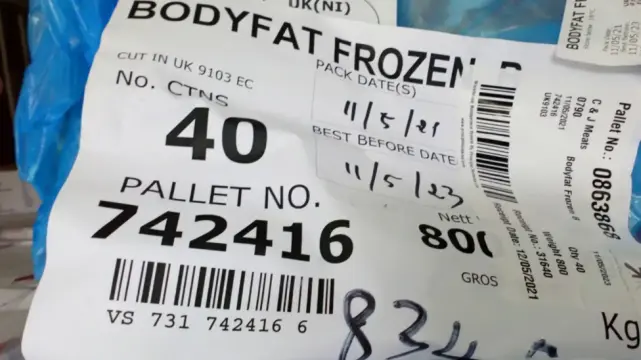
A pallet label for frozen body fat found during the inspection — invoices showed the firm bought large volumes of fat, skin and lower-grade products while selling kebabs labelled as lamb, the court heard (Image: Swansea Council)The results showed that products made by Kismet Kebabs did not match the meat content declared on their labels — and further samples bought from wholesalers confirmed the contents “differed significantly” from what the labels claimed.
What investigators went on to uncover was a sustained, UK-wide fraud. The court heard that products marketed and sold as lamb were found in many cases to contain little or no lamb — with skin, fat and other lower-grade ingredients used instead.
The company “routinely and knowingly” purchased goat, lamb fat, skin and mutton, the court heard, and once the material had been processed through its factory, sold it on as lamb.
In one example, a lamb doner kebab whose label claimed an 87 per cent lamb content was found to contain just 51 per cent meat of any kind — and 40 per cent fat.
After making enquiries with the National Food Crime Unit and the Food Standards Agency, a multi-agency team led by Swansea Council’s trading standards officers visited the company’s Chelmsford factory in May 2021.
Officers found no actual lamb on the premises — but significant quantities of lamb fat, skin, goat and mutton. Recipe cards showed very little lamb going into products labelled as lamb kebabs, and what entered the production line at one end did not correspond to the labels coming out at the other.
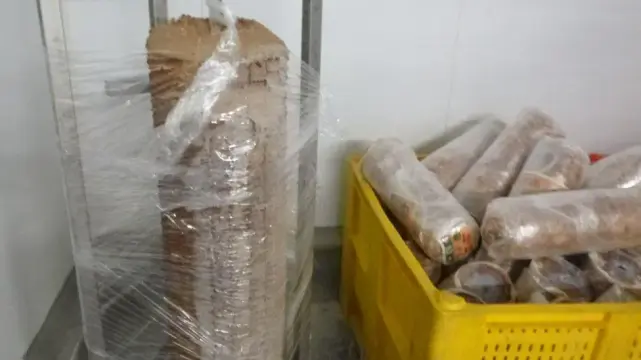
Produce recovered during the multi-agency visit — products that “cannot be called meat as per the legal definition” were being used, the court heard (Image: Swansea Council)Finished kebab rolls at the factory — products sold as lamb were found to contain a mix of other meats, skin and fat (Image: Swansea Council)The court also heard the company produced mechanically derived meat made up predominantly of neck trim, mutton trim, water and ice — which was then counted towards the declared meat content of its products.
It emerged that Essex County Council, the company’s local authority, had received complaints from councils around England about labelling and meat content — and had terminated its formal partnership with the firm over a lack of cooperation and “serious labelling and potential public health issues” found during a factory audit.
Prosecutors described the operation as “organised, planned, unlawful activity” that misled wholesalers, retailers and consumers across the UK — including in Swansea. Sentencing guidelines for a firm of Kismet’s size suggested a fine of between £15m and £24m, the court heard, but that was described as “wholly unrealistic” as it would inevitably put the company out of business.
Defending, the court was told the company — established in 2008 — accepted it had “taken its eye off the ball” at the time of the offending, that significant changes had since been made, and that little financial gain had resulted.
Judge Huw Rees said fraudulent activity had been “endemic” at the firm at the time, and that the company had engaged in “considerable dishonesty” over a prolonged period — while noting the steps taken since.
Inside the Kismet Kebabs factory in Chelmsford — officers found what entered the production line did not match the labels on the products leaving it (Image: Swansea Council)Rhys Harries, Swansea Council’s Trading Standards Team Leader, said: “We became aware of the actions of Kismet Kebabs when we carried out some city-wide analysis of food being offered to consumers in Swansea.
“Our investigations highlighted serious discrepancies with the food labelling of the product compared to the results of our analysis and prompted our follow-up actions against the food manufacturer.
“Consumers deserve to know that what’s going into the food they buy is what the label says it is.
“The £500,000 fine imposed by Swansea Crown Court, along with costs of £259,298.67, reflects the seriousness of the offending and follows the company’s guilty plea to the offences. We hope that the fine and costs serve as a deterrent to other businesses who might consider selling falsely-labelled food in this way.”
Related stories from Swansea Bay News
New data shows almost HALF of all UK cigarettes smoked pay no tax — with Swansea ranked among highest for illegal vape seizures
Trading Standards’ other front line — the illicit tobacco and vapes trade in the city.
DVLA FRAUD: Swansea insider jailed after doctoring car records in £1.3m scam
The insider fraud uncovered at the Swansea-based licensing agency.
SCHOOL TRANSPORT: Driver fined for carrying children on school run without taxi licence — despite earlier warning
Another enforcement case from the courts this week.


 Mediterranean Diet
 Dining and Cooking
 The-14
 GreenSupplyChain DIH
 Vietnamnet BOT


 DIVYA444