#FathomNet has a new Kaggle competition. we’re tackling one of the biggest challenges in computer vision for marine imagery: incomplete labels. Marine biologists are experts in specific animals so they only label what they know in each image. Consequently, annotators may carefully focus on jellyfish in a given image, while ignoring the dozen other creatures swimming by. Just because something isn't labeled doesn't mean it isn't there, and that's a serious problem for anyone trying to teach a computer to recognize all ocean life.

The FathomNet 2026 challenge addresses this real-world constraint by focusing on positive-unlabeled learning for object detection. More details at https://www.kaggle.com/competitions/fathomnet-2026

FathomNetCLEF2026 @ LifeCLEF & CVPR-FGVC

Positive-Unlabeled Object Detection in Marine Images

We've released a couple more visual event detection models, for deep-sea video and image analysis. There's 3 models, a benthic model (for marine organisms that live on the sea floor), a midwater model (for things that swim or drift), and a vulnerable marine ecosystems model (corals, crinoids, sponges, fish).

https://huggingface.co/collections/FathomNet/fathomnet-baseline-models-65ef353f440a5fc3d933d649

#machinelearning #FathomNet

FathomNet Baseline Models - a FathomNet Collection

The FathomNet baseline models are object detectors intended for a broad range of use cases, maintained and re-trained periodically by FathomNet.

We've published a new visual event detection model for vulnerable marine ecosystems based on #FathomNet data.

https://huggingface.co/FathomNet/vulnerable-marine-ecosystems

#machinelearning

Our paper on #FathomNet in Scientific Reports was selected as an editor's choice for World Ocean Day. https://www.nature.com/collections/hichfcjeec

#MachineLearning #MarineBiology #ComputerVision

Editor’s choice: World Oceans Day

This Collection highlights recent research in marine science, in recognition of World Oceans Day.

Nature

Join our #Kaggle competition to help improve #MachineLearning for #DeepSea images.

This competition is all about out-of-sample detection and could help scientists discover new animals and improve ecosystem management practices.

https://www.kaggle.com/competitions/fathomnet-out-of-sample-detection/overview

#FathomNet

FathomNet 2023

Shifting seas, shifting species: Out-of-sample detection in the deep ocean

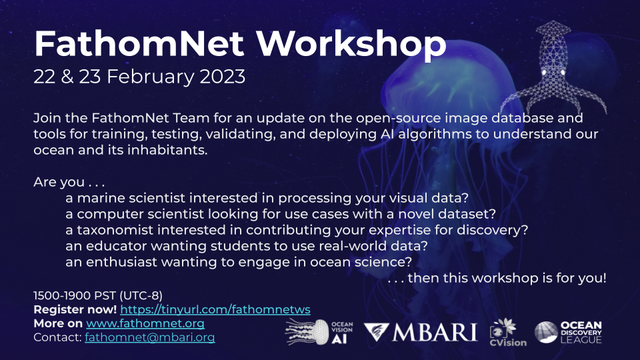
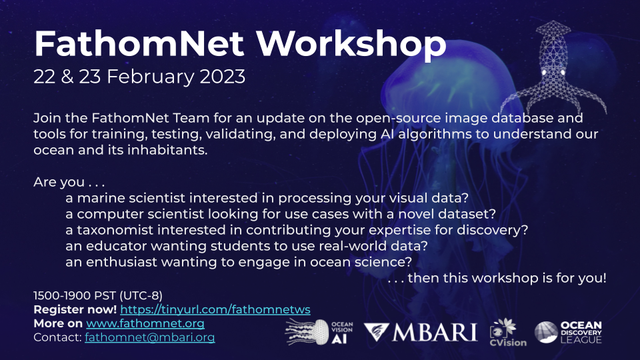
FathomNet Workshop
February 22 - 23, 2023
3:00 - 7:00 pm PST

Join the #FathomNet team for an update on the open-source image database and tools for training, testing, validating, and deploying AI algorithms to understand our ocean and its inhabitants. The workshop timing is also optimized for Pacific and Asian timezone participants.

Please register at http://tinyurl.com/fathomnetws

Welcome! You are invited to join a meeting: FathomNet Workshop. After registering, you will receive a confirmation email about joining the meeting.

FathomNet is an open-source image database that can be used to train, test, and validate state-of-the-art artificial intelligence algorithms to help us understand our ocean and its inhabitants (see recent article - https://www.nature.com/articles/s41598-022-19939-2) for more information. Join us for a 2-day workshop, including how you can contribute to and benefit from the FathomNet ecosystem, as well as how to get involved in the FathomNet community. When: February 22 and 23, 2023. 1500-1900 Pacific Time Registration is limited to 500 people. For more information: Web: http://fathomnet.org/ GitHub: https://github.com/fathomnet Medium: https://medium.com/fathomnet

Zoom

#FathomNet is a resource to help foster collaboration between the #MachineLearning and the #OceanScience communities.

We're working hard to aggregate expertly curated imaged data sets, sort of like ImageNet, but for the ocean. Our goal is to have amazing data sets that can be used by experts in #MachineLearning to help us, folks who are really good at identifying things in the ocean, but maybe less good at developing novel machine learning models, solve important science problems.

/2

I've been working on a team trying to tackle the problem of how to analyze the deluge of underwater video being collected. Why collect underwater video you ask? The reasons range from trying to answer foundational science questions, fisheries stock assessments, environmental surveys, etc. Specific examples include: How will deep sea mining affect the oceans? How will that offshore wind farm impact local ecosystem?

One tool that we've developed is #FathomNet (https://fathomnet.org)

/1

FathomNet

We're excited to announce the second #FathomNet online workshop, happening next February 22-23 from 1500-1900 PST (UTC-8). Please register at http://tinyurl.com/fathomnetws. We'll be sharing progress, exciting updates, and details on #OceanVisionAI. Looking forward to seeing you there!

#ocean #AI #ArtificialIntelligence #imaging #computervision #bigdata

Welcome! You are invited to join a meeting: FathomNet Workshop. After registering, you will receive a confirmation email about joining the meeting.

FathomNet is an open-source image database that can be used to train, test, and validate state-of-the-art artificial intelligence algorithms to help us understand our ocean and its inhabitants (see recent article - https://www.nature.com/articles/s41598-022-19939-2) for more information. Join us for a 2-day workshop, including how you can contribute to and benefit from the FathomNet ecosystem, as well as how to get involved in the FathomNet community. When: February 22 and 23, 2023. 1500-1900 Pacific Time Registration is limited to 500 people. For more information: Web: http://fathomnet.org/ GitHub: https://github.com/fathomnet Medium: https://medium.com/fathomnet

Zoom

One of the topics we think a lot about in #MBARI's #BioinspirationLab is how to scale observations of #ocean #life. This extends not only to data analysis pipelines for visual data but also how algorithms can help us achieve true autonomy with our #robotic platforms.

Thanks to #FathomNet (www.fathomnet.org), we now have vehicles that can search for #animals we want to study w/o human input #mltracking 

Check out a demonstration here: https://youtu.be/HMIELL0xErs.

FathomNet-trained ML-Tracking algorithm acquisition demonstration using MiniROV

YouTube