One surface of one glider wing has now been covered with mylar gap seal tape.

Tomorrow I will flip the wing over and apply gap seal tape to the other surface.

#AvGeek #Aviation #ElectricAircraft #Homebuilt #Glider #DIY #EAA #Fairing #Drag #Aerodynamics

Gliders often go to significant lengths to reduce drag.

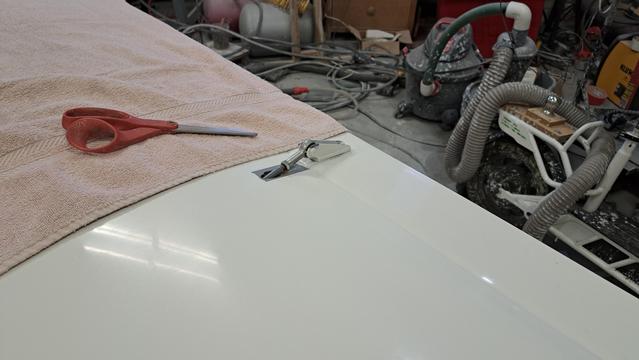
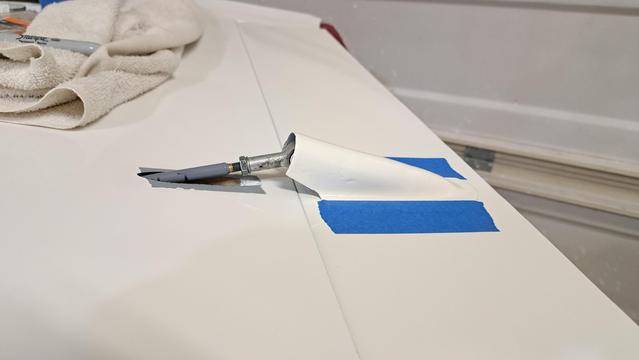
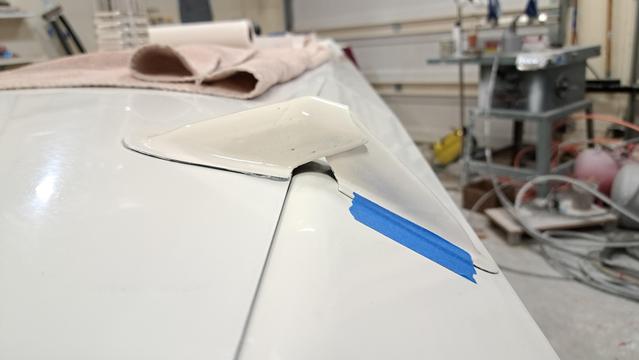
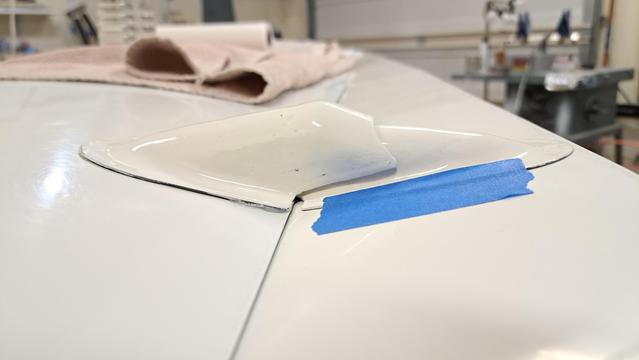
My flaperons are driven by a push-pull tube that exits the wing skin and pushes against an external drive horn. There are two of these setups on each wing...four external devices that need fairings.

But they and the flaperons move. That complicates things.

First photo shows one push-pull tube and drive horn without fairings.

Second photo shows the inner/smaller fairing that will eventually be glued into place.

Third photo shows both fairings in place and the flaperon near the limit of its down travel.

Fourth photo shows both fairings and the flaperon approaching the limit of its upward travel.

One fairing of the two pairs on one wing are drying overnight. Tomorrow morning, I will make final adjustments to the remaining inner fairings and then glue them in place.

I'm using RTV silicone, which needs humid air to cure well. It's winter in New Mexico and the air is super dry. I have put a very large pot of water on the wood stove to humidify the air overnight.

#AvGeek #Aviation #ElectricAircraft #Homebuilt #Glider #DIY #EAA #Fairing #Drag #Aerodynamics

"
SpaceX Hit with 2 New Lawsuits Alleging Retaliation Over Safety Concerns
"
"..facility in Texas recorded an injury rate of 4.27 per 100 workers last year—nearly triple the aerospace manufact. av. of 1.6. .. group tied to the west coast rocket fairing recovery ops, which have an even higher injury rate of 7.6 per 100 workers."

https://www.newsbreak.com/dmr-news-321522575/4152112616556-spacex-hit-with-two-new-lawsuits-alleging-retaliation-over-safety-concerns
2.8.2025

#Arbeitssicherheit #Arbeitsschutz #EmployeeWellBeing #fairing #firing #OccupationalSafety #OSHA #Raumfahrt #safety #SpaceFlight #SpaceX

SpaceX Hit with Two New Lawsuits Alleging Retaliation Over Safety Concerns - NewsBreak

Robert Markert, a longtime supervisor at SpaceX, claims he warned leadership that part of the rocket fairing recovery process posed serious safety risks th

NewsBreak

"
An unlikely suspect has emerged during the investigation into the technical issue that caused the first Australian-made rocket launch to be delayed.
"
https://www.news.com.au/technology/science/space/unlikely-suspect-caught-redhanded-over-failed-rocket-launch-in-bowen-qld/news-story/e489f5e9443d7209906d81e86a4498b0

(https://www.gspace.com/missions : "PS: No, it wasn’t the cockatoo.")

28.5.2025

#Australia #Australien #cockatoo #ERIS #fairing #GilmourSpace #Rakete #Raumfahrt #rocket #rocketry #SpaceFlight

Astra’s Frugal Design Leads To Latest Unusual Failure

We've all heard it said, and it bears repeating: getting to space is hard. But it actually gets even harder the smaller your booster is. That's because the structure, engines, avionics, and useful payload of a rocket only make up a tiny portion of its liftoff mass, while the rest is dedicated to the propellant it must expend to reach orbital velocity. That's why a Falcon 9 tipping the scales at 549,054 kilograms (1,207,920 pounds) can only loft a payload of 22,800 kg (50,265 lb) -- roughly 4% of its takeoff weight.

As you might imagine, there's a lower limit where there simply isn't enough mass in the equation for the hardware necessary to build a fully functional rocket. But where is that limit? That's precisely what aerospace newcomer Astra is trying to find out. Their Rocket 3 is among the smallest orbital boosters to ever fly, closer in size and mass to the German V2 of World War II than the towering vehicles being built by SpaceX or Blue Origin. Even the Rocket Lab Electron, itself an exceptionally svelte rocket, is considerably larger.

The reason they're trying to build such a small rocket is of course very simple: smaller means cheaper. Assuming you've got a payload light and compact enough to fit on their launcher, Astra says they can put it into orbit for roughly $2.5 million; less than half the cost of a dedicated flight aboard Rocket Lab's Electron, and competitive with SpaceX's "rideshare" program. Such a low ticket price would have been unfathomable a decade ago, and promises to shake up an already highly competitive commercial launch market. But naturally, Astra has to get the thing flying reliably before we can celebrate this new spaceflight milestone.

Their latest mission ended in a total loss of the vehicle and payload when the upper stage tumbled out of control roughly three minutes after an otherwise perfect liftoff from Cape Canaveral Space Force Station in Florida. Such issues aren't uncommon for a new orbital booster, and few rockets in history have entered regular service without a lost payload or two on the books. But this failure, broadcast live over the Internet, was something quite unusual: because of the unconventional design of Astra's diminutive rocket, the upper stage appeared to get stuck inside the booster after the payload fairing failed to open fully.

A Slight Second Stage

To understand this failure, we have to take a step back and look at the design of a conventional multi-stage rocket. While an oversimplification, it would be fair to say that the upper stage is generally just a smaller version of the first stage. It will be shorter in length, perhaps more narrow in diameter, and have fewer engines; but fundamentally its design will resemble that of its larger counterpart. The payload is mounted to the top of the upper stage, which in turn is enclosed by an aerodynamic fairing or nosecone.

The first and second stages of the Falcon 9, separated by the black interstage, are the same diameter.

But Astra's Rocket 3 is unique in that its second stage looks nothing like the first. Rather than a sleek rocket, its design is more reminiscent of a satellite; with exposed tanks and a skeletal structure that would never survive flight through the dense lower atmosphere. Since this stage will be traveling through the wispy upper atmosphere where drag isn't a concern, Astra decided to strip it down to the bare essentials to reduce its mass.

A rare look at the Rocket 3's satellite-like upper stage, partially tucked inside of the conical interstage.

The downside of this design is that the fragile upper stage must be covered until the rocket has gained considerable altitude. So rather than placing just the payload into a protective aerodynamic fairing, the entire second stage needs to be enclosed. The lower portion of the second stage is tucked into the hollow interstage, and an elongated fairing makes sure the payload and its ride to space aren't exposed to supersonic airflow in the early phases of flight.

Costly Compromise

The beauty of this design is that the material used to construct a payload fairing, usually carbon fiber or fiberglass, is exceptionally lightweight. Even taking into account the additional fairing length required, the overall weight ends up being lower than if the second stage had a more traditional rigid fuselage. That said, there's a glaring problem with this approach if you're looking to build the cheapest rocket possible: producing these lightweight payload fairings is very expensive.

Assembling Rocket 3's aluminum payload fairing.

In fact, in a 2020 interview with Ars Technica, Astra co-founder Chris Kemp admitted the astronomical cost of carbon fiber fairings forced the company to abandon them in favor of aluminum for Rocket 3. Rather than spending $250,000, Kemp said the team at Astra was able to produce them in-house for just $2,500. That's a huge cost savings for such a low-cost vehicle, but the trade-off is that the new metal fairings weigh 20% more than the originals.

The switch to heavier aluminum payload fairings means the mass savings of Astra's unique second stage design isn't quite as substantial as was originally intended. In practice this likely resulted in a hit to the total payload capacity of the vehicle, but it was still deemed the right call from a cost standpoint. But given this recent failure, perhaps the change had larger implications that are only now becoming apparent.

Getting Jammed Up

Looking at the live video from the February 11th launch, we can clearly see the chain of events that led to the upper stage losing control and ultimately failing to enter orbit. At almost exactly three minutes into the flight the payload fairing visibly shudders, but fails to open. Four seconds later the second stage, propelled forward by a spring-loaded mechanism, slams into the fairing but fails to knock it lose. Finally, at three minutes and eleven seconds into the mission, the second stage's engine ignites while still inside the interstage. This build up of pressure blows off the fairing, but unfortunately also destabilizes the second stage and sends it tumbling.

<https://hackaday.com/wp-content/uploads/2022/02/astrastage_video.mp4>

We can clearly see what happened, but the task for Astra is now to figure out why it happened. The Alameda, California based company is still working their way through an investigation with the Federal Aviation Administration (FAA), and as of yet haven't released any public statement as to why the payload fairing didn't open properly when commanded.

But that doesn't mean we can't speculate as armchair engineers. Could it be that the mechanism used to separate the payload fairing needs to be made stronger due to the added mass of the aluminum? One also wonders if the lighter carbon fiber payload fairings might have given way once the second stage smashed into them, potentially saving the mission. In any event, one thing is for sure: Astra's low-cost rocket seems to have a knack for failing in unusual ways.

#currentevents #featured #space #astra #commercialspace #fairing #falcon9 #payload #spacex

Astra’s Frugal Design Leads To Latest Unusual Failure

We’ve all heard it said, and it bears repeating: getting to space is hard. But it actually gets even harder the smaller your booster is. That’s because the structure, engines, avionics,…

Hackaday

SpaceX Drops the Ball on Catching Fairings

You don't have to look very hard to find another rousing success by SpaceX. It's a company defined by big and bold moves, and when something goes right, they make sure you know about it. From launching a Tesla into deep space to the captivating test flights of their next-generation Starship spacecraft, the private company has turned high-stakes aerospace research and development into a public event. A cult of personality has developed around SpaceX's outlandish CEO Elon Musk, and so long as he's at the helm, we can expect bigger and brighter spectacles as he directs the company towards its ultimate goal of putting humans on Mars.

Of course, things don't always go right for SpaceX. While setbacks are inevitable in aerospace, the company has had a few particularly embarrassing failures that could be directly attributed to their rapid development pace or even operational inexperience. A perfect example is the loss of the Israeli AMOS-6 satellite during a static fire of the Falcon 9's engines on the launch pad in 2016, as industry experts questioned why the spacecraft had even been mounted to the rocket before it had passed its pre-flight checks. Since that costly mistake, the company has waited until all engine tests have been completed before attaching the customer's payload.

SpaceX's concept art for propulsive landing

But sometimes the failure isn't so much a technical problem as an inability for the company to achieve their own lofty goals. Occasionally one of Musk's grand ideas ends up being too complex, dangerous, or expensive to put into practice. For instance, despite spending several years and untold amounts of money perfecting the technology involved, propulsive landings for the Crew Dragon were nixed before the idea could ever fully be tested. NASA was reportedly uncomfortable with what they saw as an unnecessary risk compared to the more traditional ocean splashdown under parachutes; it would have been an impressive sight to be sure, but it didn't offer a substantive benefit over the simpler approach.

A similar fate recently befell SpaceX's twin fairing recovery ships Ms. Tree and Ms. Chief , which were quietly retired in April. These vessels were designed to catch the Falcon's school bus sized payload fairings as they drifted down back to Earth using massive nets suspended over their decks, but in the end, the process turned out to be more difficult than expected. More importantly, it apparently wasn't even necessary in the first place.

Deadliest Catch

Credit where credit is due, both Ms. Tree and Ms. Chief did successfully catch fairings during their tenure with SpaceX. The ships proved the concept was viable, and on two missions in 2020, they even managed to capture both fairing halves. But taken as a whole, their success rate was quite poor. According to a tally from SpaceXFleet.com, of the 37 missions on which one or both ships attempted to recover the fairings, they only managed a total of nine catches. That's already a pretty bad average, but when you realize each mission actually has two fairings that needed to be caught, it's abysmal.

The low success rate is bad enough, but even when the ships actually nabbed one of the fairings in mid-air, it didn't always end well. During the October 18th, 2020 Starlink mission, the live video feed from Ms. Tree briefly showed a fairing ripping through the net and smashing down onto the deck. With each fairing half estimated to weigh approximately 950 kilograms (2094 pounds), having one break lose presents a clear danger to the crew and equipment aboard the recovery vessel, to say nothing of the fairing itself. After all, the goal is to recover them intact so they can be used on a subsequent flight.

Only a few seconds of low-resolution video were shown before SpaceX cut the stream.

It might seem odd that SpaceX had so much trouble catching these relatively large and docile objects as they drifted down to the surface under their parafoils, especially when compared to the fire and fury of the Falcon 9's first stage landing. Over the last three years SpaceX has managed to maintain a success rate of around 90% for booster recoveries at sea, and at least on the surface, it would seem both procedures are more alike than they are different.

But ultimately, it's a question of command authority. The active grid fins and thrust vectoring capabilities of the Falcon 9 make it far more maneuverable on descent than the steerable parafoils used by the fairings. Even with the recovery ship actively communicating with the fairing's own avionics and attempting to plot an intercept point, a strong gust of wind at the wrong moment was all it took to knock them off course.

Making a Splash

From the beginning, SpaceX believed that they'd need to catch the fairings with a net because allowing them to come into direct contact with salt water would damage them beyond the point of economical repair. While specific details are hard to come by publicly, it's widely believed that the concern stemmed not so much from the electronics onboard, which could presumably be waterproofed, but the unique construction of the fairings themselves. Made from an aluminum honeycomb structure sandwiched between layers of composite material, water intrusion could be a serious problem; as once salt water got inside the structure of the fairing itself, getting it back out quickly and economically might not be possible.

But in the face of a recovery program that seemed to be going nowhere, the engineers at SpaceX have apparently figured out a way to make it work. Closeup photographs of recently constructed fairings show that various vents and openings have been relocated so they'll be higher from the surface of the water, and rumor has it that the internal sound dampening panels are now considered a consumable and discarded after each mission rather than trying to dry them out. What, if any, steps were taken to prevent water from seeping into the fairing's aluminum/composite construction is currently unknown.

While the refurbishment process for these "wet" fairings is undoubtedly more costly and time consuming than if they had been caught in the net, the difference is evidently not enough to justify the continued operation of Ms. Tree and Ms. Chief. Instead, SpaceX has chartered the much larger Shelia Bordelon to take over as primary fairing recovery vessel. Intended for underwater research, the 78 m (256 ft) long ship features wide open decks, a built-in crane, and a Triton XLX remotely operated vehicle (ROV) that can dive down to 3,000 m (9,840 ft).

Shelia Bordelon unloading a fairing half. Photo by Kyle Montgomery.

The integrated crane makes it easier to pull fairings out of the water and drop them on the dock, but otherwise, this vessel doesn't seem particularly well suited to the task at hand. For one thing, its underwater capabilities are being completely squandered. But more importantly, the rapid launch cadence demanded by Starlink missions means that the recovery vessel should ideally be able to hold four fairing halves before returning to port. So either the Shelia Bordelon is going to be getting some modifications of its own soon, or SpaceX is only using it temporarily until they can come up with a long-term solution.

#engineering #featured #interest #space #fairing #falcon9 #ocean #recovery #spacex

SpaceX Drops The Ball On Catching Fairings

You don’t have to look very hard to find another rousing success by SpaceX. It’s a company defined by big and bold moves, and when something goes right, they make sure you know about it…

Hackaday
SpaceX tried to catch its rocket nose cone with a giant net — and just missed

Mr. Steven will do better next time