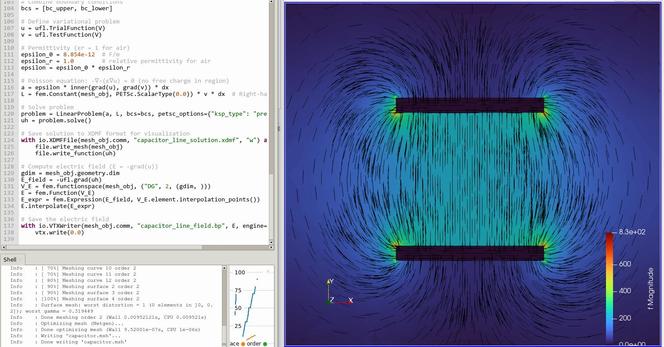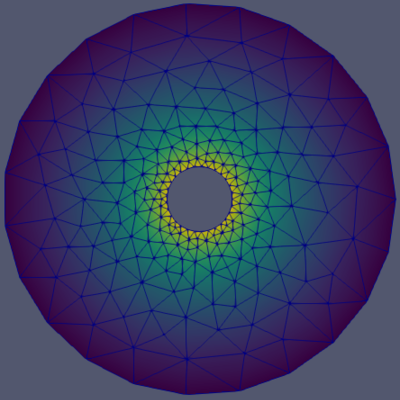
FEniCSx a great tool for FEM analysis. #fenics #fem

Woow, lo siento, no puedo evitar compartir este libro, tambén encontrado a través de https://www.oapen.org: Mathematical Modeling of the Human Brain, disponible con licencia libre #ccby https://library.oapen.org/handle/20.500.12657/53362

✅ Se estudian modelos 3-d del cerebro (EDP de tipo parabólico)
✅ Usan la biblioteca #FEniCS
👍 Se merece un buen vistazo para nuestro proyecto MAIN·Brain·Repair https://mainbrainrepair.github.io


Online library and publication platform

Mastodon #introduction: TuxRiders is a journey to research experiences using free and #opensource scientific computing programs, which aimed to demonstrate their power for real-world scientific research.

In our #YouTube channel, we regularly talk about #FiniteElement, #EngineeringMath, #PDEs, #NumericalMethods, #FreeFEM, #FEniCS, #ParaView, #C++, #Python, #OpenFOAM, and #Linux.

Check out our YT channel: https://www.youtube.com/TuxRiders

TuxRiders

Hi guys, TuxRiders is a journey to research experiences using free and open-source scientific computing programs, which aimed to demonstrate the power of open-source for real-world scientific research. In addition to this, we want to cover the underlying mathematics and computer science-related concepts to help you efficiently employ the discussed methods and techniques in mathematical and computational modeling projects. This will be achieved by various video series featuring different aspects of validated research projects in the field of computational science. These research works are (getting) published in the relevant scientific journals. GitHub ► https://github.com/TuxRiders Instructors: Mojtaba Barzegari ► https://mbarzegary.github.io ► https://twitter.com/MojBarz ► https://github.com/mbarzegary

YouTube

Hello there! #introduction

I am a postdoc at Université Laval in Québec working in collaboration with Michelin. My current work is about #ErrorEstimation for #FiniteElements methods. More precisely, I am working on gradient reconstruction for multimaterial problems.

I am also a #fenics user and I am interested in #NonLocalModels and more precisely in the error estimation in the finite element discretization of fractional partial differential equations.
#WelcometoMastodon
#WelcometoMathstodon

Finally made my 2D magnet post. In this example I do a simple demonstration of finding a magnetic field from a coax, and verify the result with an analytical solution. I then use the same method to find the field inside a dipole magnet of the type used at the LHC; a cos(phi) magnet. https://comphysblog.wordpress.com/2020/08/19/2d-magnetostatics-cos%cf%86-dipole-magnet/

#fenics #physics #finite_element_analysis

2D Magnetostatics – cos(φ) Dipole Magnet

Physics & Computers

Just made a short post about how to simulate electrostatic nonuniform charge density distributions with FEniCS; that is spatially varying charge density distributions. This could be useful for simulating things like particle beams which are commonly assumed to have Gaussian (or similar) distributions. This is a small extension of a previous post about how to simulate uniform charge density distributions.

https://wordpress.com/post/comphysblog.wordpress.com/988

#fenics #physics #opensource #python #ham

WordPress.com

My latest post is about using boundary conditions to assume symmetry in a finite element electrostatics problem.

To demonstrate Neumann boundaries I solve the Laplace equation for a coaxial geometry using 1/4 of the cross section. I then find the fields of a differential pair transmission line using half the cross section and a Dirichlet boundary.

This is all done with FEniCS, the open source finite element solver. #physics #python #opensource #ham #radio#fenics

https://comphysblog.wordpress.com/2019/07/15/assuming-symmetry-with-boundary-conditions/​​

Finally finished my post on electrostatics with linear dielectrics using the open source finite element solver FEniCS. It's surprisingly easy!

#physics, #rf, #opensource, #python, #fenics

https://comphysblog.wordpress.com/2019/01/12/electrostatics-with-linear-dielectric-materials-using-fenics/

After a couple of months without a new post I've started writing about simulating charge distributions, rather than just boundary value problems. I'll explain how #FEniCS can calculate the electrostatic fields of arbitrarily shaped charge densities, which are specified with mesh subdomains. These will have hard edges for now but I want to look into having more general charge distributions.

I've also run 3D simulations for calculating capacitances between arbitrarily shaped conductors and 2D linear dielectrics. I need to do some more testing & comparison with other FEA tools/ analytical methods before I publish any posts. Seems to be going well though!

Small update to the TEM mode analysis with #FEniCS example.

I've added in a calculation for the mutual capacitance and self-inductance per unit length of the transmission line.

https://comphysblog.wordpress.com/2018/09/06/tem-mode-analysis-with-fenics/

#opensource #physics #python #ham

TEM Mode Analysis with FEniCS

Physics & Computers