 Kevin Moerman 🔓🦿
Interesting paper by @jedbrown et al.
https://doi.org/10.48550/arXiv.2401.13196
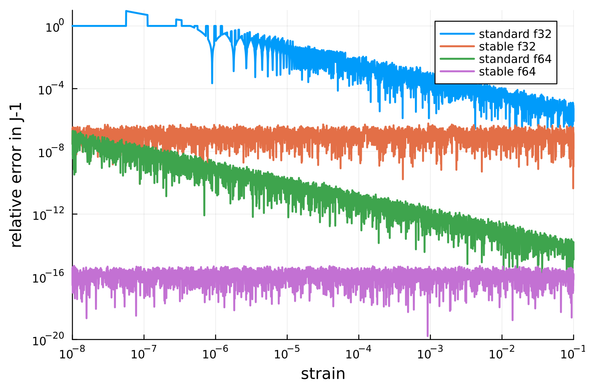
For computational mechanics/physics, if you code by just punching in the equations from the textbooks directly, the physics should work, but computationally the way you evaluate the quantities may be unstable. This paper lists some recipes to avoid these.
Mostly small strain problem, but still feels icky to leave in.

Stable numerics for finite-strain elasticity
A backward stable numerical calculation of a function with condition number $κ$ will have a relative accuracy of $κε_{\text{machine}}$. Standard formulations and software implementations of finite-strain elastic materials models make use of the deformation gradient $\boldsymbol F = I + \partial \boldsymbol u/\partial \boldsymbol X$ and Cauchy-Green tensors. These formulations are not numerically stable, leading to loss of several digits of accuracy when used in the small strain regime, and often precluding the use of single precision floating point arithmetic. We trace the source of this instability to specific points of numerical cancellation, interpretable as ill-conditioned steps. We show how to compute various strain measures in a stable way and how to transform common constitutive models to their stable representations, formulated in either initial or current configuration. The stable formulations all provide accuracy of order $ε_{\text{machine}}$. In many cases, the stable formulations have elegant representations in terms of appropriate strain measures and offer geometric intuition that is lacking in their standard representation. We show that algorithmic differentiation can stably compute stresses so long as the strain energy is expressed stably, and give principles for stable computation that can be applied to inelastic materials.
