My 25 years of palaeoart chronology...

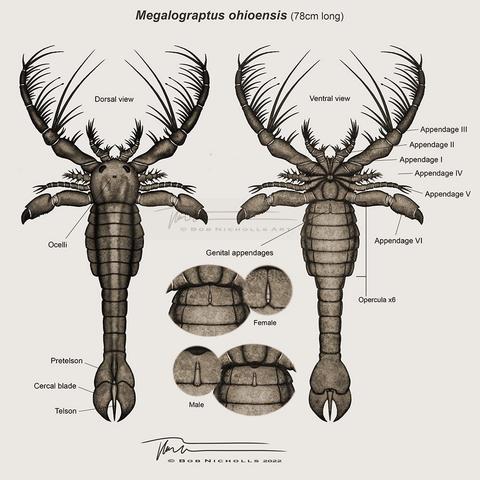
Here's a cheat sheet for Megalograptus, commissioned in 2022 for a project I cannot talk about yet. The scientific consultant was Fiann Smithwick.

#Art #Painting #PaleoArt #PalaeoArt #SciArt #SciComm #DigitalArt #Illustration #Dinosaurs #Reptiles #Palaeontology #Paleontology #Megalograptus #Eurypterid #Eurypterids #SeaScorpions #FossilFriday

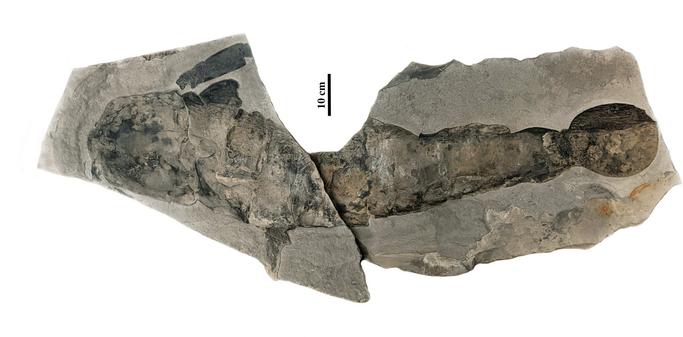
#Eurypterids, often informally called sea scorpions, are a group of extinct arthropods that form the order Eurypterida. The earliest known eurypterids date to the Darriwilian stage of the Ordovician period 467.3 million years ago. The

Findings reveal #eurypterids evolved giant size independently at least nine times https://phys.org/news/2024-08-reveal-eurypterids-evolved-giant-size.html

#ConvergentEvolution of giant size in eurypterids https://royalsocietypublishing.org/doi/10.1098/rspb.2024.1184

#SeaScorpions, ancient predators that patrolled Earth's marine and freshwater habitats hundreds of millions of years ago, are the focus of a sizable scientific mystery... the #evolution of giant size in eurypterids was rapid, and in some instances giant species evolved among much smaller relatives.

Findings reveal eurypterids evolved giant size independently at least nine times

Sea scorpions, ancient predators that patrolled Earth's marine and freshwater habitats hundreds of millions of years ago, are the focus of a sizable scientific mystery.

Phys.org

#NewPaper #Paleontology #Eurypterids #Biomechanics

Bicknell RDC, Simone Y, van der Meijden A, Wroe S, Edgecombe GD, Paterson JR. 2022. Biomechanical analyses of pterygotid sea scorpion chelicerae uncover predatory specialisation within eurypterids. PeerJ 10:e14515 https://doi.org/10.7717/peerj.14515

Biomechanical analyses of pterygotid sea scorpion chelicerae uncover predatory specialisation within eurypterids

Eurypterids (sea scorpions) are extinct aquatic chelicerates. Within this group, members of Pterygotidae represent some of the largest known marine arthropods. Representatives of this family all have hypertrophied, anteriorly-directed chelicerae and are commonly considered Silurian and Devonian apex predators. Despite a long history of research interest in these appendages, pterygotids have been subject to limited biomechanical investigation. Here, we present finite element analysis (FEA) models of four different pterygotid chelicerae—those of Acutiramus bohemicus, Erettopterus bilobus, Jaekelopterus rhenaniae, and Pterygotus anglicus—informed through muscle data and finite element models (FEMs) of chelae from 16 extant scorpion taxa. We find that Er. bilobus and Pt. anglicus have comparable stress patterns to modern scorpions, suggesting a generalised diet that probably included other eurypterids and, in the Devonian species, armoured fishes, as indicated by co-occurring fauna. Acutiramus bohemicus is markedly different, with the stress being concentrated in the proximal free ramus and the serrated denticles. This indicates a morphology better suited for targeting softer prey. Jaekelopterus rhenaniae exhibits much lower stress across the entire model. This, combined with an extremely large body size, suggests that the species likely fed on larger and harder prey, including heavily armoured fishes. The range of cheliceral morphologies and stress patterns within Pterygotidae demonstrate that members of this family had variable diets, with only the most derived species likely to feed on armoured prey, such as placoderms. Indeed, increased sizes of these forms throughout the mid-Palaeozoic may represent an ‘arms race’ between eurypterids and armoured fishes, with Devonian pterygotids adapting to the rapid diversification of placoderms.

PeerJ
Biomechanical analyses of pterygotid sea scorpion chelicerae uncover predatory specialisation within eurypterids

Eurypterids (sea scorpions) are extinct aquatic chelicerates. Within this group, members of Pterygotidae represent some of the largest known marine arthropods. Representatives of this family all have hypertrophied, anteriorly-directed chelicerae and are commonly considered Silurian and Devonian apex predators. Despite a long history of research interest in these appendages, pterygotids have been subject to limited biomechanical investigation. Here, we present finite element analysis (FEA) models of four different pterygotid chelicerae—those of Acutiramus bohemicus, Erettopterus bilobus, Jaekelopterus rhenaniae, and Pterygotus anglicus—informed through muscle data and finite element models (FEMs) of chelae from 16 extant scorpion taxa. We find that Er. bilobus and Pt. anglicus have comparable stress patterns to modern scorpions, suggesting a generalised diet that probably included other eurypterids and, in the Devonian species, armoured fishes, as indicated by co-occurring fauna. Acutiramus bohemicus is markedly different, with the stress being concentrated in the proximal free ramus and the serrated denticles. This indicates a morphology better suited for targeting softer prey. Jaekelopterus rhenaniae exhibits much lower stress across the entire model. This, combined with an extremely large body size, suggests that the species likely fed on larger and harder prey, including heavily armoured fishes. The range of cheliceral morphologies and stress patterns within Pterygotidae demonstrate that members of this family had variable diets, with only the most derived species likely to feed on armoured prey, such as placoderms. Indeed, increased sizes of these forms throughout the mid-Palaeozoic may represent an ‘arms race’ between eurypterids and armoured fishes, with Devonian pterygotids adapting to the rapid diversification of placoderms.

PeerJ
#paleontology #fossils #Silurian #arthropods #SeaScorpions An article published in the journal "Science Bulletin" reports the identification of Terropterus xiushanensis, a species belonging to the order of the #eurypterids (Eurypterida),
https://english.netmassimo.com/2021/10/15/terropterus-xiushanensis-is-the-first-sea-scorpion-discovered-in-china/
Terropterus xiushanensis is the first sea scorpion discovered in China

An article published in the journal 'Science Bulletin' reports the identification of Terropterus xiushanensis, a species belonging to the order of the...

NetMassimo Blog