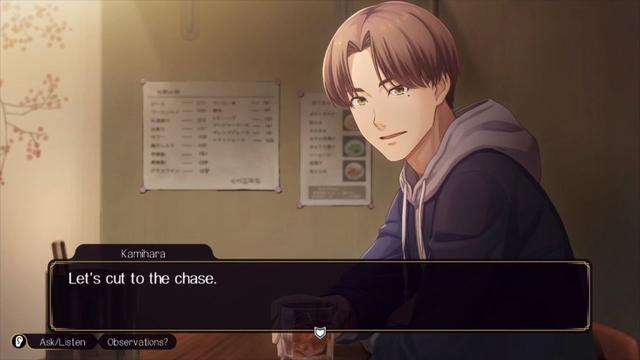
@PanNindyk dla mnie zaskoczeniem był Emio The Smiling Man. Tytuł prawie przeszedł mi koło nosa, przez reklamowanie go jako "pierwszy horror od Nintendo", a okazał się być bardzo fajną visual novelą kryminalną. To właściwie był pierwszy "duży" tytuł który skończyłem na pstryku, do tej pory raczej grałem w "popierdółki". Tymczasem Emio pokazał mi, że Switch świetnie nadaje się do gier VN - Emio w trybie zadokowanym działało świetnie.

Bezwstydnie pochwalę się, że pozwoliłem sobie również zrecenzować #Emio na łamach @pograneeu 👇🏻

https://pograne.eu/emio-the-smiling-man-famicom-detective-club-recenzja-switch/

@switchbuddy @nemecek_f

Emio – The Smiling Man (Famicom Detective Club) – recenzja | Pograne

Emio – The Smiling Man to ciekawa powieść wizualna o dwójce młodych detektywów, którzy poszukują seryjnego zabójcy.

Pograne
Emio – The Smiling Man (Famicom Detective Club) – recenzja | Pograne

Emio – The Smiling Man to ciekawa powieść wizualna o dwójce młodych detektywów, którzy poszukują seryjnego zabójcy.

Pograne

Review – Emio – The Smiling Man: Famicom Detective Club

Reviewed on: Nintendo Switch
Developed by: Nintendo
Published by: Nintendo
Release Date: 29 August 2024
Code Provided by Nintendo

Emio – The Smiling Man: Famicom Detective Club is a new entry in a series that its fanbase had long presumed dead. It’s the first new entry in 35 years and follows the first and second instalments of the series, yet does not require prior knowledge when picking up this title. Visual novels have come a long way since the original titles came to fruition, can Emio – The Smiling Man: Famicom Detective Club revive a long, almost lost legacy?

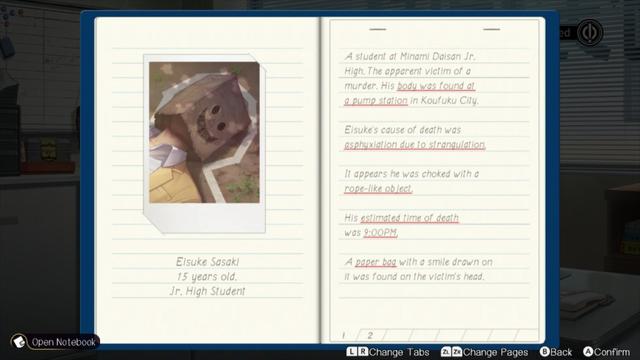
Emio – The Smiling Man: Famicom Detective Club is a narrative-heavy game, first and foremost because it’s a visual novel. The story opens with the discover of Eisuke Sasaki’s body. A young school student wearing a paper bag on his head, designed with a smiley face and marks on his neck. The murder strongly resembles a string of serial killings eighteen years prior, and thus begins the investigation into Emio, The Smiling Man.

Passion bleeds through the story telling of this visual novel. It’s easy to see how much dedication this title received from its development team as a whole. Like any good detective thriller, there are breadcrumbs to follow throughout the story, leading you to suspect just about everyone and anyone who’s path you cross. But a good story is nothing without compelling characters, each with distinct and real personalities. By the end of the game, they feel like real people you know. The game starts by tickling your mind with wild theories, but by the end it grabs your soul as you feel emotionally connected to the cast.

Obviously a visual novel requires a lot of reading, it’s in the name. But for those who prefer a more relaxed experience or dislike the strain of reading for too long, they might want some voice acting in a game like this. There is voice acting throughout, however it is entirely in Japanese.

For the most part, I can’t criticise any of the story-telling. Almost each and every scene is as important as the next as the narrative evolves deeper into conspiracies and suspicions. There is the occasional scene which feels like a filler, or padding. But really they are opportunities to get to know the characters better, and to immerse yourself into the world of Famicom Detective Club.

As a traditional visual novel, there isn’t a lot of gameplay to digest and discuss, but Emio – The Smiling Man does a few things to make the player engage with the game, rather than just sit and read away.

As you work your way through conversations in this game, there’s a menu with a variety of prompts to select from. In order to progress to the next scene, or the next crucial part of the conversation, it’s up to the player to select the right option, such as to press the subject for more answers, or show them something to trigger their memory. Sometimes it’s guess work, other times it’s more obvious about what you have to do, especially when a new option becomes available. It’s not the most exciting mechanic in any game, but there is a sense of reward as you progress through conversations and discover something to make the game tick forward.

Don’t go into this expecting interactivity on the same level as something like Pheonix Wright. Although they both sit firmly in the same genre, the Famicom Detective Club series takes a more relaxed approach. There isn’t really any way to fail this game. At the end of most chapters, or during certain scenarios, you “review” what you’ve learned so far for that given day. It usually takes as a conversation between you and your partner, Ayumi Tachibana. If you get the prompt wrong, there’s no penalty, other than watching your character go through the sheer embarrassment of being a pretty poor detective at times.

I did find that, despite the compelling nature of the narrative, the lack of interactivity in the gameplay made me not want to binge this game. Maybe for the better, as I looked forward to my evening dose of Emio. I would progress a chapter or two and feel like it was enough. I didn’t want to rush through the game and complete chapter after chapter every night. I just wanted to enjoy the experience in bite-sized portions while tucking in to a piping hot cup of tea and seeing that part of the day out.

As a visual novel, both the art-direction and OST play a vital part in setting the scene and creating ambience surrounding the words the player reads. Emio – The Smiling Man does just that, with beautiful anime-style scenes, animations and sound effects that capture the essence of the moment within the story.

Being a visual novel, there’s not an awful lot to discuss with the controls. Mainly you will be pressing “A” to progress the text, while using directional inputs to select your options. Despite there only being a small set of controls, I had one very minor criticism.

When using the “Look” function, which requires the user to move a magnifying glass across the screen and identify a subject, the scroll is slow. There’s no way to speed up the sensitivity or the movement, so this can feel sluggish when it’s used.

Emio – The Smiling Man: Famicom Detective Club is no doubt one of the best games I’ve played this year. It made me fall in love again with visual novels and reminded me of not only how good they can be, but how they rightly deserve a place in the gaming world. This is the perfect game to settle down with a cup of tea, turn the lights low and watch the evening go by as you progress a chapter or two.

5 out of 5 – Excellent

Rating: 9 out of 5.

#Emio #FamicomDetectiveClub #Gaming #Nintendo #NintendoSwitch #TheSmilingMan #videoGames #VisualNovel #WhoIsEmio_

Overall I really really enjoyed it. Just to be clear, it's absolutely not a horror game, but a solid and concise traditional detective short story. It's oddly refreshing to have something so hearty and so conventional, considering all the major mystery titles in the past decade were triple time travelling body swapping space alien cyborg spirit summoning global conspiracy theories. Sure, I loved my Zero Escapes and Danganronpas, but it's just nice to have something that's more grounded, almost like a subversion to what's default. I agonised to decide whether I'd file it under 本格派/ほんかくは/Honkaku or 変格派/へんかくは/Henkaku, in the end I thought it's probably a Honkaku Lite that's done pretty well.

What it stood out to me, is whoever wrote the script clearly lived a real life. I love the initial fallout between the Kuze siblings made so much sense in child mindset: adults would find someone picked their grown flower kinda irritating, though it's probably not even going to affect the crops. For children, the same thing means the sky had fallen. And I found the section involving the teenagers were particularly well layered: the adults can't stop being patronising to the teens, while the teens were addressing their own issues in their own ways. And for Shoko, to flatly state that children from abusive households want to distant from their surnames, I've never seen fictions flatly stating this fact like the commonsense it really is.

Say, in terms of gathering information. This is going to be a bit of marmite, essentially you have to ask a person the same thing like three times before you get the full info. Not usually done in visual novels, but as anyone who suffered the whole "would you like salad or chips" and get a "yes" as reply, yes this is the most accurate human interaction simulator.

The protagonist is unusually young, normally I just figured hey it's a video game they can't have anyone old enough to hit two decades unless it's like, a white stubbly guy who abuses everyone around him but love to pretend to be the victim. But later on it really shows that the protagonist's youngness is part of the narrative. He's relatively competent, but lots of nuances flatly whoosh over him, or in some instances he intuitively felt something was off but lacked the self assurance to comment on, mate knock it off that's fucked.

I'm just glad the protagonist is mostly a hired investigator. My least favourite subgenre is the protagonist's own sob story overtakes the main mystery. There are situations where it works, chances are whoever thinks they can make it work couldn't.

With the disclaimer that I think the writers have very clear understanding on what are "off" behaviours, and what are "off" behaviours that the protagonist failed to fully recognise, let me tell you how much I detest Tsubasa Fukuyama and Daisuke Kamihara. The idea of being trapped to work with Daisuke the Serial Sexual Harasser is bad enough, he's actually more bearable than Tsubasa Fukuyama.

I get that Tsubasa Fukuyama is only 23, but even taking into account of his age, the way he completed treats every social situation as soapbox on how altruistic and caring and selfless and virtuous he is just makes me think he's basically a Well Actually As A Nice Guy. My most generous reading of him is he's an emotional truffle pig. Even then, as a teacher he pretty much mishandled every single issues possible, then still had the audacity of turning the whole thing all about how he feels. Also he's so sleazy, to the point that even the protagonist was creeped out by his grossness toward Ayumi. I'm just mad that I don't have an option of telling him as Ayumi, please quit teaching and get therapy. Or, don't. He comes across as someone who'd use therapy speak to further fuel his self-obsessiveness.

Kuze is a hot mess through and through, it's pretty much implied right from the beginning. I'm sure she resigned instead of being removed and asked to literally never hold a position of trust ever again. Probably for the best.

The Minoru route went a little more in-depth about domestic violence. There are various social systems, it takes a village to raise a child, or formalised child protection service. Both were still deeply ingrained in the mindset that children are the properties of their parents. The village knew something was wrong, but the social awkwardness of confronting an abuser is deemed as less acceptable than preventing a property's death. As for the child protection service, Ayaka knew it was about look like they were doing something then just to return the property to sender. It's not inaccurate to reality.

This is the strength and the weakness of this game. It's half social realism that approaches 社会派/しゃかいは/shakai, half body-horror boogieman, so a lot of the time I don't know how seriously I'm expected to take a scene. Is it meant to be serious? Is it meant to be gaudy? Much like early Richard Gadd anti-comedy, even if it's international it makes the serious subject matter difficult to gauge. It's not quite mood whiplash, it's literally I don't know what's expected for the audience to react, and in here it's more a bug than feature. Like when it hard fixated on sure Kuze slashed up the smiling man in the back while being strangled on the front (???), which felt really really out of place given the game's own brand is about tight coherent logic. Then there's the prolonged amnesia plotline, one so absurd that even the first writer 27 years ago hated it. However, I do like the resolution of Eisuke's death, one that makes most sense given the clues within the game.

I do like how it has some complete banal moments, like the protagonist just don't seem to know how to charge his phone. Come to think about it, whatever happened to that huge bag of eggplants?

#Emio #EmioTheSmilingMan #visualnovel

Análisis #Emio – El Sonriente: Famicom Detective Club - Nintendo Switch. Misterios ocultos en bolsas de papel. LEER MÁS: https://www.nextn.es/2024/09/analisis-emio-el-sonriente-famicom-detective-club-nintendo-switch/

Nintendo kehrt mit einem packenden neuen Titel ins Famicom Detective Club Universum zurück #Emio #Nintendo

https://dailygame.at/emio-der-laechelnde-mann-switch-game-review/

Emio – Der lächelnde Mann (Switch) - Game Review

Tauchen Sie ein in die düstere Welt von Emio - Der lächelnde Mann. Löse den mysteriösen Fall eines Killers, der es auf Teenager abgesehen hat. Ein Detektiv-Thriller für die Nintendo Switch.

DailyGame

Reviewed on: Nintendo Switch (System Exclusive)
Developed by: Nintendo
Published by: Nintendo
Release Date: 29 August 2024
Code Provided by Nintendo

Emio – The Smiling Man: Famicom Detective Club is a new entry in a series that its fanbase had long presumed dead. It’s the first new entry in 35 years and follows the first and second instalments of the series, yet does not require prior knowledge when picking up this title. Visual novels have come a long way since the original titles came to fruition, can Emio – The Smiling Man: Famicom Detective Club revive a long, almost lost legacy?

Narrative

Emio – The Smiling Man: Famicom Detective Club is a narrative-heavy game, first and foremost because it’s a visual novel. The story opens with the discover of Eisuke Sasaki’s body. A young school student wearing a paper bag on his head, designed with a smiley face and marks on his neck. The murder strongly resembles a string of serial killings eighteen years prior, and thus begins the investigation into Emio, The Smiling Man.

Passion bleeds through the story telling of this visual novel. It’s easy to see how much dedication this title received from its development team as a whole. Like any good detective thriller, there are breadcrumbs to follow throughout the story, leading you to suspect just about everyone and anyone who’s path you cross. But a good story is nothing without compelling characters, each with distinct and real personalities. By the end of the game, they feel like real people you know. The game starts by tickling your mind with wild theories, but by the end it grabs your soul as you feel emotionally connected to the cast.

Obviously a visual novel requires a lot of reading, it’s in the name. But for those who prefer a more relaxed experience or dislike the strain of reading for too long, they might want some voice acting in a game like this. There is voice acting throughout, however it is entirely in Japanese.

For the most part, I can’t criticise any of the story-telling. Almost each and every scene is as important as the next as the narrative evolves deeper into conspiracies and suspicions. There is the occasional scene which feels like a filler, or padding. But really they are opportunities to get to know the characters better, and to immerse yourself into the world of Famicom Detective Club.

Gameplay

As a traditional visual novel, there isn’t a lot of gameplay to digest and discuss, but Emio – The Smiling Man does a few things to make the player engage with the game, rather than just sit and read away.

As you work your way through conversations in this game, there’s a menu with a variety of prompts to select from. In order to progress to the next scene, or the next crucial part of the conversation, it’s up to the player to select the right option, such as to press the subject for more answers, or show them something to trigger their memory. Sometimes it’s guess work, other times it’s more obvious about what you have to do, especially when a new option becomes available. It’s not the most exciting mechanic in any game, but there is a sense of reward as you progress through conversations and discover something to make the game tick forward.

Don’t go into this expecting interactivity on the same level as something like Pheonix Wright. Although they both sit firmly in the same genre, the Famicom Detective Club series takes a more relaxed approach. There isn’t really any way to fail this game. At the end of most chapters, or during certain scenarios, you “review” what you’ve learned so far for that given day. It usually takes as a conversation between you and your partner, Ayumi Tachibana. If you get the prompt wrong, there’s no penalty, other than watching your character go through the sheer embarrassment of being a pretty poor detective at times.

I did find that, despite the compelling nature of the narrative, the lack of interactivity in the gameplay made me not want to binge this game. Maybe for the better, as I looked forward to my evening dose of Emio. I would progress a chapter or two and feel like it was enough. I didn’t want to rush through the game and complete chapter after chapter every night. I just wanted to enjoy the experience in bite-sized portions while tucking in to a piping hot cup of tea and seeing that part of the day out.

Visuals and Audio

As a visual novel, both the art-direction and OST play a vital part in setting the scene and creating ambience surrounding the words the player reads. Emio – The Smiling Man does just that, with beautiful anime-style scenes, animations and sound effects that capture the essence of the moment within the story.

Controls

Being a visual novel, there’s not an awful lot to discuss with the controls. Mainly you will be pressing “A” to progress the text, while using directional inputs to select your options. Despite there only being a small set of controls, I had one very minor criticism.

When using the “Look” function, which requires the user to move a magnifying glass across the screen and identify a subject, the scroll is slow. There’s no way to speed up the sensitivity or the movement, so this can feel sluggish when it’s used.

Summary

Emio – The Smiling Man: Famicom Detective Club is no doubt one of the best games I’ve played this year. It made me fall in love again with visual novels and reminded me of not only how good they can be, but how they rightly deserve a place in the gaming world. This is the perfect game to settle down with a cup of tea, turn the lights low and watch the evening go by as you progress a chapter or two.

9 out of 10

Rating: 9 out of 10.

https://everyonesarcade.com/2024/09/09/review-emio-the-smiling-man-famicom-detective-club/

#Emio #FamicomDetectiveClub #Nintendo #NintendoSwitch #TheSmilingMan #VisualNovel #WhoIsEmio_

Review – Emio – The Smiling Man: Famicom Detective Club

Emio – The Smiling Man: Famicom Detective Club is a thrilling visual novel that re-ignited my love for the genre.

Everyone’s Arcade

Reviewed on: Nintendo Switch
Developed by: Nintendo
Published by: Nintendo
Release Date: 29 August 2024
Code Provided by Nintendo

Emio – The Smiling Man: Famicom Detective Club is a new entry in a series that its fanbase had long presumed dead. It’s the first new entry in 35 years and follows the first and second instalments of the series, yet does not require prior knowledge when picking up this title. Visual novels have come a long way since the original titles came to fruition, can Emio – The Smiling Man: Famicom Detective Club revive a long, almost lost legacy?

Narrative

Emio – The Smiling Man: Famicom Detective Club is a narrative-heavy game, first and foremost because it’s a visual novel. The story opens with the discover of Eisuke Sasaki’s body. A young school student wearing a paper bag on his head, designed with a smiley face and marks on his neck. The murder strongly resembles a string of serial killings eighteen years prior, and thus begins the investigation into Emio, The Smiling Man.

Passion bleeds through the story telling of this visual novel. It’s easy to see how much dedication this title received from its development team as a whole. Like any good detective thriller, there are breadcrumbs to follow throughout the story, leading you to suspect just about everyone and anyone who’s path you cross. But a good story is nothing without compelling characters, each with distinct and real personalities. By the end of the game, they feel like real people you know. The game starts by tickling your mind with wild theories, but by the end it grabs your soul as you feel emotionally connected to the cast.

Obviously a visual novel requires a lot of reading, it’s in the name. But for those who prefer a more relaxed experience or dislike the strain of reading for too long, they might want some voice acting in a game like this. There is voice acting throughout, however it is entirely in Japanese.

For the most part, I can’t criticise any of the story-telling. Almost each and every scene is as important as the next as the narrative evolves deeper into conspiracies and suspicions. There is the occasional scene which feels like a filler, or padding. But really they are opportunities to get to know the characters better, and to immerse yourself into the world of Famicom Detective Club.

Gameplay

As a traditional visual novel, there isn’t a lot of gameplay to digest and discuss, but Emio – The Smiling Man does a few things to make the player engage with the game, rather than just sit and read away.

As you work your way through conversations in this game, there’s a menu with a variety of prompts to select from. In order to progress to the next scene, or the next crucial part of the conversation, it’s up to the player to select the right option, such as to press the subject for more answers, or show them something to trigger their memory. Sometimes it’s guess work, other times it’s more obvious about what you have to do, especially when a new option becomes available. It’s not the most exciting mechanic in any game, but there is a sense of reward as you progress through conversations and discover something to make the game tick forward.

Don’t go into this expecting interactivity on the same level as something like Pheonix Wright. Although they both sit firmly in the same genre, the Famicom Detective Club series takes a more relaxed approach. There isn’t really any way to fail this game. At the end of most chapters, or during certain scenarios, you “review” what you’ve learned so far for that given day. It usually takes as a conversation between you and your partner, Ayumi Tachibana. If you get the prompt wrong, there’s no penalty, other than watching your character go through the sheer embarrassment of being a pretty poor detective at times.

I did find that, despite the compelling nature of the narrative, the lack of interactivity in the gameplay made me not want to binge this game. Maybe for the better, as I looked forward to my evening dose of Emio. I would progress a chapter or two and feel like it was enough. I didn’t want to rush through the game and complete chapter after chapter every night. I just wanted to enjoy the experience in bite-sized portions while tucking in to a piping hot cup of tea and seeing that part of the day out.

Visuals and Audio

As a visual novel, both the art-direction and OST play a vital part in setting the scene and creating ambience surrounding the words the player reads. Emio – The Smiling Man does just that, with beautiful anime-style scenes, animations and sound effects that capture the essence of the moment within the story.

Controls

Being a visual novel, there’s not an awful lot to discuss with the controls. Mainly you will be pressing “A” to progress the text, while using directional inputs to select your options. Despite there only being a small set of controls, I had one very minor criticism.

When using the “Look” function, which requires the user to move a magnifying glass across the screen and identify a subject, the scroll is slow. There’s no way to speed up the sensitivity or the movement, so this can feel sluggish when it’s used.

Summary

Emio – The Smiling Man: Famicom Detective Club is no doubt one of the best games I’ve played this year. It made me fall in love again with visual novels and reminded me of not only how good they can be, but how they rightly deserve a place in the gaming world. This is the perfect game to settle down with a cup of tea, turn the lights low and watch the evening go by as you progress a chapter or two.

5 out of 5 – Excellent

Rating: 9 out of 5.

https://nintendolink.net/2024/09/09/review-emio-the-smiling-man-famicom-detective-club/

#Emio #FamicomDetectiveClub #Gaming #Nintendo #NintendoSwitch #TheSmilingMan #videoGames #VisualNovel #WhoIsEmio_

Review – Emio – The Smiling Man: Famicom Detective Club

Emio – The Smiling Man: Famicom Detective Club is a thrilling visual novel that re-ignited my love for the genre.

Nintendo Link

#EmioTheSmilingMan #WrażeniaNaGorąco

Trzeba się wyrwać z niemocy, więc może #Emio mi w tym pomoże. Od samego początku mam bardzo pozytywne odczucia – już na ekranie startowym przygrywa przyjemna muzyka, styl graficzny bardzo ładny, tła szczegółowe, ale sylwerki postaci... Jestem pod wrażeniem animacji 😯 Nie chodzi tylko o mimikę, postacie się całe poruszają w obrębie danej sceny. Pewnie nie jest to już taka nowość w świecie #visualnovel, ale przy przejściu z bardziej klasycznego przedstawiciela gatunku, robi wrażenie.

Voice acting naprawdę dobry. Trochę dziwnie się czuję, słysząc Shinji-ego z #NeonGenesisEvangelion jako protagonistę 😅

Sama rozgrywka, po spędzeniu ponad 200h z #Utawarerumono, to też sporą odmiana. Mamy dość dużą kontrolę nad poczynaniami bohatera, musimy decydować o co chcemy zapytać i co zbadać z bliska. Podejrzewam, że większość czasu jest to wybór złudny, ale przyjemny w odbiorze.

Gra daje nam możliwość zbadania elementów sceny na którą akurat patrzymy. Nie przewidziałem jednak, że próba przyjrzenia się pani oficer, wywoła inną reakcje jeżeli „kliknę” na jej klatkę piersiową 😂

#giereczkowo #vn #Nintendo #Switch

Zostajemy w tematyce #visualnovel i #TeamPudełka. Muszę przyznać, że prawie odpuściłem ten tytuł, ze względu na (w mojej ocenie) niepoprawną klasyfikację 🤷🏻 Tyle słyszałem o „nowym horrorze na #Switch”, a że horrorów nie lubię, to oczywiście olałem temat. Aż na dzień przed premierą, trafiłem na recenzję #Emio i okazało się, że żaden to horror (w moim rozumieniu), za to jest to zajebista visual novela 🤷🏻

I wiecie co? W dzień premiery tytuł był praktycznie niedostępny w polskich sklepach 🤬 Tam gdzie dzień wcześniej wisiał preorder – towar wyprzedany. Znalazłem sklep, w którym była ostatnia sztuka – zniknęła na moich oczach. W 2-3 sklepach nakład jeszcze jakiś był, ale za 150% ceny.

Mam ostatnio bardzo złe doświadczenia z takimi sytuacjami – gier trudno lub w ogóle niedostępnych, nawet jeżeli premiera dopiero co się odbyła. Na całe szczęście i dzięki pomocy małżonki (i kilku osób z serwisu z ptakiem!) udało mi się zabezpieczyć swoją kopię.

Tak też wszedłem w posiadanie #EmioTheSmilingMan, będącego ostatnim tytułem w #FamicomDetectiveClub. Możecie spodziewać się więcej wrażeń za jakiś czas, może nawet recenzji.

#giereczkowo #vn #Nintendo