Chiapas.eu » EZLN: Der Verdammte und die Ameisen

(Kurze Erklärung für alle, die es nicht wissen: GAL steht für „Gobierno Autónomo Local« [Lokale Autonome Regierung], und ...

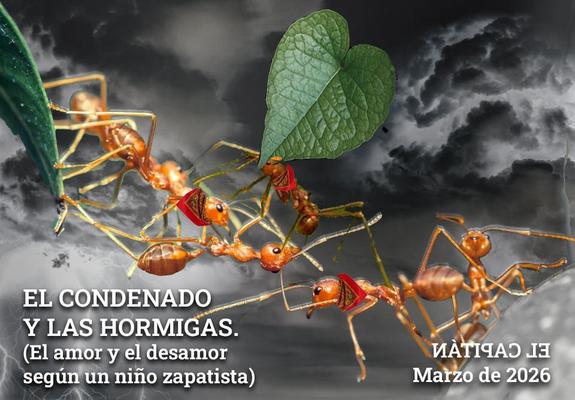
The Damned and the Ants (Love and Heartbreak According to a Zapatista Child)

(A note of clarification for those unfamiliar with certain terms: GAL stands for Local Autonomous Government, and GALes is the plural. CGAZ is like the coordinating body for the GALes, organized by geographical proximity. ACEGAZ is the assembly of the GAL coordinating bodies. The INTERZONA is where those in charge of all the Zapatista zones meet (the comandantas and comandantes, that is). The PERMANENTE is an assembly of comrades who are learning to govern. But don’t pay too much attention to these names because, as the COMMON is still being built, the structure keeps changing in form and name. End of explanatory note.)

Once upon a time, there was a boy. A Zapatista. Not very big, but not very small either. He is of Mayan descent and lives with his family in a community where there are Zapatistas and partisans—that is, what we now call “non-Zapatista brothers and sisters.”

This kid is a real handful. As soon as he learned to walk, he’d wander out of the house and off he’d go. When they went out to look for him, his parents always found him in trouble: he’d tried to catch a wasp, or he’d covered his whole body in mud—completely naked, but covered in mud—because he’d started playing with the little pigs. Another time they found him in the pasture, apparently talking to a cow that had just had a calf. “I was just asking her about her calf,” he said when they scolded him.

Well, since the boy was so mischievous, his dad and mom took turns watching him.

But you know how men are—they say they’re watching him, but they’re just on their phones, checking Facebook or WhatsApp and stuff like that.

Moms, we know, if they’re going to watch you, they’re really going to watch you. And it’s like they have eyes everywhere, even in the back of their heads, because any mischief you try to pull off in secret, they catch you right away.

Well, we also know that moms scold a lot. It’s not just that they say, “Don’t do that”—no, they start telling you a whole bunch of things that sound like they’re praying, and what’s worse is that they scold you in your native language, in Spanish, and sometimes even in English, French, Italian, German, and even Farsi.

This boy’s mom scolded him, saying, “You goddamn devil child, you’re going to hell for all the mischief you get into.”

And that’s how this boy’s day went: him getting into mischief, his dad playing dumb, and his mom scolding both of them.

Well, the day finally came when the boy had to go to the public school. So all the boys and girls are at school on the first day of class, and the education promoter arrives.

So the rumor goes that the education promoter was head over heels in love—in a way you wouldn’t believe—with a health promoter. But the problem was that she and he were from two different puyes, that is, from two different caracoles (“puy” means “caracol” in the Mayan language). She was in one puy, and he was in another puy that’s out in the middle of nowhere. She and he met at an anniversary party for the uprising. They didn’t say a word; they just danced together. And even though it was freezing cold, they didn’t feel the cold. He was even sweating, and she was blushing, blushing bright red with embarrassment. They didn’t say a word to each other, but the education promoter looked into it thoroughly.

You see how our comrades are—they have a secret system of investigation and communication—so this comrade first investigated the most important thing. That is, whether or not the guy has a wife.

Once she found out he didn’t have a wife, the compañera looked for a good excuse to see him.

And the idea came to him because the theater folks frompuyes get together every so often when SubMoy calls on them to put on a play.

And she figured out a way for the boy to join the theater group too, so they could see each other, and maybe talk, and maybe hold hands, and maybe hug, and maybe share a little kiss, and maybe… Oh my goodness!

Well, it was known that there would soon be an arts festival and that the theater folks would be called upon to prepare a play about community and nature. So, is the education promoter even paying attention in class? No, she’s completely distracted, thinking about something else; she can’t concentrate and is just sighing, wondering when she’ll get to see her beloved. But all the girls and boys are already here, and they’re already fighting over a chamoy candy that Verónica, Ceci, and Hermelinda Damiana brought (who are the new recruits of the Popcorn Command).

So, since the class monitor is distracted because she’s in love, when she goes to take attendance using the list the teacher gave her, she can’t find it. She looks for the list, but it’s not there.

And it’s a big problem, but the class monitor may be in love, she’s not stupid, and she says, “Okay, everyone is going to say their name so we all know each other’s names.”

So every girl and boy goes around saying their name, and when it’s the mischievous boy’s turn, he says, “My name is Condenado (Damned) and my last name is Chamaco del Demonio  (Devil’s Child).” “That’s what my mom calls me all the time—‘Damned Devil’s Child’—so that’s my name.”

The promoter, as I said, was head over heels in love, so she didn’t care and wrote him down on the list: “Condenado Chamaco del Demonio. 4 years old, almost 5, from GAL such-and-such,” and all that stuff about cgaz, acegaz, interacegaz, permanente, interzona, and those weird names that are common among the Zapatistas.

When he checked the list, the teacher trainer didn’t notice because he was arguing with his wife, who was scolding him for supposedly flirting with their friend Ruperta.

And the teacher defended himself: “But how could you think that, woman? Ruperta is 80 years old.” “It doesn’t matter,” said the jealous wife, “she’s got 80 years of tricks—so many that not even a truck could carry them all—and she’s a husband-stealer.”

And there they were, fighting and fighting, and the teacher didn’t notice that on the list there was a boy named “Condenado” whose last name was “Chamaco del Demonio.

And so that boy’s name remained on his school record. And that’s how his classmates knew him.

But the matter reached the meetings of the Word of God. And there they heard the tunel (pronounced with an acute accent, who is in charge of the sacraments) say that one must be careful with bad people, “they are the damned,” he said, “and one must not associate with the damned.”

And sure enough, the next day, no one went near the boy named “Condenado,” and they didn’t play with him or anything. So they left him alone.

But Condenado, the Devil’s Child, wasn’t sad; instead, he organized his own games and went into the woods to gather herbs, because his grandmother knew about medicinal plants and he used to accompany her.

He also went with his dad when he went to the milpa, and with his mom when she went to gather firewood, and there his dad and mom taught him which animals are dangerous and should be avoided, which are harmless and won’t hurt you, which look alike but are different, and what they’re called.

So the boy learned the names and habits of many animals, as well as the names of many plants and what they’re used for. And the boy made a notebook: on one page he wrote the names of all the animals he knew, and on another page the names of the plants.

Then one day the boy was looking through his notes and noticed that the ants weren’t there. So he went and asked his dad about the ants.

His father was arguing with his mother because the pozol was sour, it just wasn’t right, and the two of them were nagging each other, just as couples who love each other tend to do. The boy asked again if ants are good or bad. And the man, since he was still arguing, just told him, “Ants are ants.”

So the boy thought that meant no one knew whether ants were good or bad, and that’s why he had to study them.

And the boy began to study the ants: where they walk, where they live, what they do. And he learned that there are different kinds of ants. He observed and analyzed several anthills, and saw how organized the ants are—that is, they have divided up the work and roles: some go out to explore, some gather food and bring it back to the anthill, some care for the young, some defend the colony, and some just slack off, depending on the situation—that is, they’re lazy.

But the boy wasn’t satisfied and thought he needed to investigate further. So he came up with a mischievous plan: he went to see the Monarch and told him he had to find and show him videos of the ants. The Monarch looked at him—he was just a little kid—and asked who had told him to do that. The boy told his lie that it was an order from SubMoy.

The Monarch didn’t believe him and asked the boy his name. The little boy said his name: “Damned Devil’s Child,” and then the Monarch got scared that maybe he really was the devil’s, and, no matter what, he had to find the videos and show them to the boy.

That night, the Monarch couldn’t sleep because he was afraid of the devil. Because the Monarch gets scolded by SubMoisés, and he gets scolded by Captain Marcos. If the devil is going to scold him too, well, that’s just too much.

But that’s how the boy learned more about the ants, how they’re organized, and the roles and jobs they have.

-*-

 Once, after a really intense rain—that is, after a storm—the boy went to check on an anthill near his hut. There were little streams of water around the entrance to the anthill.

And the ants coming out of the ant hill’s entrance seemed confused, wandering back and forth. Suddenly, one of them crawled into the hole, and other ants followed behind her, marching as if they were an army.

There is no one in command, but the soldier ants quickly organize themselves and grab each other’s legs, forming a bridge over one of the streams. Then the other ants follow, crossing the bridge and heading where they need to go to find food and explore.

Once the sun dries up the little streams, the soldier ants let go and return to the anthill, and then head out again to do their assigned work.

The boy is very impressed by what he saw and is left thinking about it.

-*-

 On another day, while they are at school with the love-struck and distracted education promoter–the poor thing, sighing with love—the GALs from that town arrived and told her that at the GALs’ general assembly, the highest Zapatista authority, it had been decided to invite SubMoy to give a talk, and he would be in town that day, and SubMoy asked about the school and they showed him, and SubMoy said: “I’m going to give a talk to the girls and boys, so that from a young age they understand what is being done.”

And with that, SubMoy comes into the classroom, but the education promoter barely notices him and is just in a corner sighing and sighing for her distant love.

Then SubMoy realizes that the compañera hasn’t even seen him and greets the boys and girls. “Good morning,” he says to them, “my name is Subcomandante Insurgente Moisés and I’m going to give you a little talk.”

And, right away, SubMoy begins to explain what the común is, and the pyramids, and political work, and the sciences, and the arts, and military training to defend oneself, and all that.

And the children remain silent, as if they didn’t understand a thing, just as those from the Interzona remain silent, not wanting to participate because it quickly becomes clear that they didn’t understand a thing since they were distracted by their cell phones or picking their noses.

So, since everyone is quiet and even the town’s GALs are staring at their muddy boots—basically, they’re just standing there like ducks—SubMoy asks the boys and girls if they understood the explanation.

No one says a word; it’s completely silent. Even SubMoy thinks he’s at an Interzona meeting, and he’s about to leave when a boy raises his hand.

SubMoy stops at the door, turns back, and tells the boy to speak up.

The boy just says, “Ants.”

SubMoy raises an eyebrow, as if he doesn’t understand, and says, “Okay, go ahead and explain that about the ants.”

And the boy begins to describe what he saw in the anthill—how the ants were organized, how each one had its own job, how they support each other, teach each other, and even heal one another, and what happened after it rained, and how one group of ants was tasked with caring for, protecting, and supporting their ant community.

SubMoy listened carefully, turned to look at the committee members accompanying him, and gave them a look that seemed to say, “Aren’t you ashamed that a kid gets it, but you grown-ups can’t even explain it?” The committee members kept playing dumb, acting like they weren’t even there.

Then SubMoy congratulated the child and asked him his name. And the child replied, “Condenado Chamaco del Demonio,” but one of the GALs approached and told SubMoy that he is the grandson of an elderly couple, Zapatistas since before the uprising.

SubMoy asked the boy why he was called that, and the boy looked at the education promoter, who was still sighing, and said, “Because of love”; then the boy looked at the teacher trainer and added, “And because of love lost.”

SubMoy laughed heartily for a while, shot a dirty look at the promoter, shot a dirty look at the teacher trainer, and invited the boy to eat with him the raw tamale that the local women cooks had prepared.

“All single women,” said Captain Marcos, “because they don’t know how to make tamales, and that’s why they never even catch a cold, let alone find a partner.”

In reality, it was SubMoy’s trick to get the boy to eat the tamale first, and if it didn’t make him sick, then SubMoy would eat it too.

-*-

 No one even said hello to the Captain. That’s what he gets for talking trash about the cooks.

But the Captain didn’t care, because he ate all the chamoy candy and marshmallow pops that were meant for the Popcorn Command.

And in the end, the Captain’s tummy still hurt from eating so much candy.

Tan-tan.

From the Mountains of the Mexican Southeast

The Captain
January-February 2026.

Originally published at Enlace Zapatista on March 18th, 2026.
Translation by Schools for Chiapas.

https://abolitionmedia.noblogs.org/?p=30172 #chiapas #ezln #mexico #northAmerica #zapatista

El abogado Carlos González suelta una verdad incómoda: "Pensar que con los Acuerdos en la Constitución, ya tenemos autonomía, es una ficción"

👉 https://wp.me/pdD3iE-vOb 🐝

#Ezln #Mexico #Latinoamérica #Morena #ClaudiaSheimbaum #Zapatistas #Trenzatón2026 #Resistencia #PueblosIndigenas #PueblosOriginarios #AmericaLatina #Protesta #Sheinbaum

La estrategia es clara: desactivar la resistencia. Mientras el pueblo #Otomí lucha por recuperar sus pozos de #agua, el Estado responde con acusaciones penales contra ellos

👉 https://wp.me/pdD3iE-vPC 🐝

#otomi #claudiasheinbaum #mexico_maravilloso #água #resistência #queretaro #cdmx #pueblosoriginarios #pueblosindigenas #zapatistas #ezln #latinoamérica #americalatina #otomi

Chiapas.eu » EZLN: Die Kunst ist ein Fluch.

Als allererstes möchten wir Gabriel Pascal, David Olguín und Philippe Amand danken, sowie der ganzen Bande, die dieses Event möglich ...

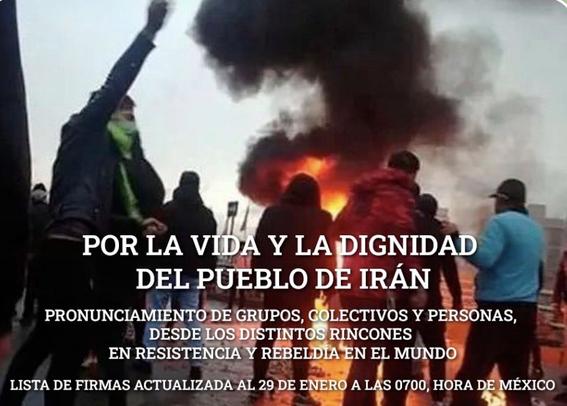
Die Zapatisten haben am 30. Januar eine Solidaritätsbotschaft für das iranische Volk verfasst.

"... erleben einen Sturm. Er ist weder neu noch vorübergehend. Es ist der Sturm des Kapitalismus, des Imperialismus, des Patriarchats und der Staaten, die den Tod verwalten, während sie von Ordnung, Stabilität oder Sicherheit sprechen. In diesem Sturm streiten sich die da oben um Territorien, Ressourcen und Macht; die da unten setzen ihre Körper, ihr Leben, ihre Angst und ihre Hoffnung ein."

....

Schon zahlreiche Organisationen und Einzelpersonen haben diese Botschaft mitunterzeichnet.

Die ganze Botschaft findet sich hier:

https://www.ya-basta-netz.org/fuer-das-leben-und-die-wuerde-des-iranischen-volkes/

#Zapatisten #Iran #EZLN #UntenGegenOben

FÜR DAS LEBEN UND DIE WÜRDE DES IRANISCHEN VOLKES ⋆ Ya Basta Netz

 erleben einen Sturm. Er ist weder neu noch vorübergehend. Es ist der Sturm des Kapitalismus, des Imperialismus, des Patriarchats und der Staaten, die den Tod verwalten, während sie von Ordnung, Stabilität oder Sicherheit sprechen. In diesem Sturm streiten sich die da oben um Territorien, Ressourcen und Macht; die da unten setzen ihre Körper, ihr Leben, […]

Ya Basta Netz

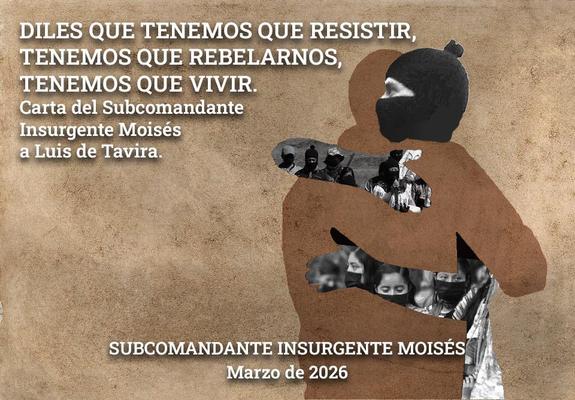
Tell Them That We Must Resist, We Must Rebel, We Must Live. Letter from Subcomandante Insurgente Moisés to Luis de Tavira.

To: Maestro Luis de Tavira.
From: Subcomandante Insurgente Moisés.

Compañero Tavira:

I send you our greetings on behalf of Zapatista children, elders, women, men, and non-binary people.

From one theater director to another, I send you a warm embrace. We are happy that your health has improved a little and that you are now able to attend this tribute organized by your closest family and friends.

Here we continue in the struggle, in our resistance and rebellion which, as you well know, also walks through the arts and sciences. A few weeks ago, the art and culture coordinators and theater artists wrote you a letter, and you responded. That warmed our hearts because we understand that you see us as we see you: as a compañero in the struggle for life.

As we well know, the storm is growing stronger and deadlier in every corner of the world, and it is the disadvantaged who suffer the most.

But, as you have rightly said on several occasions, the arts are also a way of fighting for life. And those of us who fight, resist, and rebel also learn and teach through the arts and sciences.

The struggle for life in these difficult and hard times is fought with the head, the heart, and the guts. And all three have to do with each person’s history. Those of us who are of what we call native, indigenous blood are different. We are different in our heads, hearts, and guts from those who have another language, another way, another history. But we are made equal in the sciences, the arts, and the struggles. And even more so now that the struggle is for life, because the capitalist system is determined to destroy all of humanity.

We find life on earth. Others in science. Others in the arts. Others in their history.

Perhaps some think that each person should look out for their own life, but the current situation leaves no room for individual struggle. All of us are in mortal danger. Distinct, different, each according to their geography, their calendar, their way, we become equal in recognizing the criminal and in the struggle to defeat him.

Our effort, as Zapatistas that we are, is so that the day after the death of the inhuman beast of the system, we do not do the same, and that other monsters are not born from our roots. Other pyramids, we say, we the Zapatista communities.

What we want is another world where we can be ourselves. Not all the same as copies, not all with the same way of being, but each one what they are and want to be, without oppressing those who are different, without trying to make them like us, but respecting those who are not like us. A world without exploitation, without repression, without theft, without contempt.

We salute you, maestro. Tell those close to you that geography and circumstance do not matter, nor do age or health. Tell them that we must resist, we must rebel, we must live.

A hug from your compañerxs, the Zapatista peoples.

Subcomandante Insurgente Moisés.
Mexico, February 2026.

Original text published at Enlace Zapatista on March 13th, 2026.
Translation by Schools for Chiapas.

https://abolitionmedia.noblogs.org/?p=29991 #chiapas #ezln #mexico #northAmerica #zapatista
EZLN: Sage ihnen, wir müssen widerstehen, müssen rebellieren ... #EZLN #Widerstand #chiapas98 https://www.chiapas.eu/news.php?id=12982
Chiapas.eu » EZLN: Sage ihnen, wir müssen widerstehen, müssen rebellieren ...

Von Theaterdirektor zu Theaterdirektor schicke ich dir meine Umarmung. Wir sind froh, dass deine Gesundheit etwas besser geworden ist und du nun bei der ...

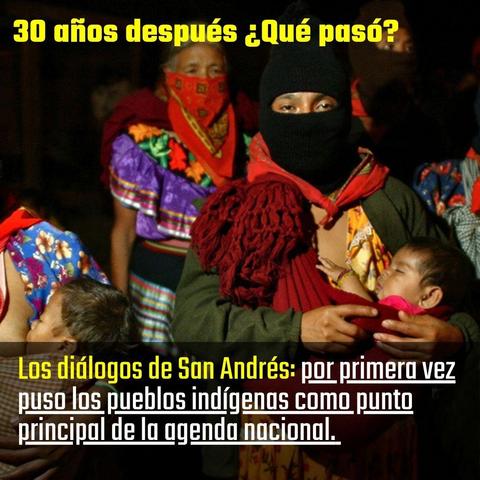
A 30 años de los #DiálogosDeSanAndrés del #EZLN, el experto Carlos González suelta una verdad incómoda: "Pensar que con los Acuerdos en la Constitución ya tenemos autonomía es una ficción"

👉 https://wp.me/pdD3iE-vOb 🐝
Más en AVISPA.ORG

#zapatistas #ezln #cni #mexico_maravilloso #pueblosoriginarios #pueblosindigenas #resistência #indígenas #chiapas #morena #claudiasheinbaum #ddhh #justicia #anarquia #colonialismo #capitalismo #protesta #anarquismo

12 Women in Year 12 (in the Second Year of the War)

In the 12th year of the EZLN, thousands of miles away from Beijing, 12 women arrive on March 8, 1996, with their faces concealed.

  • Yesterday…
  • Her face covered in black, only her eyes and some hair at the nape of her neck remain visible. In her gaze, the sparkle of someone searching. An M-1 carbine slung across her chest, in what is known as the “assault” position, and a pistol at her waist. On her left chest, the seat of hope and conviction, she wears the insignia of Major of Infantry of an insurgent army that, until that frosty dawn of January 1, 1994, called itself the Zapatista Army of National Liberation. Under her command is the rebel column that assaults the historic capital of the southeastern Mexican state of Chiapas, San Cristóbal de Las Casas. The central park of San Cristóbal is deserted. Only the indigenous men and women she commands witness the moment when the Major, a Tzotzil indigenous woman and rebel, collects the national flag and hands it over to the leaders of the rebellion, the so-called “Clandestine Revolutionary Indigenous Committee.” Over the radio, the Major reports: “We have recovered the flag. 10-23 stand by.” It is 2:00 a.m. southeastern time on January 1, 1994. 1:00 a.m. on New Year’s Day for the rest of the world. She waited ten years to say those seven words. She arrived in the mountains of the Lacandon Jungle in December 1984, less than twenty years old and with a lifetime of humiliation of indigenous people etched on her body. In December 1984, this dark-skinned woman said, “Enough is enough!” but she said it so quietly that only she could hear herself. In January 1994, this woman and tens of thousands of indigenous people no longer say but shout “Enough is enough!” They say it so loudly that everyone hears them…

    On the outskirts of San Cristóbal, another rebel column commanded by a man—the only one with light skin and a large nose among the indigenous people attacking the city—has finished storming the police station. Indigenous people who spent New Year’s Eve locked up for the most serious crime in southeastern Chiapas—being poor—are freed from clandestine prisons. Eugenio Asparuk is the name of the insurgent captain, a Tzeltal indigenous rebel who, with his enormous nose, directs the search of the station. When the Major’s message arrives, Insurgent Captain Pedro, a Chol indigenous rebel, has finished taking over the Federal Highway Police barracks and securing the road between San Cristóbal and Tuxtla Gutiérrez; Insurgent Captain Ubilio, a Tzeltal indigenous rebel, has controlled the northern accesses to the city and taken the symbol of government handouts to the indigenous people, the National Indigenous Institute; Insurgent Captain Guillermo, a Chol indigenous rebel, has taken the most important high ground in the city, from where he dominates with his gaze the surprised silence that peeks through the windows of houses and buildings; Insurgent Captains Gilberto and Noé, Tzotzil and Tzeltal indigenous people respectively, rebels alike, finish storming the state judicial police headquarters, set it on fire, and march to secure the edge of the city that connects to the 31st military zone headquarters in Rancho Nuevo.

    At 2:00 a.m. Southeast Time on January 1, 1994, five insurgent officers, all men, indigenous and rebels, listen to the radio and hear the voice of their commander, a woman, indigenous and rebel, saying, “We have recovered the flag, 10-23 stand by.” They repeat it to their troops, men and women, indigenous and rebels in their entirety, translating. “We’ve begun…”

    In the municipal palace, the Major organizes the defense of the position and the protection of the men and women who are currently governing the city, all of whom are indigenous and rebels. A woman in arms protects them.

    Among the indigenous leaders of the rebellion is a small woman, small even among small women. Her face is covered in black, leaving only her eyes and some hair at the nape of her neck exposed. Her gaze has the sparkle of someone who is searching. A sawed-off 12-gauge shotgun is slung across her back. Wearing the unique costume of the sandreseras, Ramona descends from the mountains, along with hundreds of women, heading for the city of San Cristóbal on the last night of 1993. Together with Susana and other indigenous men, she forms part of the indigenous leadership of the war that dawns in 1994, the Clandestine Revolutionary Indigenous Committee-General Command of the EZLN. Commander Ramona will astonish the international media with her stature and brilliance when she appears at the Cathedral Dialogues carrying in her backpack the national flag that the Mayor recovered on January 1. Ramona does not know it at the time, and neither do we, but she already carries in her body a disease that is eating away at her life, silencing her voice and dimming her gaze. Ramona and the Mayor, the only women in the Zapatista delegation that is showing itself to the world for the first time in the Cathedral Dialogues, declare: “We were already dead, we didn’t count for anything,” and they say it as if taking stock of humiliations and forgetfulness.

    The Major translates the journalists’ questions for Ramona. Ramona nods and understands, as if the answers they are asking for had always been there, in that small figure who laughs at Spanish and the way city dwellers behave. Ramona laughs when she doesn’t know she is dying. When she finds out, she continues to laugh. Before, she didn’t exist for anyone; now she exists, she is a woman, she is indigenous, and she is a rebel. Now Ramona lives, a woman of that race who has to die in order to live…

    The Major watches as daylight begins to fill the streets of San Cristóbal. Her soldiers organize the defense of the old town and the protection of the men and women who are still asleep, indigenous and mestizo, all taken by surprise. The Major, a woman, indigenous and rebellious, has taken the city. Hundreds of armed indigenous people surround the old Royal City. A woman in arms commands them…

    Minutes later, the rebel forces take control of Las Margaritas, and hours later, the government forces defending Ocosingo, Altamirano, and Chanal surrender. Huixtán and Oxchuc are taken as a column advances on the main prison in San Cristóbal. Seven municipal capitals are in the hands of the insurgents after the Major’s seven words.

    The war of words has begun…

    In those other places, other women, indigenous and rebellious, are rewriting the piece of history that they have had to bear in silence until that first day of January. Also nameless and faceless are:

    Irma. An indigenous Chol woman and insurgent infantry captain, Irma leads one of the guerrilla columns that take the plaza of Ocosingo on January 1, 1994. From one side of the central park, she and the fighters under her command harassed the garrison guarding the municipal palace until they surrendered. Then Irma let down her braid, and her hair fell to her waist. As if to say, “Here I am, free and new,” Captain Irma’s hair shines, and continues to shine as night falls on Ocosingo, now in rebel hands…

    Laura. Insurgent Infantry Captain. A Tzotzil woman, brave in battle and in her studies, Laura becomes captain of an all-male unit. But that’s not all: in addition to being men, her troops are recruits. With patience, like the mountain that watches her grow, Laura teaches and commands. When the men under her command hesitate, she sets an example. No one carries as much or walks as far as she does in her unit. After the attack on Ocosingo, she withdraws her unit, complete and in order. This fair-skinned woman boasts little or nothing, but she carries in her hands the rifle she took from a police officer, one of those who only saw indigenous women as objects to be humiliated or raped. After surrendering, the police officer, who until that day thought that women were only good for cooking and bearing children, runs away in his underwear…

    Elisa. Insurgent Infantry Captain. She carries, as a war trophy, mortar shrapnel forever embedded in her body. She takes command of her column as it breaks through the ring of fire that fills the Ocosingo market with blood. Captain Benito has been wounded in the eye and, before losing consciousness, reports and orders: “They’ve got me, take command Captain Elisa.” Captain Elisa is already wounded when she manages to get a handful of fighters out of the market. When she gives orders, Captain Elisa, an indigenous Tzeltal woman, seems to be asking for forgiveness… but everyone obeys her…

    Silvia. Insurgent Infantry Captain, ten days inside the mousetrap that Ocosingo became on January 2. Disguised as a civilian, she slips through the streets of a city full of federal troops, tanks, and cannons. A military checkpoint stops her. They let her pass almost immediately. “It’s impossible for such a young and fragile girl to be a rebel,” say the soldiers as they watch her walk away. When she rejoins her unit in the mountains, Silvia, a Chol indigenous woman and Zapatista rebel, looks sad. I cautiously ask her the reason for the sadness that dampens her laughter. “Back in Ocosingo,” she replies, lowering her gaze, “back in Ocosingo, all my music cassettes were left in my backpack. Now we don’t have them anymore.” She remains silent, holding her sorrow in her hands. I say nothing, I just share her sorrow and realize that in war, everyone loses what they love most…

    Maribel. Insurgent Infantry Captain. She takes over the Las Margaritas radio station when her unit storms the municipal capital on January 1, 1994. She spent nine years living in the mountains to be able to sit in front of that microphone and say: “We are the product of 500 years of struggle: first against slavery…” The broadcast is not made due to technical problems, and Maribel retreats to cover the unit advancing on Comitán. Days later, she will have to escort the prisoner of war, General Absalón Castellanos Domínguez. Maribel is Tzeltal and was less than fifteen years old when she arrived in the mountains of southeastern Mexico. “The most difficult moment of those nine years was when I had to climb the first hill, the hill of hell. After that, everything got easier,” says the insurgent officer. When General Castellanos Domínguez is handed over, Captain Maribel is the first rebel to make contact with the government. Commissioner Manuel Camacho Solís shakes her hand and asks her age: “502,” says Maribel, who counts her birth year from when the rebellion began…

    Isidora. Infantry insurgent. As a private, Isidora enters Ocosingo on January 1. As a private, Isidora leaves Ocosingo in flames, having spent hours evacuating her unit, composed entirely of men, with forty wounded. She also has shrapnel in her arms and legs. Isidora arrives at the medical station and hands over the wounded, asks for some water, and gets up. “Where are you going?” they ask her as they try to treat her wounds, which are bleeding, staining her face and reddening her uniform. “To bring the others,” says Isidora as she loads ammunition. They try to stop her but cannot. Private Isidora has said she must return to Ocosingo to rescue more of her comrades from the death song sung by mortars and grenades. They have to take her prisoner to stop her. “The good thing is that if they punish me, they can’t demote me,” says Isidora as she waits in the room that serves as her prison. Months later, when she is given the star that promotes her to infantry officer, Isidora, Tzeltal and Zapatista, looks alternately at the star and at the commanding officer and asks, like a scolded child, “Why?” She does not wait for an answer.

    Amalia. Second Lieutenant of Health. With the quickest laugh in southeastern Mexico, Amalia lifts Captain Benito from the pool of blood where he lies unconscious and drags him to safety. She carries him on a stretcher and pulls him out of the death belt that surrounds the market. When someone talks about surrendering, Amalia, honoring the Chol blood that runs through her veins, gets angry and starts arguing. Everyone listens to her, even above the noise of explosions and gunshots. No one surrenders.

    Elena. Lieutenant of Health. She arrived at the EZLN illiterate. There she learned to read, write, and what they call nursing. From treating diarrhea and giving vaccinations, Elena goes on to treat war wounds in her little hospital, which is also her home, warehouse, and pharmacy. With difficulty, she extracts the pieces of mortar lodged in the bodies of the Zapatistas who arrive at her medical post. “Some can be removed and others cannot,” says Elenita, a Chol and an insurgent, as if she were talking about memories and not pieces of lead…

    In San Cristóbal, on the morning of January 11, 1994, she communicates with the big-nosed, fair-skinned man: “Someone has arrived who is asking questions, but I don’t understand the language. It sounds like he’s speaking English. I don’t know if he’s a journalist, but he has a camera.” “I’m on my way,” says the big-nosed man, adjusting his balaclava.

    He loads the weapons they recovered from the police station into a vehicle and heads to the city center. They unload the weapons and distribute them among the indigenous people guarding the municipal palace. The foreigner is a tourist asking if he can leave the city. “No,” replies the balaclava-clad man with the disproportionate nose, “it’s better if you go back to your hotel. We don’t know what’s going to happen.” The foreign tourist leaves after asking for permission and taking a video. Meanwhile, the morning progresses, and curious onlookers, journalists, and questions arrive. The nose responds and explains to locals, tourists, and journalists. The Major is behind him. The balaclava talks and jokes. A woman in arms watches his back.

    A journalist behind a television camera asks, “And who are you?” “Who am I?” hesitates the balaclava-clad man as he fights against sleepiness. “Yes,” insists the journalist, “are you called ‘Commander Tiger’ or ‘Commander Lion’?” “Ah! No,” replies the balaclava-clad man, rubbing his eyes in annoyance. “Then what is your name?” says the journalist as he moves the microphone and camera closer. The big-nosed balaclava-clad man replies: “Marcos. Subcomandante Marcos…” Above, the Pilatus planes fly overhead…

    From that point on, the impeccable military action of the takeover of San Cristóbal becomes blurred, and with it, the fact that it was a woman, an indigenous rebel, who commanded the operation is erased. The participation of women combatants in the other actions of January 1 and in the long ten-year journey of the EZLN’s birth is relegated to the background. The face hidden by the balaclava is further obscured when the spotlight turns to Marcos. The Major says nothing, continuing to watch over that prominent nose that now has a name for the rest of the world. No one asks her name…

    In the early hours of January 2, 1994, this woman led the retreat from San Cristóbal to the mountains. She returned to San Cristóbal fifty days later, as part of the escort guarding the safety of the EZLN CCRI-CG delegates to the Cathedral Dialogue. Some female journalists interviewed her and asked her name. “Ana María. Major Insurgent Ana María,” she replied, looking at them with her dark eyes. She left the Cathedral and disappeared for the rest of 1994. Like her other compañeras, she had to wait and remain silent…

    In December 1994, ten years after becoming a soldier, Ana María receives the order to prepare to break through the siege imposed by government forces around the Lacandon Jungle. In the early hours of December 19, the EZLN takes position in thirty-eight municipalities. Ana María commands the action in the municipalities of the Chiapas Highlands. Twelve female officers are with her in the action: Monica, Isabela, Yuri, Patricia, Juana, Ofelia, Celina, Maria, Gabriela, Alicia, Zenaida, and Maria Luisa. Ana Maria herself takes the municipal capital of Bochil.

    After the Zapatistas withdrew, the federal army high command ordered that nothing be said about the breach in the siege and that it be handled in the media as a mere propaganda stunt by the EZLN. The federal forces’ pride was doubly wounded: the Zapatistas had broken out of the siege and, what’s more, a woman was commanding a unit that had taken several municipal capitals. This was impossible to accept, so a lot of money had to be thrown at it to keep the action from becoming known.

    2. Today

    First through the involuntary action of her brothers in arms, then through the deliberate action of the government, Ana María, and with her the Zapatista women, were minimized and belittled…

    I am finishing writing this when…

    Doña Juanita arrives. With old Antonio dead, Doña Juanita is slipping away from life as slowly as she makes coffee. Still strong in body, Doña Juanita has announced that she is dying. “Don’t talk nonsense, Grandma,” I say, avoiding her gaze. “Look,” she replies, “if we die in order to live, no one is going to stop me from living. And certainly not a young boy like you,” says Doña Juanita, the wife of old Antonio, a woman who has been rebellious all her life and, as it seems, also in her death…

    Meanwhile, on the other side of the fence, there appears…

    She has no military rank, no uniform, no weapon. She is a Zapatista, but only she knows it. She has no face and no name, just like the Zapatista women. She fights for democracy, freedom, and justice, just like the Zapatistas. She is part of what the EZLN calls “civil society,” people without a party, people who do not belong to the “political society” made up of rulers and leaders of political parties. She is part of that diffuse but real whole that is the part of society that says, day after day, “Enough is enough!” She too has said “Enough is enough!” At first she surprised herself with those words, but then, by repeating them and, above all, by living them, she stopped being afraid of them, of herself. She is now a Zapatista, having joined her destiny to that of the Zapatistas in this new delirium that so terrifies political parties and intellectuals in power, the Zapatista National Liberation Front. She has already fought against everyone, against her husband, her lover, her boyfriend, her children, her friend, her brother, her father, her grandfather. “You’re crazy,” was the unanimous verdict. She leaves behind no small thing. Her renunciation, if it were a matter of size, is greater than that of the rebels who have nothing to lose. Her whole world demands that she forget about “those crazy Zapatistas,” and conformity calls her to sit in the comfortable indifference of those who only see and care for themselves. She leaves everything behind. She says nothing. Early in the morning, she sharpens the tender tip of hope and emulates the January 1st of her Zapatista compañerxs many times in a single day that, at least 364 times a year, has nothing to do with January 1st.

    She smiles. She used to admire the Zapatistas, but not anymore. She stopped admiring them the moment she realized that they were only a reflection of her own rebelliousness, of her own hope.

    She discovers that she was born on January 1, 1994. Since then, she feels alive and that what she was always told was a dream and a utopia can be true.

    She begins to quietly and without payment, together with others, pursue that complicated dream that some call hope: everything for everyone, nothing for ourselves.

    She arrives on March 8 with her face concealed, her name hidden. Thousands of women arrive with her. More and more arrive. Tens, hundreds, thousands, millions of women around the world remembering that there is still much to be done, remembering that there is still much to fight for. Because it turns out that dignity is contagious, and women are the most likely to fall ill with this uncomfortable disease…

    This March 8 is a good excuse to remember and give credit to the Zapatista insurgent women, Zapatistas, both armed and unarmed.

    To the rebellious and uncomfortable Mexican women who have insisted on emphasizing that history, without them, is nothing more than a poorly written story…

    3. Tomorrow…

    If there is one, it will be with them and, above all, thanks to them.

    From the mountains of southeastern Mexico,

    Subcomandante Insurgente Marcos

    Published at Enlace Zapatista on March 11th, 1996.
    Translated by Schools for Chiapas.


    https://abolitionmedia.noblogs.org/?p=29689 #chiapas #ezln #feminism #mexico #northAmerica #zapatista