Differential Logic • 2.2
https://inquiryintoinquiry.com/2026/02/06/differential-logic-2-b/

Cactus Language for Propositional Logic (cont.)

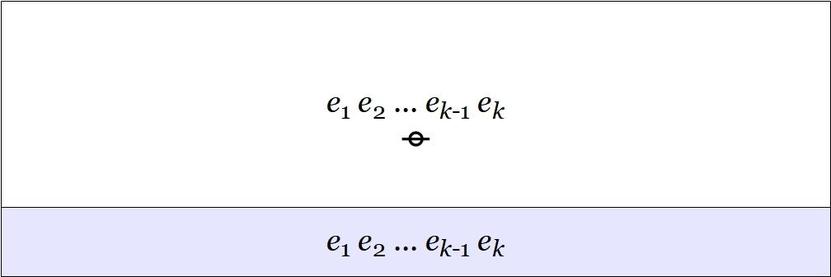
The second kind of connective is a concatenated sequence of propositional expressions, written e₁ e₂ … eₖ₋₁ eₖ to mean all the propositions e₁, e₂, …, eₖ₋₁, eₖ are true, in short, their “logical conjunction” is true. An expression of that form is associated with a cactus structure called a “node” and is “painted” with the colors e₁, e₂, …, eₖ₋₁, eₖ as shown below.

Node Connective
https://inquiryintoinquiry.files.wordpress.com/2020/04/cactus-graph-ej-node-connective.jpg

All other propositional connectives can be obtained through combinations of the above two forms. As it happens, the parenthesized form is sufficient to define the concatenated form, making the latter formally dispensable, but it's convenient to maintain it as a concise way of expressing more complicated combinations of parenthesized forms. While working with expressions solely in propositional calculus, it's easiest to use plain parentheses for logical connectives. In contexts where ordinary parentheses are needed for other purposes an alternate typeface (…) may be used for the logical operators.

Resources —

Logic Syllabus
https://inquiryintoinquiry.com/logic-syllabus/

Minimal Negation Operator
https://oeis.org/wiki/Minimal_negation_operator

Survey of Differential Logic
https://inquiryintoinquiry.com/2025/05/03/survey-of-differential-logic-8/

Survey of Animated Logical Graphs
https://inquiryintoinquiry.com/2025/05/02/survey-of-animated-logical-graphs-8/

#Peirce #Logic #Mathematics #LogicalGraphs #DifferentialLogic #DynamicSystems
#Inquiry #PropositionalCalculus #BooleanFunctions #BooleanDifferenceCalculus
#EquationalInference #MinimalNegationOperators #CalculusOfLogicalDifferences

Differential Logic • 2.1
https://inquiryintoinquiry.com/2026/02/06/differential-logic-2-b/

Cactus Language for Propositional Logic —

The development of differential logic is facilitated by having a moderately efficient calculus in place at the level of boolean-valued functions and elementary logical propositions. One very efficient calculus on both conceptual and computational grounds is based on just two types of logical connectives, both of variable k-ary scope. The syntactic formulas of that calculus map into a family of graph-theoretic structures called “painted and rooted cacti” which lend visual representation to the functional structures of propositions and smooth the path to efficient computation.

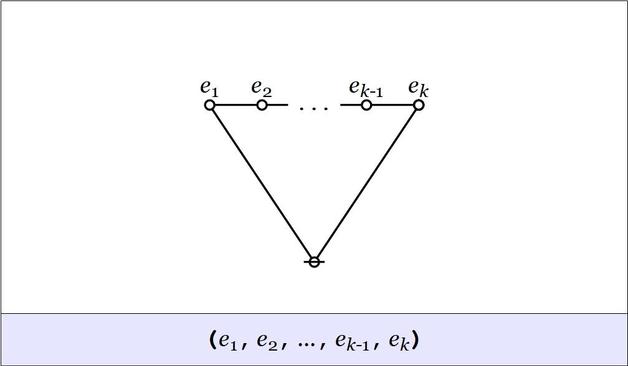
The first kind of connective is a parenthesized sequence of propositional expressions, written (e₁, e₂, …, eₖ₋₁, eₖ) to mean exactly one of the propositions e₁, e₂, …, eₖ₋₁, eₖ is false, in short, their “minimal negation” is true. An expression of that form is associated with a cactus structure called a “lobe” and is “painted” with the colors e₁, e₂, …, eₖ₋₁, eₖ as shown below.

Lobe Connective
https://inquiryintoinquiry.files.wordpress.com/2020/04/cactus-graph-ej-lobe-connective.jpg

Resources —

Logic Syllabus
https://inquiryintoinquiry.com/logic-syllabus/

Minimal Negation Operator
https://oeis.org/wiki/Minimal_negation_operator

Survey of Differential Logic
https://inquiryintoinquiry.com/2025/05/03/survey-of-differential-logic-8/

Survey of Animated Logical Graphs
https://inquiryintoinquiry.com/2025/05/02/survey-of-animated-logical-graphs-8/

#Peirce #Logic #Mathematics #LogicalGraphs #DifferentialLogic #DynamicSystems
#Inquiry #PropositionalCalculus #BooleanFunctions #BooleanDifferenceCalculus
#EquationalInference #MinimalNegationOperators #CalculusOfLogicalDifferences

Differential Logic • 1
https://inquiryintoinquiry.com/2026/02/05/differential-logic-1-b/

Introduction —

Differential logic is the component of logic whose object is the description of variation — focusing on the aspects of change, difference, distribution, and diversity — in universes of discourse subject to logical description. A definition that broad naturally incorporates any study of variation by way of mathematical models, but differential logic is especially charged with the qualitative aspects of variation pervading or preceding quantitative models.

To the extent a logical inquiry makes use of a formal system, its differential component governs the use of a “differential logical calculus”, that is, a formal system with the expressive capacity to describe change and diversity in logical universes of discourse.

Simple examples of differential logical calculi are furnished by “differential propositional calculi”. A differential propositional calculus is a propositional calculus extended by a set of terms for describing aspects of change and difference, for example, processes taking place in a universe of discourse or transformations mapping a source universe to a target universe. Such a calculus augments ordinary propositional calculus in the same way the differential calculus of Leibniz and Newton augments the analytic geometry of Descartes.

Resources —

Logic Syllabus
https://inquiryintoinquiry.com/logic-syllabus/

Survey of Differential Logic
https://inquiryintoinquiry.com/2025/05/03/survey-of-differential-logic-8/

#Peirce #Logic #Mathematics #LogicalGraphs #DifferentialLogic #DynamicSystems
#Inquiry #PropositionalCalculus #BooleanFunctions #BooleanDifferenceCalculus
#EquationalInference #MinimalNegationOperators #CalculusOfLogicalDifferences

Differential Logic • 1

Introduction Differential logic is the component of logic whose object is the description of variation — focusing on the aspects of change, difference, distribution, and diversity — in …

Inquiry Into Inquiry

Differential Logic • Overview
https://inquiryintoinquiry.com/2026/02/03/differential-logic-overview-b/

A reader once told me “venn diagrams are obsolete” and of course we all know how unwieldy they become as our universes of discourse expand beyond four or five dimensions. Indeed, one of the first lessons I learned when I set about implementing Peirce’s graphs and Spencer Brown’s forms on the computer is that 2‑dimensional representations of logic quickly become death traps on numerous conceptual and computational counts.

Still, venn diagrams do us good service at the outset in visualizing the relationships among extensional, functional, and intensional aspects of logic. A facility with those connections is critical to the computational applications and statistical generalizations of propositional logic commonly used in mathematical and empirical practice.

All things considered, then, it is useful to make the links between various styles of imagery in logical representation as visible as possible. The first few steps in that direction are set out in the sketch of Differential Logic to follow.

Resources —

Logic Syllabus
https://inquiryintoinquiry.com/logic-syllabus/

Survey of Differential Logic
https://inquiryintoinquiry.com/2025/05/03/survey-of-differential-logic-8/

Survey of Animated Logical Graphs
https://inquiryintoinquiry.com/2025/05/02/survey-of-animated-logical-graphs-8/

#Peirce #Logic #Mathematics #LogicalGraphs #DifferentialLogic #DynamicSystems
#Inquiry #PropositionalCalculus #BooleanFunctions #BooleanDifferenceCalculus
#EquationalInference #MinimalNegationOperators #CalculusOfLogicalDifferences

Differential Logic • Overview

A reader once told me “venn diagrams are obsolete” and of course we all know how unwieldy they become as our universes of discourse expand beyond four or five dimensions.  Indeed, …

Inquiry Into Inquiry

Watch the fascinating behaviour of a mass-spring-damper system as it transitions from overdamped (where motion is slow and heavily resisted) to undamped (where it oscillates freely without energy loss). This animation beautifully demonstrates how varying levels of damping impact motion and energy dissipation in mechanical systems.

#Physics #Engineering #MassSpringDamper #Damping #MechanicalSystems #Oscillations #Overdamped #Undamped #CriticalDamping #DynamicSystems #EnergyDissipation #MechanicalEngineering #STEM

Agentic AI is reshaping how we build autonomous agents—moving from static models to dynamic, multi‑step systems that can manage supply chains or handle customer queries without constant human input. Discover why this shift is a foundational leap for the market and what it means for open‑source innovation. #AgenticAI #AutonomousAgents #DynamicSystems #SupplyChains

🔗 https://aidailypost.com/news/agentic-ai-explained-how-autonomous-systems-mark-foundational-leap

Survey of Differential Logic • 7
https://inquiryintoinquiry.com/2024/02/25/survey-of-differential-logic-7/

This is a Survey of work in progress on Differential Logic, resources under development toward a more systematic treatment.

Differential logic is the component of logic whose object is the description of variation — the aspects of change, difference, distribution, and diversity — in universes of discourse subject to logical description. A definition as broad as that naturally incorporates any study of variation by way of mathematical models, but differential logic is especially charged with the qualitative aspects of variation pervading or preceding quantitative models. To the extent a logical inquiry makes use of a formal system, its differential component treats the use of a differential logical calculus — a formal system with the expressive capacity to describe change and diversity in logical universes of discourse.

Please follow the above link for the full set of resources.
Articles and blog series on the core ideas are linked below.

Differential Logic • The Logic of Change and Difference
https://inquiryintoinquiry.com/2023/08/22/differential-logic-the-logic-of-change-and-difference/

Differential Propositional Calculus
https://inquiryintoinquiry.com/2023/11/12/differential-propositional-calculus-overview-a/
https://oeis.org/wiki/Differential_Propositional_Calculus_%E2%80%A2_Overview

Differential Logic
https://inquiryintoinquiry.com/2020/03/20/differential-logic-overview/
https://oeis.org/wiki/Differential_Logic_%E2%80%A2_Overview

Differential Logic and Dynamic Systems
https://inquiryintoinquiry.com/2023/03/04/differential-logic-and-dynamic-systems-overview-a/
https://oeis.org/wiki/Differential_Logic_and_Dynamic_Systems_%E2%80%A2_Overview

#Peirce #Logic #LogicalGraphs #DifferentialLogic #DynamicSystems
#BooleanFunctions #BooleanDifferenceCalculus #QualitativePhysics
#CactusCalculus #MinimalNegationOperators #NeuralNetworkSystems
#CalculusOfLogicalDifferences

Survey of Differential Logic • 7

This is a Survey of work in progress on Differential Logic, resources under development toward a more systematic treatment. Differential logic is the component of logic whose object is the descript…

Inquiry Into Inquiry

New blog post! I review a dynamic systems model of pursuing happiness. Zerwas and Ford find that the system of happiness and goal pursuit can potentially lead to paradoxical effects. Pursuing happiness too intensely can make you less happy!

https://www.psychologytoday.com/us/blog/how-do-you-know/202401/systems-thinking-and-how-pursuing-happiness-backfires

@psychology
@socialpsych

#Psychology #PsychologyToday #Happiness #DynamicSystems #Cyberntics #SystemsThinking #Emotion #EmotionRegulation

Systems Thinking and How Pursuing Happiness Backfires

What can flows and feedback teach us about chasing happiness?

Psychology Today