Differential Logic • 2.2
https://inquiryintoinquiry.com/2026/02/06/differential-logic-2-b/

Cactus Language for Propositional Logic (cont.)

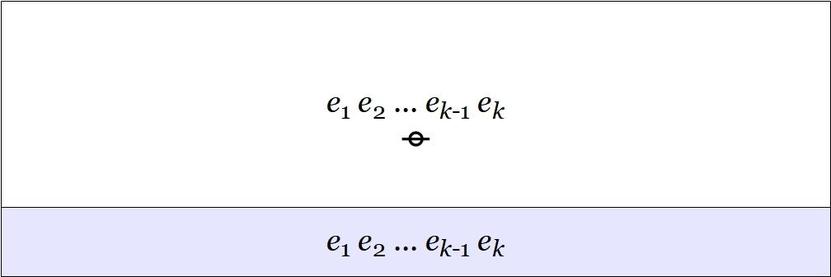
The second kind of connective is a concatenated sequence of propositional expressions, written e₁ e₂ … eₖ₋₁ eₖ to mean all the propositions e₁, e₂, …, eₖ₋₁, eₖ are true, in short, their “logical conjunction” is true. An expression of that form is associated with a cactus structure called a “node” and is “painted” with the colors e₁, e₂, …, eₖ₋₁, eₖ as shown below.

Node Connective
https://inquiryintoinquiry.files.wordpress.com/2020/04/cactus-graph-ej-node-connective.jpg

All other propositional connectives can be obtained through combinations of the above two forms. As it happens, the parenthesized form is sufficient to define the concatenated form, making the latter formally dispensable, but it's convenient to maintain it as a concise way of expressing more complicated combinations of parenthesized forms. While working with expressions solely in propositional calculus, it's easiest to use plain parentheses for logical connectives. In contexts where ordinary parentheses are needed for other purposes an alternate typeface (…) may be used for the logical operators.

Resources —

Logic Syllabus
https://inquiryintoinquiry.com/logic-syllabus/

Minimal Negation Operator
https://oeis.org/wiki/Minimal_negation_operator

Survey of Differential Logic
https://inquiryintoinquiry.com/2025/05/03/survey-of-differential-logic-8/

Survey of Animated Logical Graphs
https://inquiryintoinquiry.com/2025/05/02/survey-of-animated-logical-graphs-8/

#Peirce #Logic #Mathematics #LogicalGraphs #DifferentialLogic #DynamicSystems
#Inquiry #PropositionalCalculus #BooleanFunctions #BooleanDifferenceCalculus
#EquationalInference #MinimalNegationOperators #CalculusOfLogicalDifferences

Differential Logic • 2.1
https://inquiryintoinquiry.com/2026/02/06/differential-logic-2-b/

Cactus Language for Propositional Logic —

The development of differential logic is facilitated by having a moderately efficient calculus in place at the level of boolean-valued functions and elementary logical propositions. One very efficient calculus on both conceptual and computational grounds is based on just two types of logical connectives, both of variable k-ary scope. The syntactic formulas of that calculus map into a family of graph-theoretic structures called “painted and rooted cacti” which lend visual representation to the functional structures of propositions and smooth the path to efficient computation.

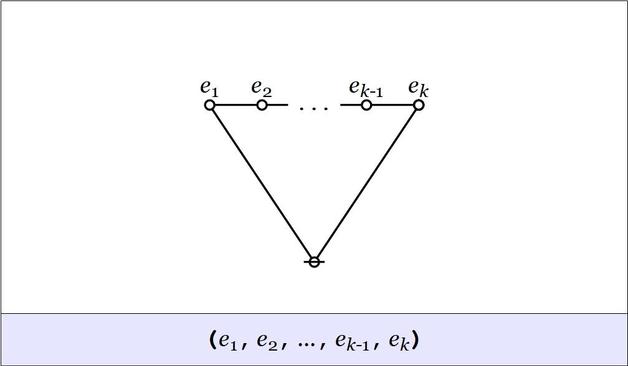
The first kind of connective is a parenthesized sequence of propositional expressions, written (e₁, e₂, …, eₖ₋₁, eₖ) to mean exactly one of the propositions e₁, e₂, …, eₖ₋₁, eₖ is false, in short, their “minimal negation” is true. An expression of that form is associated with a cactus structure called a “lobe” and is “painted” with the colors e₁, e₂, …, eₖ₋₁, eₖ as shown below.

Lobe Connective
https://inquiryintoinquiry.files.wordpress.com/2020/04/cactus-graph-ej-lobe-connective.jpg

Resources —

Logic Syllabus
https://inquiryintoinquiry.com/logic-syllabus/

Minimal Negation Operator
https://oeis.org/wiki/Minimal_negation_operator

Survey of Differential Logic
https://inquiryintoinquiry.com/2025/05/03/survey-of-differential-logic-8/

Survey of Animated Logical Graphs
https://inquiryintoinquiry.com/2025/05/02/survey-of-animated-logical-graphs-8/

#Peirce #Logic #Mathematics #LogicalGraphs #DifferentialLogic #DynamicSystems
#Inquiry #PropositionalCalculus #BooleanFunctions #BooleanDifferenceCalculus
#EquationalInference #MinimalNegationOperators #CalculusOfLogicalDifferences
Differential Logic • 1
https://inquiryintoinquiry.com/2026/02/05/differential-logic-1-b/

Introduction —

Differential logic is the component of logic whose object is the description of variation — focusing on the aspects of change, difference, distribution, and diversity — in universes of discourse subject to logical description. A definition that broad naturally incorporates any study of variation by way of mathematical models, but differential logic is especially charged with the qualitative aspects of variation pervading or preceding quantitative models.

To the extent a logical inquiry makes use of a formal system, its differential component governs the use of a “differential logical calculus”, that is, a formal system with the expressive capacity to describe change and diversity in logical universes of discourse.

Simple examples of differential logical calculi are furnished by “differential propositional calculi”. A differential propositional calculus is a propositional calculus extended by a set of terms for describing aspects of change and difference, for example, processes taking place in a universe of discourse or transformations mapping a source universe to a target universe. Such a calculus augments ordinary propositional calculus in the same way the differential calculus of Leibniz and Newton augments the analytic geometry of Descartes.

Resources —

Logic Syllabus
https://inquiryintoinquiry.com/logic-syllabus/

Survey of Differential Logic
https://inquiryintoinquiry.com/2025/05/03/survey-of-differential-logic-8/

#Peirce #Logic #Mathematics #LogicalGraphs #DifferentialLogic #DynamicSystems
#Inquiry #PropositionalCalculus #BooleanFunctions #BooleanDifferenceCalculus
#EquationalInference #MinimalNegationOperators #CalculusOfLogicalDifferences

Differential Logic • 1

Introduction Differential logic is the component of logic whose object is the description of variation — focusing on the aspects of change, difference, distribution, and diversity — in …

Inquiry Into Inquiry

Differential Logic • Overview
https://inquiryintoinquiry.com/2026/02/03/differential-logic-overview-b/

A reader once told me “venn diagrams are obsolete” and of course we all know how unwieldy they become as our universes of discourse expand beyond four or five dimensions. Indeed, one of the first lessons I learned when I set about implementing Peirce’s graphs and Spencer Brown’s forms on the computer is that 2‑dimensional representations of logic quickly become death traps on numerous conceptual and computational counts.

Still, venn diagrams do us good service at the outset in visualizing the relationships among extensional, functional, and intensional aspects of logic. A facility with those connections is critical to the computational applications and statistical generalizations of propositional logic commonly used in mathematical and empirical practice.

All things considered, then, it is useful to make the links between various styles of imagery in logical representation as visible as possible. The first few steps in that direction are set out in the sketch of Differential Logic to follow.

Resources —

Logic Syllabus
https://inquiryintoinquiry.com/logic-syllabus/

Survey of Differential Logic
https://inquiryintoinquiry.com/2025/05/03/survey-of-differential-logic-8/

Survey of Animated Logical Graphs
https://inquiryintoinquiry.com/2025/05/02/survey-of-animated-logical-graphs-8/

#Peirce #Logic #Mathematics #LogicalGraphs #DifferentialLogic #DynamicSystems
#Inquiry #PropositionalCalculus #BooleanFunctions #BooleanDifferenceCalculus
#EquationalInference #MinimalNegationOperators #CalculusOfLogicalDifferences
Differential Logic • Overview

A reader once told me “venn diagrams are obsolete” and of course we all know how unwieldy they become as our universes of discourse expand beyond four or five dimensions.  Indeed, …

Inquiry Into Inquiry

Differential Propositional Calculus • 8
https://inquiryintoinquiry.com/2024/12/07/differential-propositional-calculus-8-b/

Formal Development (cont.)

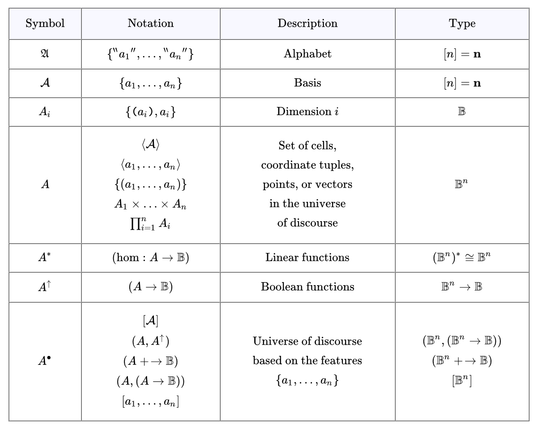
Before moving on, let's unpack some of the assumptions, conventions, and implications involved in the array of concepts and notations introduced above.

A universe of discourse A° = [a₁, …, aₙ] qualified by the logical features a₁, …, aₙ is a set A plus the set of all functions from the space A to the boolean domain B = {0, 1}. There are 2ⁿ elements in A, often pictured as the cells of a venn diagram or the nodes of a hypercube. There are 2^(2ⁿ) possible functions from A to B, accordingly pictured as all the ways of painting the cells of a venn diagram or the nodes of a hypercube with a palette of two colors.

A logical proposition about the elements of A is either true or false of each element in A, while a function f : A → B evaluates to 1 or 0 on each element of A. The analogy between logical propositions and boolean-valued functions is close enough to adopt the latter as models of the former and simply refer to the functions f : A → B as propositions about the elements of A.

Resources —

Logic Syllabus
https://inquiryintoinquiry.com/logic-syllabus/

Survey of Differential Logic
https://inquiryintoinquiry.com/2024/02/25/survey-of-differential-logic-7

#Peirce #Logic #LogicalGraphs #DifferentialLogic #DiscreteDynamicalSystems
#BooleanFunctions #BooleanDifferenceCalculus #CalculusOfLogicalDifferences
#PropositionalCalculus #DifferentialPropositionalCalculus #LogicalDynamics

Differential Propositional Calculus • 8

Formal Development (cont.) Before moving on, let’s unpack some of the assumptions, conventions, and implications involved in the array of concepts and notations introduced above. A universe o…

Inquiry Into Inquiry
Differential Propositional Calculus • 7

Formal Development The preceding discussion outlined the ideas leading to the differential extension of propositional logic.  The next task is to lay out the concepts and terminology needed to…

Inquiry Into Inquiry

Differential Propositional Calculus • 6.2
https://inquiryintoinquiry.com/2024/12/04/differential-propositional-calculus-6-b/

Cactus Calculus (cont.)

The briefest expression for logical truth is the empty word, denoted ε or λ in formal languages, where it forms the identity element for concatenation. It may be given visible expression in textual settings by means of the logically equivalent form (()), or, especially if operating in an algebraic context, by a simple 1. Also when working in an algebraic mode, the plus sign “+” may be used for exclusive disjunction. For example, we have the following paraphrases of algebraic expressions.

• x + y = (x, y)

• x + y + z = ((x, y), z) = (x, (y, z))

It is important to note the last expressions are not equivalent to the triple bracket (x, y, z).

Resources —

Logic Syllabus
https://inquiryintoinquiry.com/logic-syllabus/

Survey of Differential Logic
https://inquiryintoinquiry.com/2024/02/25/survey-of-differential-logic-7

#Peirce #Logic #LogicalGraphs #DifferentialLogic #DiscreteDynamicalSystems
#BooleanFunctions #BooleanDifferenceCalculus #CalculusOfLogicalDifferences
#PropositionalCalculus #DifferentialPropositionalCalculus #LogicalDynamics

Differential Propositional Calculus • 6

Cactus Calculus Table 6 outlines a syntax for propositional calculus based on two types of logical connectives, both of variable $latex k&fg=000000$-ary scope. A bracketed sequence of propositi…

Inquiry Into Inquiry

Differential Propositional Calculus • 6.1
https://inquiryintoinquiry.com/2024/12/04/differential-propositional-calculus-6-b/

Cactus Calculus —

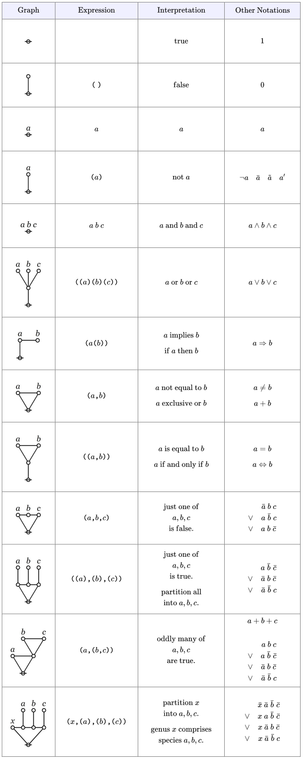
Table 6 outlines a syntax for propositional calculus based on two types of logical connectives, both of variable k‑ary scope.

• A bracketed sequence of propositional expressions (e₁, e₂, …, eₖ) is taken to mean exactly one of the propositions e₁, e₂, …, eₖ is false, in other words, their “minimal negation” is true.

• A concatenated sequence of propositional expressions e₁ e₂ … eₖ is taken to mean every one of the propositions e₁, e₂, …, eₖ is true, in other words, their “logical conjunction” is true.

Table 6. Syntax and Semantics of a Calculus for Propositional Logic
https://inquiryintoinquiry.files.wordpress.com/2022/10/syntax-and-semantics-of-a-calculus-for-propositional-logic-4.0.png

All other propositional connectives may be obtained through combinations of the above two forms. As it happens, the concatenation form is dispensable in light of the bracket form but it is convenient to maintain it as an abbreviation for more complicated bracket expressions. While working with expressions solely in propositional calculus, it is easiest to use plain parentheses for bracket forms. In contexts where parentheses are needed for other purposes “teletype” parentheses (…) or barred parentheses (|…|) may be used for logical operators.

#Peirce #Logic #LogicalGraphs #DifferentialLogic #DiscreteDynamicalSystems
#BooleanFunctions #BooleanDifferenceCalculus #CalculusOfLogicalDifferences
#PropositionalCalculus #DifferentialPropositionalCalculus #LogicalDynamics

Differential Propositional Calculus • 6

Cactus Calculus Table 6 outlines a syntax for propositional calculus based on two types of logical connectives, both of variable $latex k&fg=000000$-ary scope. A bracketed sequence of propositi…

Inquiry Into Inquiry

Differential Propositional Calculus • 5
https://inquiryintoinquiry.com/2024/12/03/differential-propositional-calculus-5-b/

Casual Introduction (concl.)

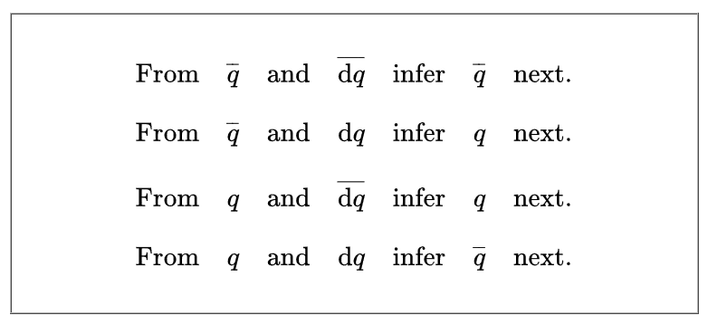
Table 5 exhibits the rules of inference responsible for giving the differential proposition dq its meaning in practice.

Table 5. Differential Inference Rules
https://inquiryintoinquiry.files.wordpress.com/2020/02/differential-propositional-calculus-e280a2-differential-inference-rules.png

If the feature q is interpreted as applying to an object in the universe of discourse X then the differential feature dq may be taken as an attribute of the same object which tells it is changing “significantly” with respect to the property q — as if the object bore an “escape velocity” with respect to the condition q.

For example, relative to a frame of observation to be made more explicit later on, if q and dq are true at a given moment, it would be reasonable to assume ¬q will be true in the next moment of observation. Taken all together we have the fourfold scheme of inference shown above.

Resources —

Logic Syllabus
https://inquiryintoinquiry.com/logic-syllabus/

Survey of Differential Logic
https://inquiryintoinquiry.com/2024/02/25/survey-of-differential-logic-7

#Peirce #Logic #LogicalGraphs #DifferentialLogic #DiscreteDynamicalSystems
#BooleanFunctions #BooleanDifferenceCalculus #CalculusOfLogicalDifferences
#PropositionalCalculus #DifferentialPropositionalCalculus #LogicalDynamics

Differential Propositional Calculus • 5

Casual Introduction (concl.) Table 5 exhibits the rules of inference responsible for giving the differential proposition $latex \mathrm{d}q&fg=000000$ its meaning in practice. $latex \text{Tabl…

Inquiry Into Inquiry

Differential Propositional Calculus • 4
https://inquiryintoinquiry.com/2024/12/02/differential-propositional-calculus-4-b/

Casual Introduction (cont.)

In Figure 3 we saw how the basis of description for the universe of discourse X could be extended to a set of two qualities {q, dq} while the corresponding terms of description could be extended to an alphabet of two symbols {“q”, “dq”}.

Any propositional calculus over two basic propositions allows for the expression of 16 propositions all together. Salient among those propositions in the present setting are the four which single out the individual sample points at the initial moment of observation. Table 4 lists the initial state descriptions, using overlines to express logical negations.

Table 4. Initial State Descriptions
https://inquiryintoinquiry.files.wordpress.com/2020/02/differential-propositional-calculus-e280a2-initial-state-descriptions.png

Resources —

Logic Syllabus
https://inquiryintoinquiry.com/logic-syllabus/

Survey of Differential Logic
https://inquiryintoinquiry.com/2024/02/25/survey-of-differential-logic-7

#Peirce #Logic #LogicalGraphs #DifferentialLogic #DiscreteDynamicalSystems
#BooleanFunctions #BooleanDifferenceCalculus #CalculusOfLogicalDifferences
#PropositionalCalculus #DifferentialPropositionalCalculus #LogicalDynamics

Differential Propositional Calculus • 4

Casual Introduction (cont.) In Figure 3 we saw how the basis of description for the universe of discourse $latex X&fg=000000$ could be extended to a set of two qualities $latex \{q, \mathrm{d}q…

Inquiry Into Inquiry