Drake University
This is the first in what will be a series of shorter blogs on hackers and journalists, or how the mainstream media can find itself caught up in trouble with the hacking subculture.
This particular story from the mid 1980s involves a reporter from a regional Iowa TV station in the United States. He contacted local hackers to help him film a five part special on computer security issues and wound up with a university threatening to sue the TV station for hacking related damages.
This is, to my understanding, the first time ever a journalist found themself in potential legal and ethical hot water through getting embroiled in a risky situation with hackers, it certainly wasn’t the last.
DES MOINES, Iowa – Drake University is trying to determine how much damage was caused when a Waterloo television station broke into the school’s computer with the help of computer hackers, a university official says.
Vice President Paul Magelli said the unauthorized entry Jan. 31 forced the system to be shut down for two days.
The hackers were working with reporter Van Carter from KWWL-TV, who was preparing a story on violating computer security. The station ran a five part series on the subject, which ended Wednesday.
Magelli told the Des Moines Register in a copyright story published Thursday that the university was considering suing the station. He said it would take several weeks to decide whether to sue and whether to discipline a student suspected of supplying the station with a computer access code.
Drake officials declined to identify the student.
Carter and his boss, Grant Price. KWWL vice president in charge of news. said the series did not reveal which computer was broken into.
But Carter told Drake officials when he became fearful that hackers would continue to rummage in the university’s computer after the station had broadcast the series.
“TV station breaks into college computer”, The Lewiston Journal, 6th March, 1984
KWWL-TV reporter Van Carter had wanted to grab viewer’s attention by revealing details of how hackers operate right there in KWWL-TV’s home state of Iowa. Unfortunately, the five part TV series on computer security he helped create is lost media now. My educated guess is, Van Carter or someone else from KWWL-TV in discussing how to go about producing this TV special discovered a local Bulletin Board System (BBS). This BBS was frequented by hackers and contact was established with them to see if they could help provide some real flavour for the show.
At this point, as I have written about on my blog on 1983 and hacking, the Inner Circle and 414s hacking groups had been busted the previous year. BBS hacker culture was being discussed in newspapers, WarGames had been and gone in cinemas and authorities and parents were worrying about teenagers and computer crime.
Van Carter realized that the hackers he had asked to be a part of his TV show were not interested in merely demonstrating that they could hack computers. They were going to actually hack a live VAX system at Drake University and were determined to make sure the university knew they had accessed it.
A 2017 blog by Drake University’s Newsroom includes details I haven’t seen published anywhere else, including that the hackers left a message on Drake’s VAX system: “We are far outside your realm. Faithfully yours, the New Overlords.”
The theory as to how the hackers were able to hack the university VAX that I have seen in coverage from the time is that a student from Drake University provided them details they needed for access. I could find no firm report of anyone from the university actually being involved, however. In his Congressional testimony, Drake’s President Dr Wilbur Miller specifically states that “the persons involved in the computer break-in at Drake University were not members of the University community.”
I think it is just as likely that the hackers were able to war-dial local phone numbers to discover modems or that university modem numbers were already known to local hackers or traded on a local BBS.
An internal memo from Drake University, shared with me by their archivist, notes that “the ability of KWWL-TV to influence individuals of dubious moral character to penetrate our system, may well have been based on their presentation to the “hackers” of Drake University as a NEW TARGET, rich with the promise of challenging security arrangements.”
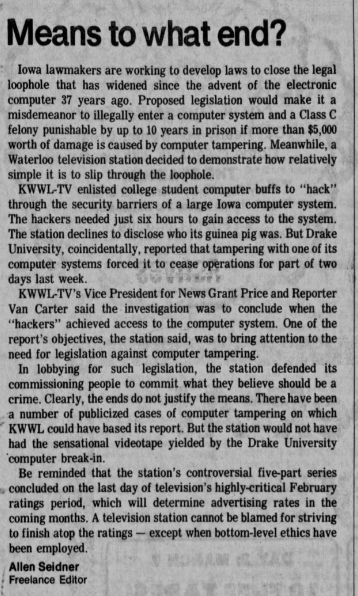
Writing in the Daily Iowan newspaper, Allan Seidner a freelance editor, in March of 1984 had some harsh words for KWWL-TV: “There have been a number of publicized cases of computer tampering on which KWWL could have based its report. But the station would not have had the sensational videotape yielded by the Drake University computer break-in.”
Seidner also pointed out that readers should “be reminded that the station’s controversial five-part series concluded on the last day of television’s highly-critical February ratings period, which will determine advertising rates in the coming months.” He concluded “a television station cannot be blamed for striving to finish atop the ratings — except when bottom-level ethics have been employed.”
“Means to what end?”, Allen Seidner, Daily Iowan, March 3rd, 1984
The KWWL-TV reporter at the center of it all, Van Carter, was quoted by Dr Wilbur Miller, President of Drake University when he testified to the Subcommittee on Crime of the House Committee of the Judiciary in Washington DC on March 28th, 1984.
“Our agreement [with the hackers] was that we wanted to prove that we could get in, and stop there. But after spending the night with these guys, I knew they weren’t going to walk away from it… I had a lot of people tell me hackers are amoral. I didn’t believe it until I saw these guys in action…. They were very arrogant. And they said all they wanted to do was work with computers. I’m not sure that I’d call it an addiction, but it was a fetish….”
Van Carter, KWWL-TV reporter
Dr Wilbur Miller described how on “the evening of January 31, 1984, one of Drake University’s computers was penetrated by hackers.” These individuals had no connection with the University as students, faculty or staff and had “gained access to the computer through a telephone connection from an off-campus location.“
Miller goes on to testify that as a “result of this unauthorized intrusion into the system, the University has been forced to dedicate scarce resources to the task of determining the extent and the effect of the intrusion.” He also states that University computer users now wonder “are my materials that I have stored in the computer system secure or have they been compromised?”
Eventually, KWWL-TV agreed to pay unspecified damages to Drake University for the damage and downtime caused to the hacked computer system.
Drake University press release, June 13th, 1984
What about the hackers themselves though?
As it turned out, hacking was not technically illegal in Iowa in early 1984. Drake University decided not to sue the hackers and seemed content with the settlement money and an apology from KWWL-TV.
Van Carter, the reporter who was central to the whole scandal, wound up becoming the vice president for news and public affairs at Sioux City KTIV-TV in April 1984, and went on to have a long and successful career in journalism.
DES MOINES (AP) – The Drake University computer “hackers” will not face criminal charges, but they still might have to pay a civil fine for breaking into the school’s computer system.
The Polk County Attorney’s office said current criminal law doesn’t allow charges to be filed against the hackers, who caused a two-day shut- down of the university’s computer in January. They were working for Van Carter, a reporter for KWWL-TV in Waterloo, who was doing a story on violating computer security.
Peter Bowers, an assistant Polk County attorney, said charges probably could have been filed if a bill passed recently by the Legislature had been law. Gov. Terry Branstad is expected to sign the bill that makes unauthorized access to a computer a simple misdemeanor punishable by a $100 fine.
The bill also provides more serious penalties, including up to 10 years in prison, for anyone who damages a computer system or destroys information in it. Bowers said it doesn’t appear that the Drake hackers did that.
“Computer hackers won’t be charged, driver license tampering may go to court”, The Daily Reporter, 26th April, 1984
I contacted the Drake University library for documents in their archives that relate to this incident, and have uploaded the documents they sent me to Internet Archive.
What can we learn from this story? Hackers had been a relative unknown at the start of 1983, but by the end of that year they were a hot topic, a novelty and a source of fear for some. From 1984 onwards, reporters went from reporting on the general existence of hackers on a fairly surface level to reaching out to them as part of reporting, or going “undercover” to interact with them on their own turf.
Over the years there has been a lot of friction between hackers, the media and hackers willing to speak with the media. The tale of Drake University, KWWL-TV and the hacker TV special that had unintended consequences is just the first of many such examples of reporters getting too close to the story of hackers and becoming a part of that story themselves. Or as Jim Waterbury, the General Manager of KWWL-TV put it back in 1984, “we got too involved in the problem we were trying to demonstrate.”
https://realhackhistory.org/2023/11/21/televised-drake-university-hack-of-1984-hackers-reporters/
#1980s #1984 #DrakeUniversity #hacker #hackers #hacking #history #Iowa #JimWaterbury #KWWLTV #NewOverlords #VanCarter #VAX #Waterloo #WilburMiller
 Colleen Theisen
 Ken
Ken
 realhackhistory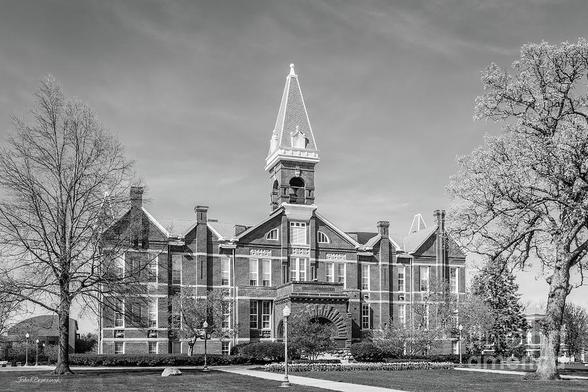

 Brett Callow