 Carmelite Quotes
Quote of the day, 29 December: Hermann Cohen
We love happiness, and Jesus Christ—true happiness, the only happiness possible—is not loved.
We love riches, and Jesus Christ, the inexhaustible treasure of the Father, abundance itself, eternal superabundance, is not loved.
We love pleasure, and Jesus Christ, the purest of delights, is not loved.
Whence then, my brothers and sisters, comes a contradiction so glaring, so revolting?
Ah! It is because He is not known. If you knew Him, my brothers and sisters, you would all love Him.
We study and examine everything—except Jesus, whom we ought to know above all. Jesus Christ is not known.
At this thought, the hermit leaves his retreat, the missionary crosses the seas, the martyr ascends the scaffold. And what do they seek? They seek to make people happy by leading them to know Jesus Christ.
Who, then, is Jesus Christ? From where does He come? Who is His Father, His homeland?
To this question, the prophet Isaiah, seized by holy enthusiasm, cries out: Generationes eius quis enarrabit? —
“Who shall ever recount His sublime generation?” (Who could have imagined his future, Is 53:8).
Let us attempt it nevertheless, my brothers and sisters. And whatever modern Jews may say—those who, in disputing the mysteries of the Trinity, appeal to this text of Moses: “Hear, O Israel, the Lord your God is one Lord” (Dt 6:4).
Let us answer them: God is infinitely simple—simple in essence, simple in substance, simple by His infinite nature; yet He is also infinitely good, and goodness, by its very nature, seeks to impart itself.
Since, therefore, the goodness of God is infinite, it must necessarily impart itself in an infinite manner. Yet it cannot do so with the creature, since the creature is finite.
It is therefore necessary that God impart Himself to Himself in an ineffable and infinite manner. And this He does by imparting His essence, His nature, to distinct persons—without separating it, without dividing it—while remaining one and the same God.
It is thus, my brothers and sisters, by this blessed necessity of imparting Himself infinitely, that God begets His only Son, His beloved Son.
Servant of God Augustine Mary of the Blessed Sacrament (Hermann Cohen)
Le bonheur n’est qu’en Dieu (Sermon, Saint-Sulpice, 1854)
Augustin-Marie du Très-Saint Sacrement 2020, Qui nous fera voir le bonheur? : sermons et autres textes, ed. S-M Morgain, Éditions du Carmel, Toulouse.
Translation from the French text is the blogger’s own work product and may not be reproduced without permission.
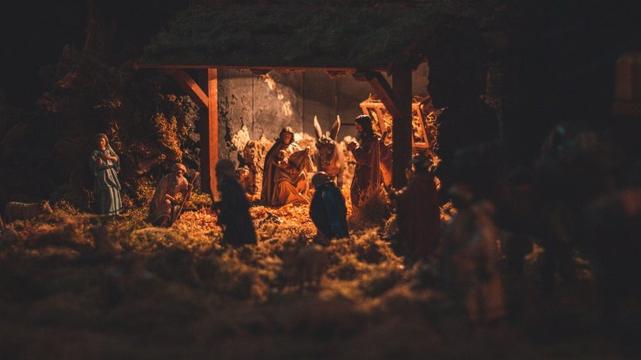
Featured image: Photo by Burkay Canatar on Pexels.com
#AugustineMaryOfTheBlessedSacrament #DivineSimplicity #HermannCohen #IncarnationOfChrist #JesusChrist
 Jewish conversations