Devil Places

There are countless places in the world named after the Devil (and variations of an evil one in other words and languages). If variations are added such as “Satan,” “Lucifer,” and “Diablo,” for example, the list is massive. Devil places sometimes owe their names to the geology. The features of these places may create a spooky and foreboding feeling that reinforces the local legends of the places being cursed, evil or enchanted.

These places have historically or very recently been associated with spirits, magic, strange phenomenon and/or death. In the U.S., many sacred places of indigenous peoples were renamed by the more puritanical sort as “devil” places in order to demonize the past (and previous spiritual beliefs). Devil places are particularly ubiquitous in New England, where the Puritans started their renaming. The rocky landscape gave them plenty of impetus. They truly believed Satan was about, ready to steal their souls. They considered Indian deities to be demons or devils. Spots where shamans would gather or practice might have been a place of geological uniqueness and were given a bad name by the newcomers.

Connecticut might be nicknamed the devil’s playground with some 34 place names including five Devil’s Dens, four Backbones, two Kitchens and a Dripping Pan, as well as a Hell Hole and two Satan’s Kingdoms. Massachusetts is the most devilish state, with 43 place names. Arizona is chock full of “devil” and “hell” names due to the hellishly hot weather suitable for demons.

Satan’s Kingdom

Legends say that Satan himself claimed the area now called Satan’s Kingdom in New Hartford, Connecticut as his own until the angel Gabriel decided the area was too idyllic and cleared out the dark lord and his band of demons. In Vermont, Satans Kingdom got its name supposedly because the settlers who expected fertile land got difficult rocks and hills instead. In Massachusetts, settlers came into the area in the 1670’s during King Philip’s War, where native villagers defended their land. The rough terrain and dangerous wildlife made it difficult for the settler-colonialists to conquer.

The Northern Cascades National park in Washington is very much a hellscape. The Backpacker.com site says of a hiking trail there: “The devil looms large on this rugged loop—you’ll pass Devils Creek, Pass, Park, Junction, and Dome—and you may curse like Satan during the initial 3,300-foot, 4-mile climb to McMillan Park”.

As you will see in this collection of Devilish places, they commonly are places of remarkable features, desolation, or treacherous traversing.

In 2013, Jonathan Hull did a map of US places with Devil-related names. Though many locations received their names from attributes other than geologically related ones, he noted that Devil-named areas often indicated a dangerous, extreme, or remote place. Sadly, I can’t find the full-scale map online anymore.

This is the best version I could find of Hull’s map.

While my collection is woefully incomplete, I did pick some notable Devil-named locations with geological connections. Several of these warrant their own pages on the site. Click on the titles to head to these pages:

Devil’s Tower
An iconic volcanic feature in the Black Hills of Wyoming was known as being the location in the culminating scene in Close Encounters of the Third Kind. It has become a draw for not only sci-fi enthusiasts but also UFO chasers and New Age believers.

Devil’s Den
To gain this place name, the location usually has stark, huge rock boulders or outcrops, often with caves and crevasses. Several famous locations exist in the U.S. where not only supposedly spirits but also people used as hiding places.

Devil’s Hole
A depression or cave often containing water that has gained a reputation of being deadly, a path to the underworld, or bottomless. (Or all three together). The most famous being the Devil’s Hole of Death Valley, a bizarre oasis in the desert.

Devil’s Kitchen
Scenic locations characterized by their impressive geological features that suggest something evil is cooking.

Devil’s Gate
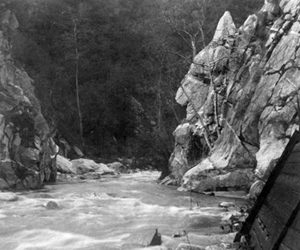
A cleft or gorge that is considered a dangerous area for natural or supernatural reasons.

Devil’s Punchbowl
Bowl-shaped depressions of various sizes that stand out from the landscape and may look as if they have been deliberately created for or from a nefarious action.

Some lesser known locations with ‘Devil’ names are just as curious. Their oddness prompted locals to bestow upon them an accursed name.

Devils Head Rock, North Carolina

Three locations in Pennsylvania have the name Devil’s Potato Patch to designate boulder fields. One is between Danielsville and Little Gap in Northampton County, just west of the Blue Mtn ski area off the Appalachian Trail. This is an otherwise featureless field of sandstone blocks resulting from frost action that broke up the ridge-forming rock. It is on State Game Lands and, like other boulder fields, is treacherous to traverse and home to sunning snakes. Another Patch is located on the border of Lebanon and Lancaster County near Brickerville. This “river” of diabase boulders is a wooded and graffiti-strewn, neglected and full of various hazards like trash, bottles, and poison ivy. The third is in Salford Township, Montgomery County, where the boulders of diabase will ring when hammered.

Another “Tater Patch” is a windy ridge with spooky twisted trees in the Great Smoky Mountains National Park of Tennessee/ N. Carolina.

Similar to these rocky landscapes is the Devil’s Marbleyard of the James River Face Wilderness, in the Blue Ridge Mountains at Natural Bridge Station, Virginia. The Virginia Trail Guide describes it thusly:

“…looks like an immense stone mountain exploded and collapsed into thousands of boulders of every shape and size.”

Australia also has the Devil’s Marbles, a scattered array of large granite boulders in a 4500-acre area of the Northern Territory which was the traditional land of the Warumungu, Kaytetye, Alyawarra and Warlpiri people. They call it “Karlu Karlu”. The rocks are set precariously and have been chemically and physically weathered into rounded shapes. One legend says the natives thought these were the eggs of the rainbow serpent. But the official management plan for the reserve explains the traditional origin:

The whole area of the reserve is known as Ayleparrarntenhe, which is also the name of the place of origin and final resting place of Arrange, the Devil Man—a twin-peaked hill to the east of the reserve. Traditional Owners tell the story of how the Marbles came into being:

Arrange, the Devil Man, came from Ayleparrarntenhe and travelled through the area. During his journey, he was making a hair belt (as worn by initiated men). Twirling the hair into strings, Arrange dropped clusters of hair on the ground. These turned into the Karlu Karlu boulders that can be seen today. On his way back, Arrange spat on the ground. His spit also turned into the granite boulders which dot the central part of the reserve. Arrange finally returned to his place of origin, Ayleparrarntenhe.

Removal or desecration (even climbing) of the rocks and smaller rocks of nearby Devil’s Pebbles (Kunjarra) is said to bring bad luck to the tribes.

Several rocky areas are also called Devil’s Garden with unique vegetation or none at all. The Devil’s Garden portion of Arches National Park in Moab, Utah features “arches, spires, and a large concentration of narrow rock walls called “fins”. The fins are the result of erosion along parallel fractures.

Devil’s Garden, Utah

A section of the High Lava Plains of central Oregon is a kipuka (an area isolated by surrounding lava flows) also known by this name. It was formed from fissure eruptions of basalt.

The Devil’s Playground is not your typical place of joy and laughter, but a grouping of granitic rock features weathered into fantastic forms and eerie shapes. A Tertiary-age (approximately 38 million years old) granitic intrusion overlying Paleozoic (400 to 300 million years old) sedimentary rocks is known as the Emigrant Pass pluton.

Devils Playground, Utah

The deadly Devil’s Playground in the Mohave Desert of California was the nickname pinned on a 17-mile stretch of drifting sand that had neither a track to follow nor water to drink.

In Tennessee, near vertical bedding produces huge rock formations that look like fins (or teeth) protrude from the Southwest flank of Cumberland Mountain known as the Devil’s Racetrack. Hikers and climbers must watch for falls from these rocks.

The Devil’s Race Course is a boulder field in Dauphin County, PA. Rock outcrops along the ridges provided the now rounded boulders. Stream flow from Rattling Run has washed away all the finer sediment. Sometimes the stream can be heard under river of rock. Legend has it that the area’s early settlers believed the sound of the water was the devil running through the depths of hell.

Devil’s Racecourse, PA

The term Devil’s Elbow often refers to an obvious and problematic bend in a river or a road. Most notably, in Pulaski County, Missouri, a sharp turn in the river has this unlucky name. Switchback bends along a hillside are constructed to navigate a steep slope. One such tight curve along a road bordering a rock cliff in New York has an associated legend of the vanishing hitchhiker. The road was eventually straightened to avoid mishaps.

The Devil’s Windpipe is a natural chute in the rocks in Arizona. When the wind blows across the hot landscape, it’s said it feels like the breathing of the devil himself. The Devil’s Throat is a remarkable cave in Bulgaria that swallows the Trigrad River where it funnels through the Hall of Thunder. This cave in the Rhodope Mountains is associated with the legend of Orpheus descending into the underworld to look for Eurydice. There is also a large sinkhole called the Devil’s Throat near Lake Mead in Nevada.

Multiple features exist with the name Devil’s Backbone which typically indicates a prominent ridge of rock that looks like a spine or teeth. Iowa has a state park characterized by a narrow and steep ridge of bedrock carved by a loop of the Maquoketa River. The towers, columns and rocky cliffs make for precipitous climbing. Maryland also has a park where a rock ridge 512 feet above sea level was formed by erosion at the confluence of the Antietam and Beaver Creek and is a noted scenic area. A narrow jutting of rock from a ridge forms a distinct “backbone” across the landscape west of Loveland, Colorado. A particularly striking vertical wall of dark andesite about 1,000 feet long exists within the volcanic crater of Crater Lake, Oregon. The dike was formed when molten lava filled cracks as it forced its way upwards and then solidified. Erosion of the surrounding material has left the resistant material standing. The Illinois “Backbone” is a rocky landmark on a ridge in the Grand Tower area. The rapids near here were supposedly very dangerous and native legends evil spirits were responsible. Nearby is the Devil’s Bake Oven – a nearly 100’ rock on the edge of the river where folklorists have documented ghostly visions and sounds.

Devil’s Backbone, Loveland CO.

About 80,000 to 100,000 years ago in eastern California, basaltic lava gushed from fissures and formed a lake within a glacial-formed valley some 400 feet deep. The lava cooled slowly, forming the hexagonal columnar structure that is so striking (also present in Devil’s Tower and Giant’s Causeway), resembling a pile of posts. Thus, it’s called the Devils Postpile. Glaciers smoothed and scarred the top of the formation. Devils Postpile (no apostrophe – which is the case with most official U.S. “devil” monuments) is now a national monument. A Little Devils Postpile exists in Yosemite.

Devils Postpile National Monument

Devils Lake in Wisconsin, part of a state park, is situated in a deep chasm formed by glacial action. It has no visible inlet or outlet. The lake was originally called “Sacred Lake” or “Spirit Lake” by the natives who considered it sacred where voices of the spirits could be heard. Glacial striations mark the rock surfaces around the lake and there are Native effigy mounds nearby. The lake has spooky legends of a phantom canoer, and lake monster, and some stories say the natives considered it a “place of many dead”.

A similar lake exists in North Dakota, also in a closed basin and also renamed from the Natives’ interpretation of “Spirit Lake”. This lake has been plagued with flooding problems.

Seven Devils Lake is a small reservoir in South Arkansas, located about 14 miles (23 km) out of Monticello. The Lake is formed by Seven Devils Dam. The area got its name from a man who was trapped in the area for days and finally made it out. A reporter asked if he found the rumored seven lakes of the area, but the man stated that there were not seven lakes, but seven devils. This area is the most northern point west of the Mississippi River where American alligators can be found.

Many bare mountain summits are named for their stark barrenness. Several rocky scenic outlooks called Devil’s Knobs are recognized around the world. There are many places called Devil’s Peak often referring to an imposing, rocky mount. Such peaks are in Cape Town in South Africa, Hong Kong, Flanders Range in Australia, Soda Springs, California, Santa Barbara, California, and in Nevada. A location in Baja, California has the Spanish name Picacho del Diablo and is also known as the Cerro de la Encantada or “Hill of the Enchanted”. It is a ragged granite summit that makes for a popular but challenging climb.

Mount Diablo in Contra Costa, California is awash with legends and has a reputation as a strange place. Now a state park, it was historically an important landmark for mapping and navigation because of its visibility and location. It is a geological anomaly, part of a thrust fault complex, growing higher every year due to compression of tectonic plates. Native tribes have various legends about it included the mountain as a point of creation. A notable legend of how the mountain got its name was from a misinterpretation of “Monte del Diablo” meaning “thicket of the devil” after several Natives escaped from the Spanish in 1805 into a nearby thicket. Not long after, the name was interpreted to mean a place of evil spirits. It’s not clear if this name was derived from a genuine tradition of spooky happenings in the area and there have been several attempts to rename the mountain to shake off the diabolical reputation. Author Loren Coleman writes that many unusual incidents have occurred in the Mount Diablo area, appropriate for its reputation, including sightings of black panthers (a difficult-to-explain animal that is reported all too regularly), mysterious lights, apparitions and even a claim of a live frog found in a stony concretion.

West Face of Mount Diablo and Highway 24. By Trurl66 – Own work, Public Domain, https://commons.wikimedia.org/w/index.php?curid=5526277

So-called Devil’s bathtubs are deep spots in a creek popular with visitors looking to cool off. In Hocking Hills State Park, Ohio, water falls from rock ledges into the stream where the water swirls into a bowl-shaped gorge. People told stories of this being as deep as hell. The pockets and tunnels were formed from scouring glacial meltwaters thousands of years ago.

In Scott County, Virginia, the Bathtub is a scour pool in the Devil’s Fork of Stony Creek. It’s not the easiest spot to get to and the water is far from hot. Many photos of the location have circulated on social media but these seem to be from the Ohio location, or from some other feature entirely, leading many to be disappointed when they reach this particular tub.  The overabundance of visitors prompted by social media has caused local problems and threaten the natural area. The South Dakota version of the devil’s tub is much more secluded. With high rocky cliffs nearby, the water cascades in a chute called “the slide” and swirls into the tub.

According to Wikipedia, there are no less than 105 different locations of the Devil’s Canyon in the United States alone including Utah, Oklahoma, and California. Areas with this designation are typically steep, remote, and have plentiful snakes as residents. In Lincoln National Forest, New Mexico, Devil’s Canyon, so far as anyone knows, is so named because of the pinnacles – needles and balanced rocks that form the canyon walls and resemble distorted human forms. A 2017 TV show called “Devil’s Canyon” is based in British Columbia. It is the story of three gold prospectors seeking treasure in the canyon where they believe large deposits have escaped exploitation by big mining companies. But the rough, isolated terrain, bad weather, and wild animals make it an unforgiving location to explore.

A rock formation where the lower strata is more eroded and weathered leaving a larger slab perched precipitously on top are called “tea tables”. Such formations are a variety of hoodoo. Notable examples of Devil’s Tea Tables exist in Athens County, Ohio and in Illinois’ Shawnee National Forest. These features appear to lean in every direction, so whatever side you view it from, it looks like it will fall on you. A tea table feature in McConnelsville, Ohio collapsed in 1906.  Explorers who came across the gravity-defying features often attributed their origin to supernatural forces.

Devils Tea Table, McConnelsville

Not necessarily natural are the standing stones in North Yorkshire, England, called Devils Arrows. Legend has it that the Devil himself threw the stones into the ground as arrows to attack Christians in Aldborough but they fell short. The prehistoric monuments likely were constructed as part of a ritual landscape. Similarly, the Devil’s Quoits in Stanton Harcourt are also part of a Neolithic-age stone circle. The legend here is “the Devil once played quoits (a game) with a beggar for his soul or, alternatively, that it was a Sunday and God rebuked him whereby he flung the stones in anger. Many stone circles and henges in the UK remain imbued with New Age and mystical significance.

The most famous Devil’s Gulch, in Garretson, South Dakota, is rife with legends. This 18-20 foot chasm across blocks of quartzite is said to have obtained its name from strange noises made by the winds as they blow through. Split Rock Creek below is associated with a “bottomless pit” in the stream bed. (If it’s bottomless, how does the stream flow over it?) A Native tale tells a different origin story. They called it “Spirit Canyon” and that it was formed when two warriors fought. When the spirit warrior’s tomahawk hit the ground, it split the land forming the gulch. But the most famous legend, now marked on the spot, is that outlaw Jesse James made a getaway by leaping the gap on his horse. The location is now a park and also has Devil’s Falls and the Devil’s Stairway nearby.

When Satan needs a rest, he chooses Devils Throne, a summit in Idaho County, Idaho. It forms part of the Seven Devils Mountains. Or the Devil’s Chair in San Gabriel Mountains is part of the Devil’s Punchbowl.

What is really haunting the Devil’s Swamp in Scotlandville, Louisiana are nasty chemicals that have been poured into it, destroying the ecosystem over the years leaving ghosts of those animals (and people) dead from pollution. Beware when visiting this toxic stew. The Seven Devils Swamp natural area in Arkansas, however, is a healthy and diverse ecosystem.

Part of the Craters of the Moon National monument, Idaho, Devil’s Orchard has trees and vegetation growing from the flood basalt lava flows of the Snake River Plain volcanic province. The Orchard is a group of lava-transported cinder cone fragments that were once part of the North Crater cinder cone but broke off and were carried away by a new lava flow. The place is described as “otherworldly” with the black rocks providing no shade. Shoshone legend speaks of a serpent on a mountain who, angered by lightning, coiled around and squeezed the mountain until liquid rock flowed, fire shot from cracks, and the mountain exploded. Craters of the Moon National Monument was proclaimed on May 2, 1924 by U.S. President Calvin Coolidge to “preserve the unusual and weird volcanic formations”

Devil’s Orchard, Idaho

In the Big South Fork National River and Recreation area in Kentucky/Tennessee, legend has it that a band of brothers looking for salt drilled a well so deep that it hit oil. They became concerned that the well was so deep, it might reach Hell. Finally, they did strike something, but instead of salt brine coming out of the ground a black, smelly, sticky liquid came oozing out of the pipe. These explorers did not know what oil was, and since they were of a religious nature, they were disturbed about the new-found product. When they saw how this black substance burned, they called it Devil’s Tar. One of the crew was sent downstream with a sample but his raft overturned at the rapids. Later, he told the story that the devil himself, angry at the invasion of his domain, leaped from one of the rocks onto the raft sinking it. The rapids were named the Devils Jump.

Two other Devil’s Jumps occur in England. Three little hills near Frensham are said to have been thrown up by the Devil taking three enormous leaps. The Devil’s Jumps in Churt, county of Surrey, (also known as Devil’s Three Jumps) are a series of three small hills made of “ironstone” making them resistant to erosion. The devil made his mark all around this area, according to legend, as several local landmarks play into the story of his visit. For example, the tale goes that Devil made off with the cauldron of the witch, Mother Ludlam. As she chased him, the Devil’s leaps kicked up hills now known as the Devil’s Jumps. He left the cauldron on Kettlebury Hill and also left a valley known as the Devil’s Punch Bowl.

Another tale tells that the Devil amused himself by leaping from the top of each hill to the next. This annoyed the god Thor who picked up a boulder and threw it at the Devil, causing him to flee. The boulder remains at Devil’s Jumps. The same story is told of the Devil’s Jumps near Treyford on the South Downs in West Sussex though these are barrows upon which the Devil jumped.  Other round barrows in Stoughton are also called the Devil’s humps.

Similar to the Jumps are the Devils Footprints – grassy meadows that top some peaks in the Appalachian mountains, particularly in the Great Smoky Mountains. These peaks, also called “balds” are where trees won’t grow, legendarily because the devil himself stepped there. More realistic theories are that the treeless patches are the result of past clearing, animal grazing or burning. Or that the soil, climate, or biota prevents trees from growing. It’s not clear why some summits are bald where others are not.

Apparent “footprints” in rock appear at Devils Foot Rock. Many colorful tales are told of the Devil himself leaving the prints as he pursued maidens or stomped in frustration.

Devil’s Promenade in extreme southwestern Missouri is the site of a regionally noted “spook light”. The locals named the four-mile-long gravel road on the border between southwestern Missouri and northeastern Oklahoma west of the small town of Hornet, Missouri. Hornet is famous for the Hornet Spooklight (also called the Joplin spooklight) – a seemingly unexplained light that appears in the distance. Some have explained it as normal lights from cars or trains and others insist it is paranormal in nature. The bridge along the Devil’s Promenade was originally a rickety wooden bridge. Legend had it that “anyone who walked back and forth across the bridge five times (or seven or three depending on who you ask) very slowly and asking for the Devil to appear, he would either answer three questions, grant three wishes or of course, kill you. Again this depends on the version you hear.” A concrete bridge was constructed and the story seems to have diminished. One story of the light’s origin was that it is the Devil swinging his Jack-o-lantern. Other stories, according to the Prarie Ghosts website, says the light represents the spirit of two young Quapaw Indians who died in the area. Another claimed the light was the spirit of an Osage Indian chief who had been beheaded on the Devil’s Promenade. As with many spook light stories, the light represents a torch carried by the ghost as he searches for his missing head. The torch motif also shows up in the version of the legend that a miner is searching in vain for his missing children by lantern light. Tellers of these tales claim that the lights and legends existed in Native lore prior to the construction of this road.

Many impressive masonry structures are named the Devil’s Bridge and have associated lore to go with them. The bridge in Sedona, Arizona, in the Coconino National Forest, is a large natural sandstone arch. In Massachusetts, the Devil’s Bridge is a shallow reef running northwest off the northwest corner of Martha’s Vineyard. This hazard to ships was supposedly created by the mighty giant Moshup. The local Wampanoag tribal history tells the tale:

Moshup was building a bridge to Cuttyhunk with heavy boulders when a giant crab latched onto his foot. In his pain and anger, he gave up leaving a treacherous shoal instead. The area has been the site of several shipwrecks.

In North Carolina’s Pisgah National Forest is the Devil’s Courthouse. According to Andrea Lankford:

“Cherokees believed an evil spirit [or giant} named Judaculla held court on top of this bare rock summit with a 360 degree view of three states”.

By bradploeger – originally posted to Flickr as Devil’s Courthouse, CC BY-SA 2.0, https://commons.wikimedia.org/w/index.php?curid=4237496

Whiteside Mountain in Jackson County, North Carolina also has a feature of this name. The bare overhanging rock is windy and dangerous.

The Devil’s Apronful cairn consists of a heap of rocks and boulders near Pendle Hill in Lancashire, England. Several natural boulders were used to construct the mound which provides an impressive view both now and back in Bronze Age times. The thousands of rocks of gritstone and sandstone are scattered in a roughly circular area. The area however is mostly limestone. It’s been suggested that the stones were glacial erratics and the stones were gathered by farmers to get them out of the fields. But there are more fantastic origin stories. The Devil was annoyed with people at Clitheroe Castle in the west. To do away with it, he filled an “apron” (quite the visual) with rocks to pitch at them. Most missed and in his rage he dropped the rest on this south side of Pendle Hill, creating Apronful Hill. For the similar Apronful in Yorkshire, the tale is that the Devil was collecting stones in his apron in order to build a bridge or fill in the ravine when his apron string broke (or he tripped) and the stones fell out. The Devil’s Apronful sites were disturbed by curious visitors and looters but are now protected.

The Devil has two “Hopyards”. One is a State Park and public recreation area in East Haddam, Connecticut. There are several ideas about how the place got its curious name. One is that it refers to supernatural origins for the naturally occurring potholes in the area. These potholes were formed by the grinding actions of stones moved downstream by the current when trapped in an eddy, wearing a depression in the rock. To the early settlers the potholes were a great mystery, and as with many “devilish” features, they explained them with references to the supernatural. They thought that the Devil has passed by the falls, accidentally getting his tail wet. This made him so mad he burned holes in the stones with his hooves as he bounded away. A sign in the park tells of the legends regarding the name. Another site with this name is in New Hampshire. This is a boulder-filled ravine where you can sometimes hear water running.

Devil’s Dyke (or ditch) near Bleaklow, in Sussex, England is a deep gully supposedly cut by Satan’s claws when he became enraged at the loss of a prospective soul. Other tales say it is his unfinished ditch as he bet St. Cuthberth he could dig it in one night and flood the town. The tourist-attracting feature is really the result of mass wasting and river erosion into a dip-slope valley. The V-shaped dry valley, the deepest in England, was born from the cold climate of 14,000 years ago when this area of chalk bedrock was covered in snow. During warm seasons, the upper layers of soil and weathered rock slid away with the thaw. Finally, an ancient river carried the material away at the end of the Ice Age. That river is now gone but its valley remains. The high hill showed the surrounding terrain and was used as a defensive position as well as being an impressive location to hold special events. Remains of an Iron Age fort have been found here. The location is managed by the National Trust and is a recreational area. A trail supposedly leads to the alleged burial site of the Devil and his wife. In 1900, a sound called The Howling Terror was heard echoing in the valley. It wasn’t demons but the testing of a new invention called the megaphone being used at the amusement park on the top of the Dyke.

—————
The information provided here is based on a cursory search of these sites and the entries will be expanded as I discover new source material (or visit them!). Please contact me with your corrections, information (preferably with solid references), and photographs and I will gladly add them to the page. Or, leave your contribution in the comments. Thanks!

Book References

Coleman, L. (2001). Mysterious America (Revised edition). Paraview Press.

Lankford, A. (2006). Haunted Hikes. Santa Monica Press.

#devil #devilPlaces #devilsBackbone #devilsElbow #devilsGarden #devilsPlayground #devilsPostpile #devilsRacecourse #devilsWindpipe #devilsLake #mountDiablo #satan

https://sharonahill.com/?p=738

Devil’s Punchbowl

All around the world are remnants of a party of epic proportions – Devils Punchbowls. Though, in some cases, the punching was taken more literally. Typically, the name means a low circular-shaped area that is obvious from the surrounding land. Sometimes the features contain water. Many of these places have interesting folklore stories about their formation.

Devils Punch Bowl, Oregon (Wikipedia Commons)

U.S.

A steep-walled travertine geothermal feature in the Monitor Valley of Nevada is also known as Diana’s Punch Bowl or the Devil’s Cauldron and filled with hot water. Don’t try to take a dip, you’ll be left to slowly simmer to death in the deep pit. The water is only accessible by rope, which is crazy dangerous. Obviously, the name derives from its hot spring origin. In August of 2020, a guy named “TechRax” tested the durability of an iPhone 11 by dropping it into this hot spring via drone. In one attempt, he publicized that there was a strange screaming sound recorded before the phone gave out. People could not resist likening this to the screaming voices from hell (see “well to hell” video clip); it is a “devil” hole after all. But the sound was more likely that of gas escaping in the echo-y cavernous space. No deaths have been documented here as far as I could find.

In Lake Crescent, Washington is a popular swimming and diving area with the name. Lake Crescent is a very deep body of water with colorful legends and lore including being bottomless, swallowing up people and treasure, and having its own monster. The lake formed in a glacial valley that experienced a massive earthquake and subsequent landslide that formed adjacent lakes Crescent and Sutherland. According to oral tradition:

Lake Sutherland was split off […] when nearby, 4,537-foot Mount Storm King, angered by fighting between the Klallam and Quileute peoples, cast a massive boulder between them to stop the fighting, says Jamie Valadez, a Lower Elwha/Klallam tribal member. It separated the big lake tribal members called Tsulh-mut into two pieces, the smaller becoming little Lake Sutherland.

The perceived danger in the depths of this quiet part of the lake likely earned it its dark name.

Oregon’s Devils Punch Bowl State Natural Area is a large bowl-shaped natural rock headland partially open to the Pacific Ocean on the Central Oregon Coast. The ocean waves roar and swirl into the hollow formation. This punch bowl was probably created by the collapse of the roof over two sea caves, then shaped by wave action. It is only safe to approach at low tide.

California has many such named places including a collapsed sea cave in the Russian Gulch State Park in Mendocino County, a snow-fed lake in the Siskiyou Wilderness in western Siskiyou County, a small explosion crater that is part of the Mono-Inyo Craters chain, and Cedar Creek Falls, a spectacular waterfall in San Diego.

The Devil’s Punchbowl within the San Gabriel Mountains and the Angeles National Forest is an area of rugged sandstone layers along the Punchbowl Fault in Los Angeles County. A deep canyon formed from a V-shaped plunging syncline. The Devil’s Chair lookout point is a jutting rock formation that offers panoramic vistas of the valley floor and the sandstone formations. The bizarre-looking rock layers were oriented into their nearly upright position by uplifting along the local faults and enhanced by subsequent erosion.

Devils Punchbowl, San Gabriel Mountains, CA, as seen from the Devil’s Chair (Wikimedia Commons)

Finally, far from the coast is a Devil’s Punch Bowl in Mississippi that may have served as a possible base of operations for bandits and river-going pirates. This natural cut into the bluff along the Mississippi River at Natchez was rumored to have hidden the outlaws… and maybe their treasures. It’s a pristine area with an infamous reputation.

Canada

The Devil’s Punch Bowl of Stoney Creek, Ontario is a glacial-derived feature that is part of the Niagara Escarpment which also produced Niagara Falls. The main falls consist of a narrow stream falling 37 m. According to the Hamilton (ON) Conservation Authority, “The Punch Bowl is the only area where one can view such a large vertical display of Ordovician and Silurian stratified rock. Some of the layers include Queenston Formation red shale, Cabot Head gray shale, limestone and shale dolomite.” It’s a popular geological teaching spot due to the exposure. The name derived from the dramatic feature as the observers thought it was too strange to be named after God. Or, the name was related to the local moonshiners who were labeled as doing “the Devil’s work”. The site was used as an evil location in the 2006 horror movie Silent Hill. Decreased flow in the creek means the water may only be a trickle during a dry spell.

Devil’s Punch Bowl falls near Hamilton, Ontario, CAN. (Wikimedia Commons)

Europe

There are several punchbowls around Europe.

In Ireland (Killarney, County Kerry), there is a glacial cirque on Mangerton Mountain that provides outstanding views. The story about the name goes like this: Local chieftain O’Donoghue Ross had a nasty argument with the Devil whereby he punched him in the face. Perturbed, the devil bit off the top off the mountain and threw it at the chieftain. The punchbowl lake is the missing piece and which missed its mark but fell in Muckross Lake to form Devil’s Island.

In Wales (Ceredigion), eroded rock chambers directly below Devil’s Bridge is also called the Devils Cauldron as the water boils and churns as if “troubled by some evil spirit”. The popular origin of the Devil’s Bridge itself is the story of Megan, her cow, her dog, and the Devil.

On Scotland’s Isle of Arran, legend tells that the side of the mountain was punched out by the Devil and some say that his face can be seen in the rugged terrain if the light is just right. The Arran’s distillery appropriately produced a series of whiskeys named the Devil’s Punchbowl.

A large natural amphitheater near Hindhead, Surrey, in England also holds the popular moniker. The collapse feature is thought to be a result of erosion from water moving in the clay beneath the sandstone. Several legends exist that attempt to put a fun spin on the geological history. One involves the Devil and Mother Ludlam. She was a witch who lived in a cave near Waverley Abbey. When the Devil stole her cauldron, she pursued him to Hindhead, where he disappeared forming the Punchbowl. Another tale states that the Devil was feuding with Thor, who was at nearby Thursley, when they began hurling rocks at each other. The Devil carved out the Punchbowl by scooping out an enormous handful of earth to hurl back. Finally, the Devil was said to be annoyed at the churches springing up in the area that he tried to dig a channel from through the South Downs from the English Channel and flood the area. Each lump of earth he tossed aside became local landmarks. When dawn was about to break, he leaped into Surrey, landing in what is now the Punch Bowl. It’s been featured as a spooky area in or inspiration for several works of fiction; it is now a nature preserve.

In the Mendip Hills of Somerset, England is another collapse feature with the name, this one karstic, that has been declared a geological Site of Special Scientific Interest. Known as the Wurt Pit and Devil’s Punchbowl, the stratigraphy is a series of limestones and clays which have been silica-enriched (known as the ‘Harptree Beds’, of early Jurassic age). This mineralogical activity also created ore-fields of limonite, yellow ochre (hydrous ferric oxides), barite (barium sulfate), sphalerite (zinc sulfide) and galena (lead sulfide).

#California #Canada #DevilPlaces #DevilSCauldron #England #Ireland #IsleOfArran #Mississippi #Nevada #Ontario #Oregon #Scotland #Somerset #Surrey #US_ #Wales #Washington

https://sharonahill.com/?p=783

Diana's Punchbowl - Wikipedia

Devil’s Gate

Several sinister and infamous places around the world have been named the Devil’s Gate and come with legends of murder, magic, and monsters. Let’s take a brief tour.

This interesting and creepy rock formation in Idaho is also known as Massacre Rocks. The pioneers through this land feared attacks from Natives while passing through this boulder-strewn area. It is now a state park. The location, along the Snake River, was altered by the Bonneville flood catastrophe 14,000 years ago that dumped these rocks here.

Devil’s Gate, Gate of Death or Massacre rocks. By Decumanus, Wikipedia, CC BY-SA 3.0, https://commons.wikimedia.org/w/index.php?curid=4039854

The Sweetwater River carved a narrow cleft in the granite about 370 feet deep and 1,500 feet long, ten times wider at the top than at the base. The river cut through the millions of years old sediment and volcanic ash and scoured the remaining rocks as well. Devil’s Gate is one of these erosional features. It was an important landmark for settlers traversing the state. As with the history of place names, it’s difficult to determine which came first, the diabolical name or its reputation. Apparently, this location was the site of several murders in the region. But one particular legend, recorded by Matthew Field of New Orleans who traveled up the river in 1843, tells of a tusked monster who roamed the valley and harassed the Natives. Finally, the locals trapped the beast and shot at it with arrows. The angry beast tore the rock with his tusks and escaped.

Devil’s Gate, Wyoming. By Ryan Reeder, Public Domain, https://commons.wikimedia.org/w/index.php?curid=4466742

The most infamous Devil’s Gate is in Pasadena, California, off the 210 Freeway near La Canada, and comes with an array of tall tales of devilry that took place there. The rapids of the Arroyo Seco here make a beating, laughing sound which, in the Tongva-Gabrieliño traditional narratives, was attributed to the coyote spirit. They may also have thought it was an evil place. Already, it has a bad vibe. One source says that it was named because of the resemblance to the Devil’s Gate in Wyoming. Normally, a dry channel, the natural dam that existed here burst under heavy flow sending a flood downstream. A rocky face remained in the granite that reminded some of the face of Satan himself. Using the human propensity to see faces in everything, you can imagine the profile of a hooked nose, jutting chin, and a forehead slopes up to the horn at the top.

This appears to be an early picture of the face at the gate when water flowed past the dam. PD-US, https://en.wikipedia.org/w/index.php?curid=5100054

Additional flooding prompted the city to construct a robust dam there.

The Native folklore about the place being a spirit dwelling or communication place may have reinforced interest by modern seekers of magick and mystery. Occultists such as Jack Parsons – a rocket engineer from the nearby NASA Jet Propulsion Lab – and Aleister Crowley, the so-called “Great Beast” himself, thought the place enchanted and one of the portals to Hell. Parsons, a follower of Crowley’s, reportedly performed not only rocket tests here but occult rituals near the dam. Read about their ideas here and listen here. Take a virtual trip here. Rumor has it that they attempted to open the portal to Hell and so a former picnic spot was now forever tainted with Satanic storytelling. Modern paranormal investigators visit the location and attribute any anomalies to spirits. Many also believe that a curse on the place or the remaining “negative energy” plays a role in the disappearances and deaths in the area. Children went missing along the trails. The face remains with a nearby “gate” securing an outfall tunnel around the dam. It remains a very popular haunted spot because of the tales and the demonic face. Sadly, graffiti and garbage litter the area.

Modern view of the Devil’s Gate and face.

#California #DevilPlaces #DevilSGate #granite #Idaho #JackParsons #occult #Wyoming

https://sharonahill.com/?p=749

Devil's Gate - Wikipedia

Devil’s Kitchen

Something evil may be cooking up in places given the name of the “Devil’s Kitchen”. In this piece, I examine some of the most famous locations that have earned this unpleasant name. It sounds like someplace you don’t want to end up but in reality, the various “DKs” are geologically interesting and fascinating places.

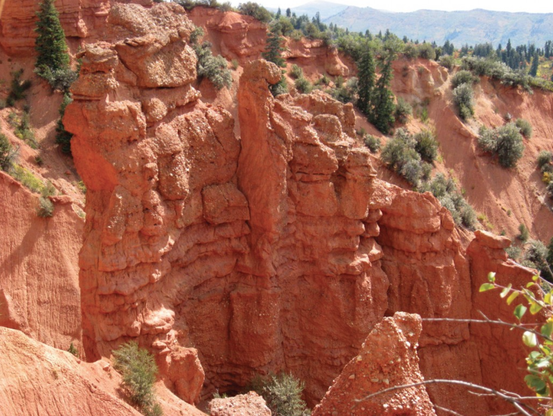
There are three places in Utah called Devil’s Kitchen. One in Millard County is a volcanic formation named for the unusual sound that the rocks made when wagons crossed it – “like tapping on a drumhead or on the flat tin roof of the devil’s kitchen”. Some of the boulders along the Devil’s Kitchen fault scarp here contain petroglyphs. The Devil’s Pocket trail in the Canyonlands National Park near Moab “is a little like walking down a long, wide racetrack, with parallel walls of sandstone that rise along either side like bleachers for the imaginary spectators”. This leads to another “kitchen” featuring a quite place of rounded blobs and tall spires of banded rock. But the most popular DK in UT is the scenic sculpted rock landscape with pillars of red sandstone along the Nebo Scenic Loop in the Uinta State Forest. Consisting of a red, iron-rich conglomerate, the outlook is accessible to wheelchairs, strollers, and kids.

The red hoodoos formed by erosion, can look like fantastic figures. (Utah Geo Survey)

The Devil’s Kitchen in Sedona, Arizona is a vertical sinkhole that appeared in the early 1880s due to a sudden collapse of the rock cave roof. It expanded with another collapse in 1989. The area is considered unstable. The limestone weathered deep under the surface and is not obvious through the overlying sandstone. More unstable hidden areas may exist in the area.

Five miles east of Greybull, Wyoming, is a dry and barren badlands landscape. It’s “bad land” as plants don’t grow. The land is steep slopes and ravines, with colorful spires of rock. The Devil’s Kitchen here is an asymmetric anticline. The Geology of Wyoming site says “Devil’s Kitchen was originally known by the less dramatic name of Shell Dome, but tourist attractions need a name that is hot and spicy.” Oil wells drilled here came up empty but you may find dinosaur gizzard stones called gastroliths among the colorful layers.

It’s not clear how the Devil’s Kitchen of Burlington, Connecticut got its name. But one blogger thinks it derived from either the treacherous steep walls or the abundance of biting insects.

The Devil’s Kitchen Lake in Illinois is one of the deepest lakes in the state – up to 90 feet –  formed from glacial downstream effects. Swimming is dangerous (and banned) because of the cold deep water and various tree stumps that remain under the water. The Natives believed the lake had a sinister nature.

At Mackinac Island, Michigan, a small shallow cave called Devil’s Kitchen was formed in breccia limestone. The cave formed during the Nipissing post-glacial period by the waves of Lake Huron. It consists of two hollows on top of each other, resembling a face with a giant maw. Local legends say that the Natives considered the cave inhabited by evil cannibalistic spirits with soot on the outside marking the cooking fires – hence the name, ‘Devil’s Kitchen.’

…for in this cave lived the Red Geebis, who were cannibal giants. The Geebis were known to roast and eat humans inside this cave. [Source]

But it’s not clear if these tales are genuine lore or made up much later. The cave is currently on dry land.

Devil’s Kitchen cave, Michigan (Wikimedia Commons)

The most appropriately hot and steamy site called Devil’s Kitchen is within the Lassen volcanic area in a place that resembles hell – with steaming fumeroles, boiling pools, bubbling mudpots and sulphur deposits. Red algae growing in the nutrient-rich waters may look ominous. This is a geothermal area where acidic hot springs have eaten away the rock to form pits. The site gets its name from the sounds and smells of various things “cooking” in the earth, including you, if you take a bad step. A visitor was badly burned in 2010. An even larger thermal area in the park is called Bumpass Hell named after the poor soul who burned his leg so badly there in the 1860s.

An aerial view of the Devils Kitchen hydrothermal area from atop a nearby mountain. (US National Park Service)

#Arizona #badlands #DevilPlaces #geothermal #Illinois #LassenVolcanicArea #Michigan #Utah #Wyoming

https://sharonahill.com/?p=781

Devils Hole

Many sites have been given the creepy name of “Devils Hole”. The most famous Hole is in Death Valley, Nevada, where a notch in the rock reveals an oasis of ancient groundwater in the otherwise brutally dry desert landscape. The cave opening is unusual, the water level responds to seismic events around the world, the underground passageways are complex and its depth is unknown. The opening in the desert sparked strange thoughts from one of the most disturbed criminal minds of our time, claimed lives, and hosts a rare species.

The water in the hole stays at a relatively constant salinity and temperature. It is warmed by the geothermal heat to about 92 degrees year-round and has remarkably stable chemistry even at depth. It is not immediately affected by rainfall, indicating the water itself is old and isolated. This is its description via the National Park Service site:

Devils Hole is a window into this vast aquifer and an unusual indicator of seismic activity around the world. A very spooky aspect of the pool is that it reacts to large earthquakes very far away. Earthquakes in Mexico, Japan, Indonesia and Chile have caused the water to ‘slosh’ around the like water in a bathtub. Waves may spash as high as two meters up the walls.

Such a phenomenon is known as a seismic seiche. Check out what observers saw at Devils Hole in response to the 2012 Mexico quake.

This location is the home to the Devils Hole Pupfish (Cyprinodon diabolis) that are found only in the water here, possibly living in isolation in the aquifer under the desert for some 25,000 years. The Devil’s hole area was named a National Wildlife Refuge in 1984 to protect the endangered pupfish. One test well drilled in the area (for irrigation of the land, of all things) caused the water level to drop. The government won a lawsuit in 1976 to prevent further development of the land and extraction of water to preserve the unique habitat.

Divers monitor the pupfish habitat.

According to Atlas Obscura, murderous cult leader Charles Manson was fascinated with place:

When Manson arrived in Death Valley he became obsessed with finding a mysterious hole that would lead his “family” to water and a safe place to live in the desert. He wandered the wastelands for days on end looking for this place—and finally found it at Devil’s Hole. Rumor has it that he spent three days sitting cross-legged, staring, and meditating inside the fenced-in observation point near the 60,000-year-old fissure. He was sure that the waters were just blocking the door to the underground kingdom that would provide shelter and water for his group when it was needed.

Legends of an ancient civilization hidden in the caverns under Death Valley may have prompted Manson to seek them out for himself. He believed this was a bottomless pit as mentioned in Revelation where he could escape the coming “Helter Skelter” (the apocalypse) [A. Lankford, Haunted Hikes, 2006]

Due to its sensitive environmental nature, the area is now heavily secured against people trying to explore or to attempt to get rid of the protected fish that blocks their land use options.

Back in 1965, it was not so protected. Kids jumped the fence and dived in the cave. Two boys, Paul Giacontieri and David Rose, failed to surface during one dive. Despite hours of searching by dozens in a rescue attempt, their bodies were never found.

Professional divers have explored the water-filled cave to a depth of 436 feet and did not see a bottom.

Cross-section of the approximate cave configuration. By Stan Shebs, CC BY-SA 3.0, https://commons.wikimedia.org/w/index.php?curid=5276935

Desert tsunamis

A magnitude 7.6 earthquake in Mexico on September 19, 2022 affected water in Devils Hole. Five minutes after the quake 1500 miles away, the underground pool began to slosh back and forth for over a half hour, with waves reaching up to four feet high. The sloshing, called a seiche, occurs because the pool is small and isolated from outside influences. When the passing oscillations are just the right speed and orientation, the pit water sloshes like in a bathtub. Some earthquakes, but not all, from around the world announce their energy waves by affecting the pool. The last large “desert tsunami” occurred in July of 2019 from the Ridgecrest quake in California. That caused the water to extend 15-ft above the static level. The sloshing helps remove algae buildup from the cave. The events can cause short-term harm to the pupfish, but ultimately increases oxygen levels in the water.

#caves #CharlesManson #DeathValley #desertTsunami #DevilPlaces #DevilsHole #endangeredSpecies #groundwater #Nevada #pupfish #seismic

https://sharonahill.com/?p=779

Devils Hole - Death Valley National Park (U.S. National Park Service)