“The foundation and maintenance of [LSHTM] were made possible through the forced labour and financial exploitation of colonised subjects”

BMJ article on the history of London’s school of #TropicalMedicine, which is now taking important steps to confront its legacy and decolonise its curriculum

#GlobalHealth #DecolonizeGlobalHealth #LSHTM

https://www.bmj.com/content/383/bmj.p2232

Decolonisation: London’s famous school of “tropical medicine” and its uncomfortable identity

One of Britain’s most renowned medical institutions is grappling with its colonial history and the effects of racism and inequality on its culture today. In the first of a two part series Mun-Keat Looi asks whether its efforts on decolonisation are enough In 2019 the London School of Hygiene and Tropical Medicine (LSHTM) put itself under interrogation. The school, at the forefront of global health with a leading role in treatments for Ebola, malaria, and HIV, commissioned a two year independent review of structural racism at its heart.1 Completed in 2021, the review found that the university’s culture and practices “still too often disadvantage people of colour” and that its curriculum remained “Eurocentric.” Staff and students from minority groups felt “unsupported” when experiencing or trying to tackle racist behaviours, and they were found not to have “equitable experiences or opportunities to progress at LSHTM.” Discriminatory behaviour by senior staff went unchecked because of their influence at the institution, the review concluded. “While the conclusions of the review are difficult to confront, facing up to them is an essential step towards creating an environment where everyone’s contributions and perspectives are valued,” says Liam Smeeth, professor of clinical epidemiology at LSHTM who, since the review was first commissioned, has been appointed as the school’s director. But what an institution is—and always has been—is not easily changed. The structural racism review included a separate historical review of the school’s foundations in colonialism. It described in detail how LSHTM owed its existence and development to funding, teaching, and research created to support colonialism—and how patterns of racial discrimination and exploitation were established by this. The review was commissioned under the watch of a previous LSHTM director, Peter Piot, at the tail end of his time in charge. Piot, known as the scientist who …
The BMJ
This ground-up commitment has the potential to complement the top-down work of the IA2030 global partners, if this community of practitioners is recognized, empowered, and listened to by global health agencies and donors. #DecolonizeGlobalHealth

If you’re going to the European #publichealth Conference this coming November, please write to them and ask for childcare services (even if not relevant 4U).
Offering childcare would be one small thing EUPHA could do to make this conference a bit more inclusive.

#eph2023
#equity
#inclusion
#AcademicParent
#AcademicParenting
#academicchatter
#academicconference
#DecolonizeGlobalHealth

The European Public Health Conference, which is all about equity, diversity & inclusion, does (once again) not offer any childcare.

I'd really think that in a registration fee of – believe it or not - 775€ (and that’s the early bird fee!), childcare could be included.

(I personally will gladly leave my kids at home. But it’d be important for those who don't have that option.)

#eph2023
#publichealth
#equity
#inclusion
#AcademicParent
#academicchatter
#DecolonizeGlobalHealth

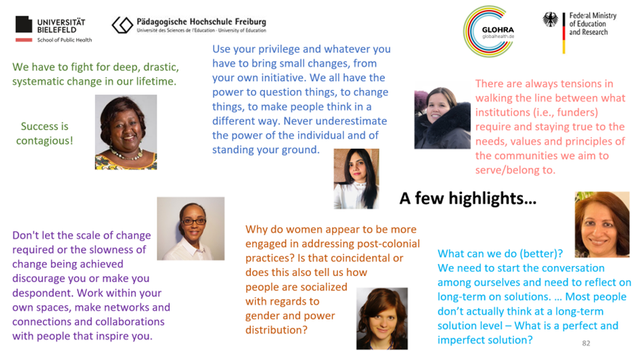
We organized a workshop series on #coloniality/ #decolonization of global health research in #Germany.

Here's a short summary:
https://tinyurl.com/532zsj3r

Thanks to our funder GLOHRA (https://tinyurl.com/yck8xrkf) & stellar speakers, incl. Agnes Binagwaho, Themrise Khan, Muneera Rasheed, Ceporah Mearns, Shenaz Munshi, Emma Rhule, Catherine Kyobutungi, Sabine Kleinert, Hannah Strohmeier, Caroline Mtaita, Poornima Thapa, Huzeifa Bodal, Friedemann Kinkel!
🙏
#DecolonizeGlobalHealth
#academicchatter

I joined PLOS Global Public Health as academic editor!

That's my little contribution to greater #equity in #GlobalHealth.

So gimme all your lovely manuscripts on health inequities affecting migrant and minority groups, on the structural determinants of these inequities, and esp. on migration, precarious labour and health!

@publichealth
@PLOS
#HealthInequities
#migration
#workersrights
#refugees
#socialdeterminantsofhealth
#socialjustice
#DecolonizeGlobalHealth
#PublicHealth

Workshop 1 on "Developing a decolonial lens to German Global Health" last Nov left us with lots of inspiration, insights, & questions - thanks to stellar speakers Agnes Binagwaho, Themrise Khan, Emma Rhule, Ceporah Mearns, Angela Schuster, @muneera_rasheed.

Workshop 2 is coming up, with @[email protected], Hannah Strohmeier, Caroline Mtaita and Poornima Thapa.

Looking fw to great (albeit often difficult) discussions!

#globalhealth
#decolonizeGH
#DecolonizeGlobalHealth #DecolonialFeminism

Dissecting the foreign gaze in global health with Seye Abimbola - Global Health Unfiltered!

"Every narration places the spectator in a position of agency" - Manthia DiawaraIn this episode, we discuss equity in global health research with Dr. Seye Abimbola. Seye is a senior lecturer at the University of Sidney and editor-in-chief of BMJ G...

Buzzsprout