@ochrewatts

And here's our 🧡 on the key #ochre paper (#Dapschauskas et al) with Ian's role highlighted here

https://c.im/@RadicalAnthro/109541354103370276

Radical Anthropology (@[email protected])

Attached: 2 images What's great about the Dapschauskas paper is the way they test models against this record (huge apologies for misspelling the lead author's name earlier. This should be correct). Notably they focus on our own FCC model. For analysis of the southern African record, they rely heavily on the pioneering work on MSA pigments by our colleague Ian Watts. Ian, now in the #UCL Anthropology dept, has worked on collections of ochre at #Blombos #PinnaclePoint and #Wonderwerk and is preparing work on #BorderCave, all key sites in Southern Africa. Ian did not just pioneer close examination of ochre, he was also way ahead of the field in the early 90s -- before we got major evidence from Blombos and Pinnacle Point -- in arguing that the human symbolic revolution was an African phenomenon. At that time this was NOT the fashionable view, with the 'Human Revolution' predicated on the European #UpperPaleolithic at 40,000 years ago. Ian simply knew that was wrong. 6/ Images: archaeologist Ian Watts, and a slide of his analysis of ochre frequency at Border Cave, which jumps between c.180 to c.160 ka

C.IM

The first #art was #body art...
Here a review based in #Blombos (S #Africa) #MiddleStoneAge evidence on the origin of personal ornamentation is presented.
* marine gastropods from Blombos Cave dated to between 100 ka and 70 ka.
* Unperforated and naturally perforated shells were collected between 100 and 73 ka.
* previously unrecorded gastropod species was used as bead 70 ka.

The #RadicalAnthro team does not think the authors (d'Errico et al) are getting the relationship right between #MSA ochre #pigment use and beads. We very much doubt initial usage of #ochre was 'utilitarian' and subsequently became symbolic. Take a look at our thread on the #Dapschauskas paper on ochre as a ritual tradition here
https://c.im/@RadicalAnthro/109540854804414843

For us: the first art was body art, and the first body art was #menstrual

https://www.sciencedirect.com/science/article/pii/S0047248423001173

Radical Anthropology (@[email protected])

For more #Fediscience of the #HumanRevolution see this 🧡 πŸ‘‡ πŸ‘‡ Our first proper 🧡on Mastodon today! And it's a biggie! When and where did symbolic culture (ritual, art, language, well everything) emerge in the human lineage? This question lies at the ❀️ of @RadicalAnthro 's research for 30 years. An exciting new paper from a team @ROCEEH (Role of Culture in Early Expansions of Humans) promises some answers. #redochre #MiddleStoneAge #symbolicculture #ritual #humanorigins 1/ https://link.springer.com/article/10.1007/s10963-022-09170-2
C.IM

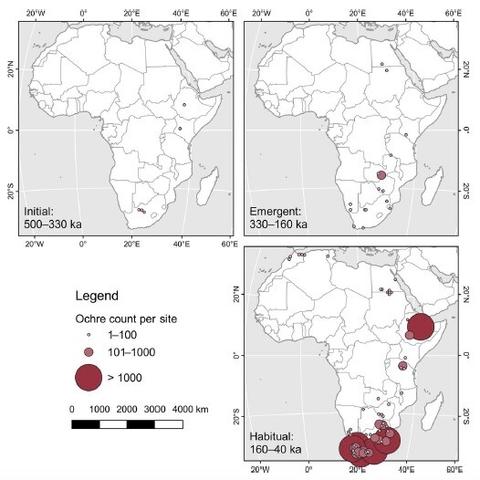
Rather than focus on specific sites,regions or technocomplexes, #Dapschauskas et al use methods based on #timeaveraging to identify three continent-wide distinct phases of ochre use: an initial phase 500-330 thousand years ago (ka); an emergent phase from 330-160 ka; and an habitual phase from 160-40 ka.

At each phase, the number of sites with ochre increases; the ratio of sites with ochre compared to those with only stone artefacts shows increasing intensity of ochre use. It becomes habitual cultural practice in S, E and N Africa from 160 ka when a third of sites contain ochre.

4/
Image: three maps of Africa show three distinct phases of ochre use, initial from 500-330,000 years ago; emergent from 330-160,000 years ago; and habitual from 160-40,000 years. The final phase shows large quantities in South and East Africa with sites also in the North.