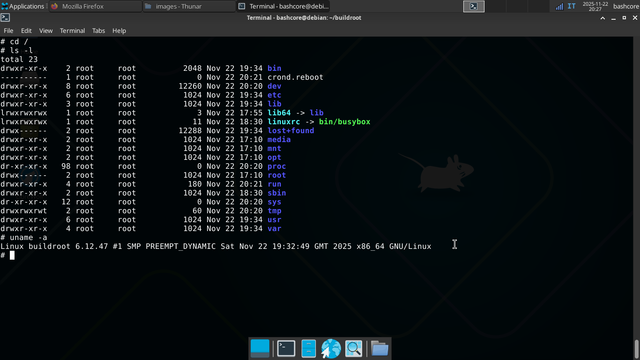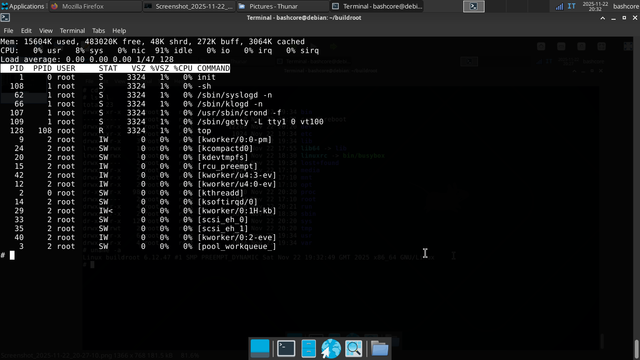
Booted a custom Linux OS with Buildroot inside QEMU.
Kernel 6.12.47, ext2 rootfs, BusyBox shell, no branding, no splash.
Filesystem mounted cleanly, init runs, system idle at 99%.
Next: network stack + GRUB2 ISO. Minimal, reproducible, silent.
#buildroot #linux #qemu #customos #bashcore #initonly #minimalism
That seemingly simple screenshot marks a milestone: I’ve successfully built a fully automated custom Debian Live ISO.
No manual login, no clicks, just boot, and the custom SystemD service runs immediately.
This moves me from 'tinkering' to professional OS-on-demand production.
Ready to deliver embedded, diagnostic, or scientific systems that just work.
Frage an die, die gerne verschiedene CustomOS ausprobieren:
Wie sichert ihr eure Smartphone Daten so, dass ihr alles im Nachgang wieder mit wenigen Klicks aufspielen könnt?
Edit: Vor allem geht es mir um eine Image-Lösung des Komplettsystems.
Früher konnte ich mit Clockworkmode einfach Images erstellen.
Das habe ich jetzt bei eOS fürs Fairphone nicht im Einsatz.
https://www.heise.de/news/Zollpolitik-der-USA-Wird-das-iPhone-deutlich-teurer-10339481.html
Wäre vielleicht geschickt sich als #iOS Nutzer*in jetzt schonmal über alternative #Hardware, #Bootloader, #Root und #CustomOS zu informieren. Ist überhaupt kein Hexenwerk und dürfte in den kommenden Jahren wohl anfangen eine größere Rolle zu spielen!