Quiet Isn’t a Flaw: Being an Introvert in a Loud Latine World

Let’s talk about something that rarely gets named out loud in Latine spaces: being an introvert and being misunderstood, shamed, or outright dismissed for it.

This isn’t theoretical for me. It’s lived.

It came up during a dinner conversation with my mother-in-law, a Latine elder who, like many in our community, carries ideas that were passed down without question. The conversation drifted toward my stepson’s plans for having a social life once he moves into our house. I laughed a little and said, “Ohhh, you had a whole plan!”

And then it clicked.

I looked at him and said, “Ohhh… you need people to recharge, don’t you?”

He nodded.

That made sense to me immediately. He’s an extrovert. People energize him. He feels better after being around others. That’s how his nervous system works.

So I shared something about myself.

“I don’t,” I said. “I need solitude.”

The conversation had been happening in English, so I translated it for my MIL and tried to make it simpler.

“He’s an extrovert,” I said, pointing to my stepson.
“I’m an introvert,” I said, pointing to myself.
“And I believe he is too,” I added, pointing to my son.

My son nodded to confirm.

That’s when my MIL’s face scrunched up.

“So you mean to tell me you like being holed up in your room?” she asked.

Both my son and I nodded vigorously. Yes. Exactly that.

But I heard the tone. It wasn’t curiosity. It was judgment. Shame wrapped in disbelief. Like something must be wrong with us for needing space instead of people. Like solitude was a sign that something was wrong with us, not simply a preference.

Then she tried to disprove it.

“Well, he plays games online,” she said, implying that meant he wasn’t really an introvert.

And that’s when I had to pause and explain something that feels obvious to me but apparently isn’t in many Latine conversations.

Online and in-person socializing are not the same.

They require different kinds of energy.

I socialize online a lot. I talk. I connect. I share. But I know I can unplug at any time. I don’t have someone physically in front of me. I don’t have to manage facial expressions, body language, small talk, or polite smiling. I don’t have to perform enjoyment.

In person, especially in group settings, I am masking.

I am showing a version of myself that is palatable, agreeable, and socially acceptable. And that takes energy. A lot of it.

She still didn’t quite believe me. I could see it in her face. But I let the conversation go. Not because I was wrong, but because I was tired.

And that moment stayed with me.

Why is this so hard to understand in Latine spaces?

Growing up, my experience of “community” was loud family gatherings, fiestas, birthdays, holidays that lasted all day, conversations layered on top of conversations, music blasting, people dropping in unannounced. And for many people, that feels like love.

For me, it always felt like a chore.

Not because I don’t love my family. Not because I’m antisocial. But because my body doesn’t recharge in noise. It drains.

I am comfortable with the people I live with. The people I see every day. The ones I’ve built safety with. Around them, I don’t have to perform. I don’t have to explain myself. I don’t have to brace for judgment.

Outside of that circle, I’m on stage.

And yes, I’ve gotten good at it.

I know how to socialize. I know how to hold conversations. I know how to navigate events, dinners, gatherings, and expectations. That’s a skill I developed, not a preference I chose. But every one of those interactions requires recovery time. Alone time. Silence. Stillness.

There are exceptions.

Bookish events don’t feel like a chore to me. When I’m surrounded by people who love stories, ideas, words, and reflection, I don’t feel like I’m wearing a mask. I don’t have to explain myself. I don’t have to prove I belong. There’s no need to perform when the room already speaks your language.

That’s the difference.

What frustrates me most isn’t having to explain myself. It’s not being believed when I do.

It’s the way introversion is treated as something suspicious in Latine culture. Like quiet equals sadness. Like solitude equals loneliness. Like needing space equals rejection of family or community.

And it doesn’t.

Introversion is not a flaw. It’s not disrespect. It’s not coldness. It’s not something to fix.

It’s a different way of being.

So when someone looks at me and says, “You like being holed up in your room?” with judgment in their voice, what they’re really saying is, “Your way of existing makes me uncomfortable.”

And I’m done carrying that discomfort for them.

You don’t get to tell me who I am.
You don’t get to override my lived experience.
You don’t get to shame my nervous system because it doesn’t match yours.

Quiet is not broken.
Solitude is not selfish.
Introversion is not a betrayal of culture.

Some of us love deeply, think quietly, and recharge alone.

And that deserves just as much respect.

#culturalExpectations #culturalMisunderstanding #emotionalLabor #familyDynamics #introversionInLatinoCulture #introvertValidation #LatineIdentity #quietStrength #socialMasking

Mel Robbins Let Them Theory Explained for You

There’s a theory I came across recently—one that cracked something open inside me. It’s called “The Let Them Theory.” Mel Robbins popularized it in her book, and the idea is simple: if people want to misunderstand you, let them. If they want to leave, let them. If they want to doubt you, let them.

It’s not a theory built on spite. It’s not about proving people wrong or cutting them off with attitude. It’s about release. About turning your energy inward and saying: I’ve got better things to focus on—namely, me.

I didn’t know there was a name for what I’d been practicing in pockets of my life for years, but when I heard it framed this way, I felt seen.

But of course, it gets complicated when you throw culture into the mix.

Cultural Expectations Don’t Let You “Let Them”

If you come from a collectivist culture—like many Latine communities—you’re often raised to not let people be. You’re taught to correct, to adjust, to keep the peace, to stay even when it costs you.

  • They said something offensive? Be polite.
  • They dismissed your boundaries? Be forgiving.
  • They questioned your choices? Explain harder.

Because we’re raised to protect the family image. To not make waves. To sacrifice “self” for the greater good, especially when that good is defined by others.

So when I started living by “Let Them,” it felt rebellious. But more than that—it felt freeing.

Let them think I’m too American.
Let them say I’m too Dominican.
Let them misunderstand the way I parent, or pray, or write, or live.
Let them believe what they want about how I left, how I stayed, how I speak.
Let them gossip. Let them guess.

It’s not my job to keep adjusting to make everyone else more comfortable.
Especially when my comfort has never been anyone’s priority but mine.

“Let Them” Is Not Indifference—It’s Boundaries

Here’s where I think people get it twisted. Practicing “Let Them” doesn’t mean I don’t care. It means I’m choosing where my care goes. It means I no longer chase validation from people who have made it clear they don’t value my voice, my identity, or my growth.

“Let Them” doesn’t mean I don’t feel the sting. It means I don’t let that sting run my life.

It’s not a wall—it’s a doorway away from trying to be palatable.

How “Let Them” Heals Cultural Guilt

Cultural guilt is real. It lingers in the background when you try to live differently, dream louder, or move beyond the path that was laid out for you. Especially as a daughter. As a mother. As a creative. As a bruja. As a woman.

But “Let Them” is a balm for that guilt.

It says:
Let them say I changed.
Let them say I’m different now.
Let them question the book I wrote, the words I chose, the stories I told.

Let them.

I don’t owe them a version of myself that stays small.

And the more I lean into this mindset, the more I see the shift in how I spend my energy. I no longer spend days rehearsing conversations that I’ll never have. I don’t write long paragraphs to defend myself in my head. I live. I speak. I write. I move.

And those who are meant to walk with me in this season? They don’t need convincing.

The Ordinary Bruja: Book One of Las Cerradoras Series – Johanny Ortega

When grief pulls Marisol Espinal back to Willowshade, she uncovers a legacy buried in shadows, silence, and ancestral magic. The Ordinary Bruja is a haunting coming-of-age story that blends psychological horror with Dominican folklore and magical realism. For fans of Silvia Moreno-Garcia and Isabel Cañas.

If you love what you read, I’d be honored to hear your thoughts. Please leave a review on your preferred platform and let other readers find the magic in The Ordinary Bruja.

$4.99 $23.99Price range: $4.99 through $23.99 Shop now

Procrastination, Culture, and the Soft Rebellion

Now, I’ll be honest—“Let Them” also requires self-awareness. Because there are times when I let myself wallow a little too long. I’ll call it rest, but really it’s resistance. I’ll call it peace, but it’s avoidance.

That’s when I check myself.

Because “Let Them” also applies inwardly.

Let the inner critic chatter.
Let the doubt be there.
Let it sit—and then keep going anyway.

It’s not about never being triggered or never second-guessing. It’s about not letting those things run your life.

The Beauty in Letting Go

There’s power in refusing to explain yourself to people who are committed to misunderstanding you. There’s liberation in not performing your worth for family, for community, for followers, for anyone.

And there’s beauty in choosing to be—without a constant need to be understood.

So if you’re navigating the tension between who your culture told you to be and who you’re becoming, this is for you:

Let them be confused.
Let them shake their heads.
Let them miss the version of you that dimmed your light to make them comfortable.

And let yourself rise in the process.

#boundaries #culturalExpectations #emotionalGrowth #LatineIdentity #letThemTheory #MelRobbins #peoplePleasing #reclaimingPeace

Bungalow at Villa

Dinner at a seaside restaurant the night before heading to Bequia.

https://islandinthenet.com/bungalow-villa/

Why We Don’t Have to Do It All — Not in Life, Not in Fiction

Being a Latina woman often feels like carrying the world’s weight on your shoulders.

From a young age, many of us are taught to juggle everything: be the caretaker, excel at work, preserve traditions, and maintain a spotless home. I’m literally writing this while taking a break from mopping the floor. That’s the rhythm we’re taught—clean, cook, work, smile. Repeat.

We are expected to be everything to everyone—the selfless mother, the devoted daughter, the hardworking professional, and the keeper of cultural values. But at what cost?

The Roots of the Expectation

The pressure to “do it all” isn’t just modern hustle culture—it’s deeply rooted in our cultural upbringing and generational patterns. In many Latine households, the idea of marianismo—the counterpart to machismo—reinforces that we should be self-sacrificing, nurturing, and morally unshakeable. And while these traits are often praised, they can quietly become cages.

Cultural sayings like “La mujer es el corazón del hogar” (The woman is the heart of the home) sound beautiful… until you realize how heavy it is to be the heart of something every single day. To never skip a beat. To feel like if you fall apart, so does everything else.

The Modern-Day Pressure Cooker

Today, we’re straddling two worlds. We chase careers, passions, education—and still feel expected to carry on all the domestic traditions without missing a step. That duality? It often leads to burnout, guilt, and an invisible scale we can never balance.

Social media intensifies it. One scroll and you see other women baking from scratch, launching businesses, looking flawless, raising kids, honoring culture—and doing it all in perfect lighting. The unspoken rule becomes: if you’re not doing it all—and perfectly—you’re not enough.

But here’s the thing: that’s a lie.

And it’s one I’ve not only had to unlearn for myself, but it’s also one I’ve written into my characters—because these expectations don’t just weigh on real people. They bleed into our inner lives, our self-worth, our sense of possibility. That’s why I gave this burden to Marisol Espinal in The Ordinary Bruja.

Marisol Espinal: A Reflection of Us

Marisol may live in a world touched by ancestral magic, but the pressure she carries is all too real. She’s the product of generations of silence, of cultural rules passed down without explanation. She’s expected to behave, to stay grounded, to not “make things up,” to hold the family’s reputation while trying to uncover its truth. She’s expected to be reliable and ordinary, even as the unexplainable calls to her.

And that’s the story for so many of us, right? Be dependable. Be useful. Be strong. But never too much. Never too loud, too angry, too curious, too bold. Never too yourself.

Marisol’s story reflects what happens when those expectations become internalized—when someone begins to wonder if the life they actually want is too far from the one they’re expected to live. She doesn’t rebel outwardly at first. She folds in on herself, quietly suffocated. And that, to me, is far more common and far more devastating than we like to admit.

Breaking the Pattern—In Fiction and in Life

So how do we break free?

Here’s what I’ve learned—and what I’ve written into both my life and my work:

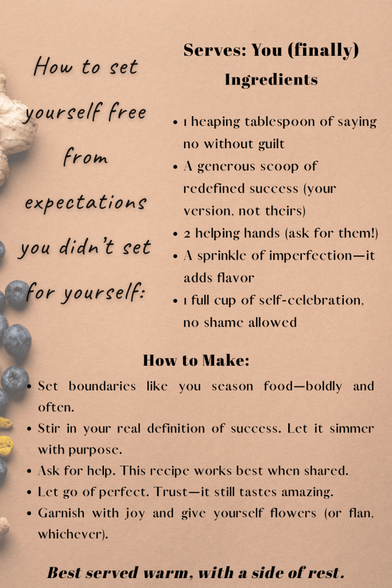
Set Boundaries: Saying “no” is a powerful act of self-preservation. Not everything deserves your yes.

Redefine Success: Maybe success isn’t doing everything. Maybe it’s choosing what matters and doing that with your whole heart.

Ask for Help: You don’t need to be the only one scrubbing floors. You know who helped me clean my house today? My husband and our kids—because it’s our house. Shared space means shared responsibility.

Embrace Imperfection: The dishes can wait. You can’t. Your peace is more important than your productivity.

Celebrate Yourself: You’re here. You’re doing the work. That deserves to be seen and celebrated.

Moving Forward

The cultural expectations placed on Latine women are real—and they are heavy. But they don’t have to define us.

We’re allowed to change the narrative.
We’re allowed to drop what doesn’t serve us.
And we’re allowed to write ourselves into stories where the main character—like Marisol—gets to choose herself.

So whether you’re a real-life mujer balancing everything or a reader watching Marisol learn to stop holding it all in… I hope you find relief in the knowing:

You don’t have to do it all to be worthy.
You are enough—just as you are.

#breakingCycles #culturalExpectations #generationalPressure #identityInFiction #latineStorytelling #latineWomanhood #marisolEspinal #ownvoicesAuthor #TheOrdinaryBruja #writingComplexCharacters