
The Complexity of Guilt-Ridden Mothers in Stories

Morally Gray Mothers in Fiction

In the world of storytelling, there’s something undeniably captivating about morally gray characters. These are the characters who exist in the messy in-between—neither fully good nor entirely bad. They challenge us, frustrate us, and, most importantly, make us think. As a writer, I find myself drawn to these complex figures. I am especially interested in mothers who are riddled with guilt. Mothers who have feelings of inadequacy. Most of my stories explore complex mother-daughter relationships.

Check out this post on morally gray characters and how to write them.

Why mothers, you ask? Because motherhood, in all its beauty and complexity, is often viewed through an unrealistic lens of perfection. Society tends to place mothers on a pedestal, expecting them to embody selflessness, strength, and unwavering love at all times. But what happens when a mother falters? When she feels like she’s not enough? When guilt becomes her constant companion?

I’ve been hurt by my own mother. She was the adult who held that role in my life. I always wondered why. Then I became a mother and realized that not everything is black and white. There is more nuanced to that. So in my curiosity I have leaned into exploring this conundrum through the safety of fictional stories.

These are the questions I love to explore in my stories.

Take Marisol Espinal’s mother in The Ordinary Bruja as an example. While she doesn’t take center stage in the narrative, her presence—or absence—shapes Marisol’s journey in profound ways. Her mother’s choices, her secrets, and her silence about their ancestral history all originate from imperfection. They stem from a place of guilt. She loved deeply but made mistakes. She carried the weight of her own trauma while trying to shield her daughter from it. Was she right? Was she wrong? The answer isn’t black and white—and that’s the point.

For me, writing these kinds of mothers is not just about creating tension or drama. It’s about reflecting real-life complexities. Many of us have complicated relationships with our mothers or as mothers ourselves. I know I do. We carry guilt, shame, and the nagging feeling that we’re not doing enough. But through these characters, I aim to offer a mirror and, perhaps, a bit of solace.

Morally gray mothers remind us that love can coexist with flaws. That guilt doesn’t erase care. And that being human means making mistakes—sometimes big ones.

In the end, these characters resonate because they feel real. They challenge readers to confront their own biases, to empathize with the imperfect, and to see beauty in the broken.

So, here’s to the morally gray, guilt-ridden, and imperfect mothers. They may not be perfect, but they are powerful. And their stories deserve to be told.

What are your thoughts on morally gray characters? Do you find yourself drawn to their complexities, too? Let’s chat in the comments!

Want to get to know these morally gray characters? Preorder The Ordinary Bruja

The Ordinary Bruja: Book One of Las Cerradoras Series – J.E. Ortega

$4.99$23.99

When grief pulls Marisol Espinal back to Willowshade, she uncovers a legacy buried in shadows, silence, and ancestral magic. The Ordinary Bruja is a haunting coming-of-age story that blends psychological horror with Dominican folklore and magical realism. For fans of Silvia Moreno-Garcia and Isabel Cañas.

If you love what you read, I’d be honored to hear your thoughts. Please leave a review on your preferred platform and let other readers find the magic in The Ordinary Bruja.

FormatChoose an optionPaperbackHardbackE-BookClear The Ordinary Bruja: Book One of Las Cerradoras Series – J.E. Ortega quantity

Pre-order now

SKU: ORDINARYBRUJAPAPERBACK Category: Books, Books for Adults, Fantasy, Fiction Books, Horror, Literary Fiction, Magical Realism, Women’s Fiction Tags: ancestral magic, atmospheric fiction, books about brujas, dark fantasy, Dominican folklore, haunted inheritance, Isabel Cañas fans, Latine fantasy, magical realism, psychological horror, Silvia Moreno-Garcia fans, spooky reads, supernatural mystery, The Ordinary Bruja, witchy books

Why We Don’t Have to Do It All — Not in Life, Not in Fiction

Being a Latina woman often feels like carrying the world’s weight on your shoulders.

From a young age, many of us are taught to juggle everything: be the caretaker, excel at work, preserve traditions, and maintain a spotless home. I’m literally writing this while taking a break from mopping the floor. That’s the rhythm we’re taught—clean, cook, work, smile. Repeat.

We are expected to be everything to everyone—the selfless mother, the devoted daughter, the hardworking professional, and the keeper of cultural values. But at what cost?

The Roots of the Expectation

The pressure to “do it all” isn’t just modern hustle culture—it’s deeply rooted in our cultural upbringing and generational patterns. In many Latine households, the idea of marianismo—the counterpart to machismo—reinforces that we should be self-sacrificing, nurturing, and morally unshakeable. And while these traits are often praised, they can quietly become cages.

Cultural sayings like “La mujer es el corazón del hogar” (The woman is the heart of the home) sound beautiful… until you realize how heavy it is to be the heart of something every single day. To never skip a beat. To feel like if you fall apart, so does everything else.

The Modern-Day Pressure Cooker

Today, we’re straddling two worlds. We chase careers, passions, education—and still feel expected to carry on all the domestic traditions without missing a step. That duality? It often leads to burnout, guilt, and an invisible scale we can never balance.

Social media intensifies it. One scroll and you see other women baking from scratch, launching businesses, looking flawless, raising kids, honoring culture—and doing it all in perfect lighting. The unspoken rule becomes: if you’re not doing it all—and perfectly—you’re not enough.

But here’s the thing: that’s a lie.

And it’s one I’ve not only had to unlearn for myself, but it’s also one I’ve written into my characters—because these expectations don’t just weigh on real people. They bleed into our inner lives, our self-worth, our sense of possibility. That’s why I gave this burden to Marisol Espinal in The Ordinary Bruja.

Marisol Espinal: A Reflection of Us

Marisol may live in a world touched by ancestral magic, but the pressure she carries is all too real. She’s the product of generations of silence, of cultural rules passed down without explanation. She’s expected to behave, to stay grounded, to not “make things up,” to hold the family’s reputation while trying to uncover its truth. She’s expected to be reliable and ordinary, even as the unexplainable calls to her.

And that’s the story for so many of us, right? Be dependable. Be useful. Be strong. But never too much. Never too loud, too angry, too curious, too bold. Never too yourself.

Marisol’s story reflects what happens when those expectations become internalized—when someone begins to wonder if the life they actually want is too far from the one they’re expected to live. She doesn’t rebel outwardly at first. She folds in on herself, quietly suffocated. And that, to me, is far more common and far more devastating than we like to admit.

Breaking the Pattern—In Fiction and in Life

So how do we break free?

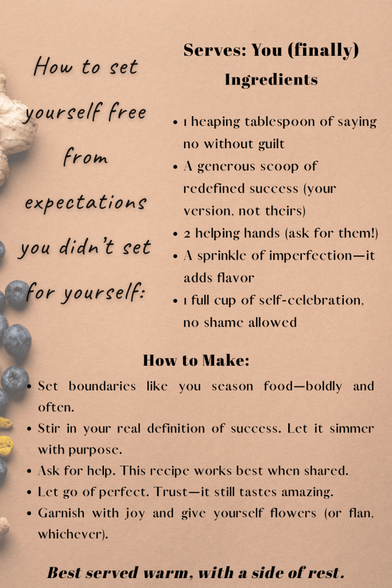
Here’s what I’ve learned—and what I’ve written into both my life and my work:

Set Boundaries: Saying “no” is a powerful act of self-preservation. Not everything deserves your yes.

Redefine Success: Maybe success isn’t doing everything. Maybe it’s choosing what matters and doing that with your whole heart.

Ask for Help: You don’t need to be the only one scrubbing floors. You know who helped me clean my house today? My husband and our kids—because it’s our house. Shared space means shared responsibility.

Embrace Imperfection: The dishes can wait. You can’t. Your peace is more important than your productivity.

Celebrate Yourself: You’re here. You’re doing the work. That deserves to be seen and celebrated.

Moving Forward

The cultural expectations placed on Latine women are real—and they are heavy. But they don’t have to define us.

We’re allowed to change the narrative.
We’re allowed to drop what doesn’t serve us.
And we’re allowed to write ourselves into stories where the main character—like Marisol—gets to choose herself.

So whether you’re a real-life mujer balancing everything or a reader watching Marisol learn to stop holding it all in… I hope you find relief in the knowing:

You don’t have to do it all to be worthy.
You are enough—just as you are.

#breakingCycles #culturalExpectations #generationalPressure #identityInFiction #latineStorytelling #latineWomanhood #marisolEspinal #ownvoicesAuthor #TheOrdinaryBruja #writingComplexCharacters