
Hach, auch schön. Man kann den FireTV Stick nicht ohne Internetverbindung nutzen… Auch keine Apps, die lokale Inhalte abspielen könnten… 🤪

#CloudFail #Amazon

so much desire for "efficiency" in capitalism prioritizes standardization and consolidation while completely ignoring the negative effects of monocultures, i.e.:

  • the internet is really 3 cloud providers in a trenchcoat
  • whatsapp is a single messaging service with 3 billion phone numbers collected to get stolen
  • there are only two kinds of smart phones, iphones and androids

even when focusing on reasons other than preventing monopolies, standardization is good when it comes to interoperability but consolidation is disastrous when it comes to goods, services and choice

this is why a bunch of random mom & pop bakeries are better than paneras or starbucks everywhere. maybe one of those bakeries are low quality... they'll get weeded out eventually. but if the dominant chain restaurant source their ingredients from the same place to save costs or reduce complexity, they're creating a monoculture where any disaster is amplified. this happened to chipotle with e.coli but chipotle was doing nothing different than any other anticompetitive monopoly-seeking capitalist greed machine company

this is not an inevitable outcome

laws allow for this kind of ugly cancer of monocultures of choice to form and laws can prevent this too

but no politician who has not declared unfettered capitalism as the enemy will ever pass a law like this because consumer choice is antithetical to the highest profits possible, the same way that you can pay young children a lot less, or nothing at all except threats of force, to mine your coal.

#aws #cloudfail #monopoly #capitalism

You may remember I posted about the garbage of the internet of things. One such IOT device and egg holder with LED lights and internet connectivity which told you which egg was the oldest. A device which was rendered useless if the internet went down, or by people grabbing any egg, regardless of age.

This was the previous tech solution. Slides and gravity.
#InternetOfThings #IoT #TechFail #Enshittification #SmartHome #TechCritique #Smarter #iKettle #RightToRepair #TechHorror #CloudFail #Abandonware

Apparently, I forgot to put the final shithouse object earlier.

The Pièce de Résistance

We have examined the kettle that cannot fill itself and the coffee machine that cannot wake you up. Now, we arrive at the final proof that the Smart Home is not a vision of the future, but a prank played on the present: The Smarter FridgeCam.

The Promise vs. The Reality

The Promise: "Turn any fridge into a Smart Fridge." The FridgeCam mounts inside your refrigerator door and takes a photo of your shelves every time you close it, ostensibly creating a live inventory of your groceries.

The Stupid Reality: The FridgeCam is a "blind" camera. It does not have eyes; it has a lens. It does not have a brain; it has a Wi-Fi chip. It cannot differentiate between a block of cheddar and a brick of C4.

To make the "Smart" inventory system work, you must do the work.

Before you put an item in the fridge, you must open the app and scan its barcode.

If the item has no barcode, you must manually search for it in the app's database and "tag" it.

When you eat the item, you must open the app and "check it out" to remove it from the inventory.

The "Smart" FridgeCam is not an automated system. It is a part-time job as a warehouse logistics manager in your own kitchen.

The "Occlusion" Problem

The camera is mounted on the door, looking in. If you place a carton of milk in the front row, the camera can no longer see the yoghurt behind it. To the "smart" system, the yoghurt has ceased to exist. It is Schrödinger's dairy: simultaneously expired and non-existent until you move the milk.

The Verdict

The Smarter FridgeCam attempts to solve a problem that was solved thousands of years ago by object permanence. The "dumb" alternative is to open the door and look. The "smart" alternative requires you to scan, tag, track, and charge a camera that sends you a bad photo of the milk you already know you have.

We have reached the terminal velocity of stupidity. We are scanning barcodes to put cheese in a cold box.

Save your money. Buy a switch. Or better yet, buy a pot. A pot has never asked for a firmware update.

#InternetOfThings #IoT #TechFail #Enshittification #SmartHome #TechCritique #Smarter #iKettle #RightToRepair #TechHorror #CloudFail #Abandonware

The Internet of Things: A Hall of Shame, cont.

Following our autopsy of the iKettle, it is only fair we turn our attention to its caffeinated cousin. If the iKettle is a tragedy of connectivity, the Smarter Coffee (2nd Gen) is a farce of engineering.

This machine promises the ultimate modern luxury: a bean-to-cup coffee maker that you can control from your bed. It grinds the beans, brews the coffee, and wakes you up with the smell of fresh roasting.

In reality, it is a machine that demands you structure your home network around its insecurities and wake up to a pot of lukewarm sludge—if it wakes you up at all.

The Product: Smarter Coffee (2nd Gen)

Price: ~£180 The Superior Alternative: The Goblin Teasmade Model 855 (Released 1974).

The "Smart" Features: It features a built-in grinder and connects to your Wi-Fi. You can schedule alarms in the app so the coffee is ready when you wake up. It also has a "Keep Warm" plate.

The Stupid Reality: First, the coffee. The machine uses a conical burr grinder (technically superior to blades), but user reports suggest it is calibrated with the precision of a woodchipper, producing a mix of "boulders and dust." This results in coffee that is simultaneously sour and bitter.

Second, the noise. The grinder is not insulated. If you set this to wake you up, you are not awoken by the gentle aroma of arabica; you are awoken by the sound of a construction site on your kitchen counter.

Third, the thermodynamics. The "Keep Warm" hotplate turns off automatically after 40 minutes to comply with EU energy regulations. If you hit snooze twice, or if you like to drink your coffee slowly over the course of a Sunday morning, you are drinking cold coffee. The "smart" machine has no sensor to know if the pot is still full; it simply follows a timer that is shorter than the average morning routine.

The Regression: A Comparative Study

To truly understand how far we have fallen, we must compare the workflow of the Smarter Coffee (2025) with the Goblin Teasmade Model 855 (1974).

The Goblin Teasmade, by comparison, was a mechanical masterpiece. It was a clock with a kettle and a teapot attached. It used gravity and a switch.

The 1974 Workflow (Goblin Teasmade)

Fill water & tea leaves.

Set analogue alarm dial.

Sleep.

Alarm triggers switch → Water boils → Pressure forces water into pot → Light turns on → Alarm rings. Success Rate: 100% Dependencies: Electricity, Gravity.

The 2025 Workflow (Smarter Coffee)

Fill water & beans.

Open App.

Wait for App to find Machine.

App fails to find machine. (Restart App).

Set Alarm time in App.

Sleep.

Router updates firmware overnight → Wi-Fi drops for 30 seconds.

Machine loses connection to Cloud. Success Rate: 0% Dependencies: Electricity, Router, ISP, DNS, Cloud Server, App Version, 2.4GHz Band Availability.

The Connectivity Trap

The Smarter Coffee machine has a fatal flaw shared by its cousin, the iKettle: it is allergic to modern technology.

The device requires a legacy 2.4GHz Wi-Fi connection. It notoriously refuses to speak to modern "Mesh" Wi-Fi systems (like Eero or Google Nest) because it gets confused by the 5GHz bands.

This leads to the absurd scenario where you, the human, must downgrade your home's entire network infrastructure—slowing down your laptop and streaming devices—just to accommodate a coffee pot that is stupider than a clock radio from 1974.

The Verdict

The Goblin Teasmade was an ugly, beige, clunky object, but it respected the laws of physics. It understood that boiling water is a mechanical task, not a digital one.

The Smarter Coffee machine is a £180 paperweight that tries to route a simple relay switch through a server farm in Frankfurt.

We have not made coffee smarter. We have simply given it anxiety.

#InternetOfThings #IoT #TechFail #Enshittification #SmartHome #TechCritique #Smarter #iKettle #RightToRepair #TechHorror #CloudFail #Abandonware

The Internet of Things: A Hall of Shame, cont.

The iKettle: A Post-Mortem of a Living Product

Given we have been talking about enshittification and the general malaise of the Internet of Things, I suppose we should return to the device which inspired this sojourn.

We need to talk about the iKettle.

If you are unfamiliar, this is a Wi-Fi-enabled kettle produced by a company called Smarter Applications Ltd. It currently retails for around £60–£100 at major retailers.

It promises to save you time. It offers "Wake Up Mode," which boils the water when your alarm goes off, and "Welcome Home Mode," which boils water when you walk through the door like a KGB nanny.

There is just one problem: The kettle cannot fill itself with water.

To use the "remote boil" feature, you must have previously walked to the kitchen, filled the kettle, and ensured it has enough water to not burn out the element. Despite the claims of "smartness", kettles are still notoriously without legs; evolution has not yet granted them the ability to walk to the sink. If you are already standing at the tap filling the kettle, you are approximately three inches from the "On" switch. By adding a Wi-Fi chip, the manufacturers have saved you the calorie expenditure of moving your thumb downwards.

The Current Reality (2024/25)

The iKettle is the perfect case study for why you should never buy an appliance that requires a server to function.

As of late 2024 and early 2025, the "Smarter" ecosystem appears to have collapsed. The company’s accounts at Companies House are overdue. Users attempting to connect their devices are met with silence.

If you filter by "Most Recent," the reviews are a wall of 1-star complaints describing "paperweights," "bricks," and "abandonware." The average score is being propped up by the ghosts of satisfied customers from five years ago.

The Trap: A consumer in 2025 sees a "4.5 Star" product.

The Reality: They buy it, unbox it, and discover they have purchased a £100 paperweight that demands a 2.4GHz Wi-Fi connection it can no longer use.

The Lesson

In 2016, a data specialist named Mark Rittman spent 11 hours trying to configure his iKettle. His struggle was a comedy. Today, the situation is a tragedy.

We have taken a vessel for boiling water—a technology perfected in the Bronze Age—and given it the ability to be "bricked" by a company going bust.

The iKettle fails when your Wi-Fi goes down. It fails when the company's servers go down. It fails when the app is no longer updated.

A normal kettle fails when the fuse blows.

The iKettle is not a tool; it is a warning. It teaches us that just because we can connect something to the internet, it does not mean we should.

Save your money. Buy a switch. Or better yet, buy a pot. A pot has never asked for a firmware update.

#InternetOfThings #IoT #TechFail #Enshittification #SmartHome #TechCritique #Smarter #iKettle #RightToRepair #TechHorror #CloudFail #Abandonware

2/2

3. The Vibrating Fork (Hapifork)

Price: $99 The Superior Alternative: A stainless steel fork ($2) and basic etiquette.

A fork designed to help you lose weight by eating slower.

The "Smart" Feature: It contains a motion sensor that tracks how many bites you take per minute. If you eat too fast, the fork vibrates in your mouth to tell you to slow down.

The Stupid Reality: It has to be charged. If you run out of battery, you just have a very heavy, thick fork. Also, users reported that if you "scoop" your food (like peas) rather than "stab" it, the fork doesn't register the bite, incentivising you to eat like a shovel to trick the algorithm.

Eating like a peasant? Shovelling the grub in there like a pig at a trough? The Hapifork brings you all the joy of being hit on the head with a guide to table manners by a Victorian mistress, all for the low cost of $99. It is essentially a vibrator for your teeth that rattles your dentures when you enjoy your meal too much.

4. The Egg Tray with an App (Quirky Egg Minder)

Price: $50 The Superior Alternative: The cardboard carton the eggs come in (Free) + Eyes.

Numerate enough to earn currency to purchase useless goods, but too lazy to count to twelve? The Quirky Egg Minder is the kitchen egg accountant you never thought you needed.

The "Smart" Feature: It connects to Wi-Fi to tell you how many eggs you have left while you are at the store. It has LED lights next to each egg to tell you which one is the "oldest."

The Stupid Reality: It turned a glance into a tech support issue. Most people eat eggs in the order they grab them, rendering the LED "aging" system useless. If the battery died or the Wi-Fi disconnected, it often reported you had zero eggs when you had a full tray. It solved the non-existent problem of "egg blindness" by introducing the very real problem of "connectivity failure."

5. The Hairbrush with a Microphone (Kérastase Hair Coach)

Price: $200 The Superior Alternative: A comb (invented approx. 5500 B.C. in Ancient Persia).

The "Smart" Feature: It has a microphone that listens to the sound of your hair breaking. It also has an accelerometer to tell you if you are brushing too hard.

The Stupid Reality: It requires you to sync your hair-brushing data to an app. It "gamifies" brushing your hair, giving you a "hair quality score."

It must be noted that the "hair quality score" has nothing to do with the actual biological state of your keratin; it is simply a game score. It effectively turns your morning routine into a round of Guitar Hero for your scalp, where you must hit the strokes perfectly to avoid a low score, only the prize is anxiety rather than applause.

Archaeologists date the first combs to 5500 B.C. For over 7,000 years, humans—from Cleopatra to the architects of Ayurvedic medicine—managed to maintain their hair without a microphone. We could make a joke about the unruliness of Medusa’s hair here, but a microphone on a hairbrush wouldn’t do much for her split roots; every time a viper struck the bristles, the accelerometer would trigger a "Brushing Force Warning."

The Verdict

We are filling our homes with landfills-in-waiting. We are trading simple mechanics for complex, fragile software.

If a normal kettle breaks, you can still boil water in it on a stove. If a smart kettle breaks, it’s a paperweight that might be DDOS-ing a server. Remember that the next time AWS-East goes down.

#InternetOfThings #IoT #TechFail #Enshittification #SmartHome #TechCritique #Smarter #iKettle #RightToRepair #TechHorror #CloudFail #Abandonware

The Internet of Things: A Hall of Shame

I recently saw a post describing a "smart" kettle that required an app or voice command to boil water. The user noted, "I can have tea as long as they have a wifi connection. Welcome to the 21st century."

This is the defining characteristic of modern tech-horror: a device made functionally inferior to its "dumb" ancestor by the addition of a microchip. The failure mode of a normal kettle is a pot; the failure mode of a smart kettle is a brick.

If you think the kettle is bad, here are five devices that prove we have peaked as a species and are now sliding rapidly backward.

1. The $400 Bag Squeezer (The Juicero)

Price: $400 (Launch price: $700) The Superior Alternative: Dieter Rams’ classic Braun Citrus Juicer ($60) or Human Hands ($0).

Juicero was a Wi-Fi-connected cold-press juicer. You bought proprietary bags of chopped fruit, put them in the machine, and it pressed them.

The "Smart" Feature: It read a QR code on the bag to ensure it hadn't expired. If the internet was down or the bag was expired, it would refuse to make juice. It is vital to note that the QR code checked the expiry of the bag, not the actual juice quality.

The Stupid Reality: Bloomberg News revealed that if you just squeezed the bag with your hands, you got the same amount of juice in the same amount of time. It was a $400 rolling pin that required a software update to function.

Furthermore, the machine’s refusal to operate on "expired" bags highlights a fundamental misunderstanding of biology. The main selling point was the ability to bulk-make juice to store. But juice is already pre-stored in nature's perfect packaging: fruit. An unpeeled orange is essentially juice with a shelf-life, contained in a biodegradable wrapper. The Juicero was a subscription service for squeezing a bag, offering less functionality than a mechanically rotated plastic cone from the 1970s.

2. The Bluetooth Salt Shaker (Smalt)

Price: $199 The Superior Alternative: Peugeot Paris u'Select Salt Mill ($45) + JBL Go Speaker ($30) + LED Candle ($10). Total: $85.

"Smalt" is a large plastic centrepiece that holds salt. It looks like an "ergonomically" designed, off-brand Waterpik.

The "Smart" Feature: It has a Bluetooth speaker (because you want your salt to play the soft jazz of Kenny G) and mood lighting, because you want your salt shaker to be a candle too. You can "dispense" salt by pinching a circle on your smartphone screen or asking Alexa to "dispense one teaspoon of salt."

The Stupid Reality: It requires batteries and a firmware connection to use gravity. The dispensing mechanism is a study in anti-ergonomics. To use the app, you must hold the heavy dispenser over your food with one hand. You must hold your phone with the other. However, a "pinch" gesture requires two fingers on the screen. Unless you place the phone on the table—taking your eyes off the food—or have a prehensile tail, the geometry of seasoning your soup is ridiculous.

Alternatively, you can talk to it. Because nothing kills the vibe of a dinner party faster than shouting commands at your table setting. This is objectively less functional than an electric button-mill (one thumb), a manual mill (two hands, one action), or the pinnacle of culinary interface design: putting your fingers in a bowl of salt.

#InternetOfThings #IoT #TechFail #Enshittification #SmartHome #TechCritique #Smarter #iKettle #RightToRepair #TechHorror #CloudFail #Abandonware

1/2

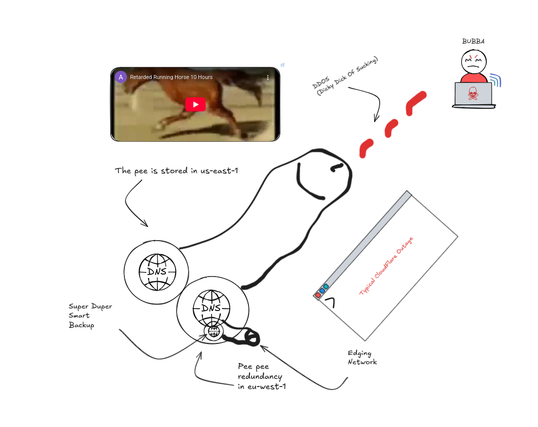
Nov 18: Clouflare outage. But just a few hours before, folks @lunai.re were like...

#cloudflare #cloudfail #dns #cloudbrained

Anubis

<img