 Ilja Becker
The EU just confirmed it:
75% of non-US companies will have a digital sovereignty strategy by 2030.
Companies are moving their data away from US clouds.
Back to Europe. Back to control.
We built DailyBuddy in Germany for exactly this reason.
The EU just confirmed it:
75% of non-US companies will have a digital sovereignty strategy by 2030.
Companies are moving their data away from US clouds.
Back to Europe. Back to control.
We built DailyBuddy in Germany for exactly this reason.
The European Commission is considering rules that would restrict EU member governments from using US cloud providers to process sensitive data including financial, judicial and health records. The restrictions would form part of the Tech Sovereignty Package scheduled for May 27, which includes the Cloud and AI Development Act (CADA) and Chips Act 2.0. Only public-sector use is in scope.
https://www.builtineu.eu/news/eu-commission-us-cloud-restrictions-tech-sovereignty-package

On 25 Feb 2026, the UAE announced the world's first sovereign financial cloud. The CEO: "Finance runs on digital infrastructure; hence it must be sovereign."
Four days later, drones hit AWS ME-CENTRAL-1. Two AZs down simultaneously. 109 services disrupted. 37 still dark two months later.
They understood the problem. The implementation gap killed them anyway.
https://haunted.lighthouse.co.im/articles/finance-runs-on-digital-infrastructure/
#CloudSovereignty #DigitalSovereignty #AWS #CloudResilience #InfoSec #Infrastructure #DataSovereignty #FinTech
English – The Conversation | Cloud tech outages: how the EU plans to bolster its digital infrastructure by Christine Abdalla Mikhaeil, Assistant professor in information systems, IÉSEG School of Management
AI generated summary, Read the full article for complete information.
The recent global failures of Amazon Web Services in October 2025 and CrowdStrike’s update in July 2024 revealed how the world’s digital infrastructure—now dominated by a few hyperscalers such as AWS, Microsoft and Google—remains surprisingly fragile, with a single error rippling across banks, hospitals, airlines and public services despite marketed redundancy and backup mechanisms. This concentration creates a structural vulnerability amplified by opaque interdependencies, making it difficult for users to map where their data and services reside and who is responsible when outages occur. In response, the EU is moving beyond the abstract notion of “digital sovereignty” toward concrete resilience measures: the Digital Operational Resilience Act (DORA) now allows regulators to designate critical third‑party ICT providers for oversight and stress‑testing; the Cyber Resilience Act (CRA) mandates “resilience by design” for all networked products; the NIS2 Directive expands security obligations to a wide range of essential sectors; and a new €180‑million Cloud Sovereignty Framework, awarded in 2026, sets strict legal, technical and environmental criteria for cloud services procured by EU institutions, promoting multi‑cloud architectures, portability and reduced lock‑in to bolster Europe’s digital resilience.
#AWS #CrowdStrike #EuropeanUnion #DORA #CloudSovereignty
AI generated summary, Read the full article for complete information.
If US legal access remains a factor, it obviously complicates the concept of 'sovereignty.'
Digital autonomy hinges on more than just jurisdiction; it's about interoperability and mitigating vendor lock-in across borders. This matters because true data residency needs open standards to back it up.
https://go.theregister.com/feed/www.theregister.com/2026/04/20/europe_picks_4_sovereign_cloud/
AWS, Azure, and Google Cloud hold 70% of the European cloud market. All European cloud providers combined hold 15%.
SAP and Deutsche Telekom are Europe's largest cloud players. They hold 2% each.
We outsourced our digital infrastructure to three American companies and called it modernization.
Source: https://www.cnbc.com/2026/02/13/four-charts-europes-reliance-us-digital-infrastructure.html
#CloudSovereignty #EUCloud #DigitalSovereignty #EUAlternatives
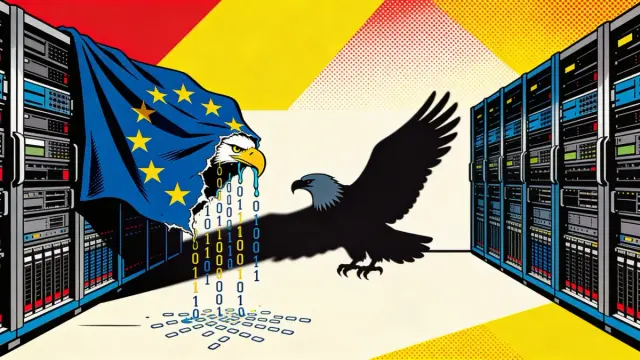
Eighty-four percent of Europeans say they distrust American tech firms with their personal data. Ninety-three percent say the same about Chinese ones. The easy read is Trump-era mood. The harder read, backed by six years of polling and one 2018 US statute, is that Brussels now holds a mandate it wasn't expecting, pointed at a Cloud and AI Development Act being drafted this month that will decide who wins the next decade of European cloud procurement. One sentence will settle it.
 Built In EU
 German UPA
 al
al The Bad Place
 Vectora
 Only-EU
 Marcus Schuler
 Ґізчина — Gizchina Ukraine
 Gizchina Ukraine