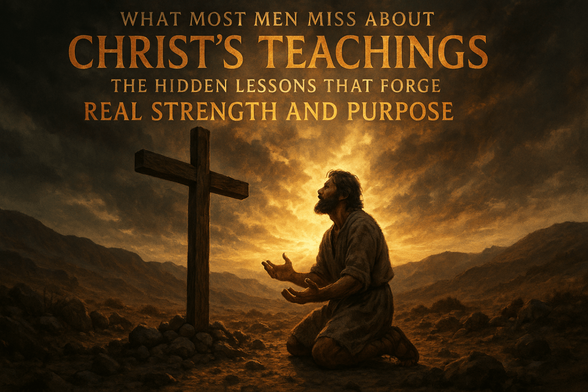
What Most Men Miss About Christ’s Teachings: The Hidden Lessons That Forge Real Strength and Purpose
8,539 words, 45 minutes read time.
Christ’s Message Isn’t Soft
I used to think Jesus was the kind of man who smiled politely, never raised His voice, and quoted poetry while walking on the beach. Somewhere along the line, churches and cheap art made Him look harmless—fragile even. But then life shattered my little ideas of control. Responsibilities piled high, pride cracked, and comfort turned hollow. That’s when His words stopped sounding gentle and started sounding like commands from a battlefront.
Jesus didn’t come to make men “nice.” He came to make them new. And new doesn’t happen without fire. If you ever read His teachings in their real context—in the time, culture, and chaos where He actually spoke—you realize how wild, dangerous, and liberating they really are. Christ wasn’t giving moral tips. He was giving orders in a war for your soul.
What most men miss about Jesus’ teaching is that His path doesn’t make you safe—it makes you solid. Let’s slow down and actually dive into His words like first-century men hearing them for the first time—through the sweat, shame, hope, and raw courage they carried.
The Strength in Surrender
When Jesus said, “If anyone wants to follow Me, let him deny himself, take up his cross daily, and follow Me,” He was not preaching poetry. Those words landed like a blade between bone and spirit. The men who heard them didn’t picture a decorative necklace—they pictured Rome’s favorite instrument of fear. The cross meant suffocation, humiliation, absolute loss. To “take up your cross” was not a metaphor for mild inconvenience. It meant you were already dead, walking under a verdict. And Jesus looked into the eyes of hardworking men living under Roman occupation and demanded they choose that death willingly, every day.
The command hit a world defined by dominion. Rome measured worth by conquest; your power was proven by whose back you stood on. The religious elite measured holiness by performance; strength meant the spotless record no one else could match. Jesus cut through both illusions with one sentence. Deny yourself—kill your own throne. Take up your cross—drag the instrument of your ego’s execution through the dust. Follow Me—walk My road, where glory and suffering are indistinguishable until resurrection.
That kind of teaching doesn’t survive inside comfort. It requires a death we don’t want. I’ve learned that no man really encounters God until he collides with the end of himself. I used to confuse pride for perseverance, stubbornness for courage. I thought striving harder was the same as leading. But I was just building idols that bore my face. Every success still left a whisper of panic: “What happens when the illusion breaks?” That’s the kind of question God eventually answers with a wrecking ball.
When your plans burn down, you start seeing the difference between achievement and obedience. I kept thinking if I tightened my grip, I could hold the pieces together. But control is just fear pretending to be strength. Real strength begins in surrender—the moment you unclench your fists and admit that you’re not the one running the universe. That admission feels like defeat. It’s actually deliverance.
Rome defined power as domination; Jesus defined it as submission to the Father’s will. That’s why the cross scandalized not just Romans but everyone watching. Imagine the disciples hearing this call in history’s harsh light: ordinary Jewish tradesmen forced daily to see crosses lining the roads where rebels had been executed as warnings. They knew that aroma, the buzz of flies, the reminder that Rome owned their flesh. And Jesus—this carpenter with miracles and military-sized crowds—tells them, “That’s the path.” No rebellion, no takeover, not even self-defense. Just surrender.
It sounded insane. But then they watched Him live it. Every step of His ministry redefined leadership and masculinity. He confronted evil without arrogance, held power without flaunting it, and when the moment of total dominance came—when He could have summoned legions of angels—He let Himself be bound. That wasn’t helplessness; it was control so extreme it surrendered itself. Rome thought it was nailing Him down. But He was laying Himself down. That’s the secret God plants in every man who follows Him: the truth that no one can take your life if you’ve already offered it up.
That’s what “dying daily” means—it’s not self-loathing; it’s self-emptying. Every sunrise you decide again: Will I live for my comfort or His command? Will I worship my need to control or follow the One who commands oceans to still? That is why surrender has to be practiced daily. Ego resurrects overnight. Pride never stays buried without supervision. You kill it this morning and find it flexing in the mirror tomorrow. So every day becomes another execution; one that brings resurrection in its wake.
Those early Christians got it because death wasn’t theoretical for them. They were chased, jailed, burned, mocked. Yet the letters they wrote talk about joy, freedom, peace. They had discovered something Rome couldn’t manufacture—life on the far side of surrender. Their power didn’t come from avoiding suffering but from interpreting it through eternity. A man who’s already surrendered can’t be owned. You can beat him, but you can’t intimidate him. Every threat loses its teeth against a soul that’s already died once.
This kind of surrender also heals a man’s mind. We live clenched—trying to fix everything, build everything, control every outcome. The modern world rewards anxiety disguised as ambition. But surrender resets your wiring. You stop reacting like a caged animal, start moving like a soldier under command. You still fight, but your motive changes. You’re no longer fighting to win approval or secure control; you’re fighting to stay faithful. That shift—from earning to obeying—is the turning point where God starts shaping a man into something steady, dangerous, holy.
Surrender doesn’t make you a spectator; it makes you a weapon. The paradox runs deep: The man who refuses to bow becomes brittle and breaks. The man who bows daily becomes unbreakable. Jesus bowed all the way to the tomb, and on the third day, hell itself let go. That’s the template. The way up is down; the way to strength is surrender; the only victory worth anything is resurrection that comes after crucifixion.
If you want to know what this looks like in real time, think of the moments that tempt you most: when your pride flares, when your lust pushes, when anger surges. Each is a miniature cross waiting for you to climb on. Painful? Always. Necessary? Every single time. Because surrender trains you to stop building altars to yourself. It breaks the addiction to control that’s been eating men alive since Eden’s first lie—“You can be like God.”
Following Christ means finally quitting that lie. It’s hearing Him say, “Take up your cross,” and understanding that death isn’t the threat—it’s the doorway. You don’t carry the cross as a symbol; you carry it as your agreement with heaven: “I’m done pretending I run this life.” And when you walk under that weight daily, your spine straightens, your fears shrink, and peace—real, grounded, quiet peace—moves in.
That’s why the cross is a paradox of power. Rome used it to control, but Jesus transformed it into freedom. The world still uses fear as a leash, but the surrendered man bites through it. He becomes the kind of man who doesn’t crumble under loss because he never built his strength on what can be taken away.
So yes, surrender slices deep. It dismantles your ego. It rearranges your ambitions. It costs everything you think you own. But on the other side, it gives you back something stronger, cleaner, eternal. When you finally lose yourself, you find the only life sturdy enough to last forever.
The cross is not an ornament. It’s an invitation. And if you decide to take it up—daily, deliberately—you don’t become weak. You become untouchable, because everything worth killing in you has already been crucified. The man who’s died before he dies doesn’t fear anything—not even death itself.
Power Through Meekness
When Jesus looked out over that slope above the Sea of Galilee and said, “Blessed are the meek, for they shall inherit the earth,” His listeners didn’t hear a soothing proverb. They heard a paradox that grated against everything their culture valued. Around them, the world belonged to the loud and the armed. Rome kept peace by breaking bones. The Herods built glory on coin and cruelty. Jewish zealots swore vengeance by the knife. In that atmosphere, the word meek landed like a riddle. How could restraint, quietness, submission ever inherit anything except chains?
But meek—in Greek, praus—did not mean weak. Every soldier standing on a Roman street knew that word. It was the term cavalry trainers used for a stallion after months of breaking and drilling. The horse stayed a beast of power: muscle coiled for speed, lungs built for the charge. Yet it moved only when touched; it stopped the instant its rider breathed the command. Praus strength was the kind that had passed through discipline. It could still destroy, but only at the Master’s bidding. It was strength refined into precision.
Jesus chose that word deliberately. He wasn’t creating a soft category of holy passivity. He was describing the posture of men who have submitted their fire to God: weapon‑grade souls under divine command. The Romans celebrated those who mastered others. Jesus blessed those who had finally mastered themselves.
If you read the Beatitudes in their first‑century setting, you realize how revolutionary they were. He wasn’t offering an escape from the world; He was teaching the conditions for ruling it under God. The meek “inherit the earth” because they’re the only kind of men who can handle possession without corruption. The unbroken man, still led by impulse and ego, conquers and then consumes. The meek man, tested by submission, builds what lasts.
Scripture gives flesh to this kind of power. Moses, called the meekest man on earth, stood unarmed before Pharaoh, the most powerful ruler alive, and refused to flinch. His meekness didn’t shrink him—it steadied him. Decades in the desert had burned away the brash temper that once killed an Egyptian. Now his anger served his mission, not his vanity. When God spoke, Moses moved; when God stayed silent, Moses waited.
Then look at Jesus before Pilate. The governor bristled with political power. Around Him, soldiers waited for the signal to strike. One sentence from Christ could have ended the trial, humiliated the court, or summoned angels. But He stood still. The silence wasn’t defeat; it was perfect composure. Heaven itself held its breath while meekness stared down empire. That’s praus in flesh—authority bridled by obedience.
Modern culture still doesn’t have a category for that kind of man. We measure aggression, charisma, volume, followers. We hand the earth to whoever can shout the longest. But Jesus doesn’t anoint conquerors; He trains custodians. He looks for men who can hold a sword without letting it own them. Power without control burns churches, families, and nations alike. The meek man is the one who has fought the inner war long enough to trust his own hands with fire.
I’ve felt the danger of untamed strength in my own life. Words sharper than knives launched in anger, decisions driven by adrenaline, moments where I needed to prove I was right. Every time I “won,” something in me shrank. Real manhood isn’t about conquering others—it’s about conquering the storm inside. Meekness doesn’t erase passion; it purifies it. It’s the difference between lightning that scorches the ground and lightning that lights the sky.
Discipline doesn’t come easy. It’s forged in the same crucible Jesus described earlier—self‑denial, daily surrender, patient obedience. A man becomes meek when he’s finally stopped performing for approval, when he no longer needs to dominate to feel alive. That’s when God starts to entrust him with influence. Because he’s not chasing power for validation; he’s channeling power for service. A meek man can lead armies, build nations, raise sons, love one woman with ferocity—because every action flows from alignment, not appetite.
Centuries of commentators have noted that the meek “inherit the earth,” not because they grab it, but because every other contender eventually implodes. Empires crumble under their own arrogance. Aggressors die young. But meek men endure. Their strength isn’t in the war of the moment; it’s in the long obedience over years. History keeps handing them the ground others fought over and lost.
Every culture that has ever glorified dominance eventually rediscovers this truth. Power secured by fear erodes; power anchored in character endures. The meek carry both sword and plow and know when to use each. They are the quiet healers after the loud men burn out. Jesus saw that, standing in that occupied land. He promised the inheritance of earth to His kind of warrior—disciplined, obedient, patient, fierce only when love demands it.
So when you hear “Blessed are the meek,” don’t picture a timid saint stepping aside. Picture the warhorse—eyes steady, muscles alive, reins held lightly by the Rider he trusts completely. That is godly manhood: not muscle without mercy or mercy without muscle, but both, synced to the rhythm of heaven’s command.
Meekness doesn’t dim a man’s fire; it focuses it. It takes all that restless energy we waste proving ourselves and welds it into purpose. It’s what allows a man to protect without controlling, to lead without boasting, to fight without hatred. It’s what makes a man safe in power and strong in service. That’s the raw heart of praus—the power that bends so it doesn’t break, that conquers self so it can inherit the earth.
Leadership by Service
Nothing captures how violently Jesus redefined authority like that moment in John 13. The story unfolds in a real room, on a real night, under the shadow of real death. The disciples didn’t know what was coming, but He did. Within hours, soldiers would come through the garden. Within a day, Rome would drive spikes through His wrists. Every empire on earth would have used such a last meal to solidify hierarchy—to remind followers who commanded and who obeyed. And Jesus, knowing the weight of time and eternity pressing against Him, stands from the table, strips down to a servant’s towel, fills a basin, and kneels.
First‑century men would have felt the jolt in their stomachs. Foot‑washing wasn’t a gesture; it was the lowest task in the household economy. Roads were bare dirt layered with sweat and manure from men and beasts. Even Jewish slaves could refuse the chore. The guests reclined; the servant crawled. That’s why Peter recoiled when Jesus reached for his feet. Every cultural instinct screamed No. Rabbis didn’t wash disciples’ feet—disciples washed rabbis’. For their Master to take the servant’s role felt wrong in the bones.
But that’s exactly what Jesus wanted them to feel. The shock was the teaching. He was burning a new shape of leadership into their memory. He looked up from the floor, wet towel in His hands, and said, “You call me Teacher and Lord, and you are right, for so I am. If I, then, your Lord and Teacher, have washed your feet, you also should wash one another’s feet.” (John 13:13‑14)
That line undercuts the entire human idea of rank. In a world where greatness meant being served, Jesus made greatness synonymous with service. The towel replaced the throne. It wasn’t sentimental humility—it was a manifesto: the kingdom of God runs on inverted power structures. The only men He trusts with authority are those willing to lay it down.
Look at the context closely. This is not a calm seminar lesson. The air was thick with tension. Judas was already looking for an opening to betray Him. The other disciples were still arguing who would be the greatest. The cross was hours away. Jesus wasn’t escaping pressure; He was modeling leadership under fire. While every other man in that room itched to secure his position, Jesus secured His by kneeling.
When the early Church remembered this scene, they didn’t romanticize it. They used it as the pattern for every form of Christian leadership—apostles, pastors, husbands, employers, soldiers. The rule was simple: you don’t grasp power, you steward it; you don’t demand honor, you earn it by service. That was unthinkable in Rome, where humility was a slave’s defect, not a virtue. Yet this small band of men, washed by their Teacher, would soon upend the empire by embodying that upside‑down ethic.
The historical weight of that act makes it impossible to reduce to politeness. Jesus was performing a living parable of the incarnation itself: God taking on the dirt of creation to lift it clean. The basin in His hands foreshadowed the blood that would wash their souls by sunrise. When the Master knelt, heaven stooped to earth. That’s not hospitality; that’s revolution at basin level.
And it’s still as offensive now as it was then. Because everything in modern manhood still wants the upper seat, the last word, the recognition. We crave being admired more than being useful. But Christ keeps pointing back to that basin. Leadership in His kingdom starts on your knees. The warriors of heaven aren’t identified by armor but by towels draped over their arms.
For years I misunderstood that. I thought serving made a man small—that it meant getting walked on, ignored, drained. But service in Christ isn’t weakness; it’s voluntary strength. It’s choosing to go low when you could stand tall, because you trust the One who sees in secret. The man who serves out of obedience doesn’t become smaller; he becomes indestructible. You can’t humiliate someone who has already decided humility is victory.
That kind of leadership transforms every arena—a marriage, a team, a business, a brotherhood. A husband who serves his wife leads her better than the man who shouts about respect. A boss who shoulders the hard tasks with his workers earns loyalty beyond salary. A pastor who listens before he commands becomes the voice people hear as safety, not control. Servant leadership breaks the cycle of domination that rots every human hierarchy.
When Jesus finished washing those feet, He didn’t tell the disciples to admire Him for the gesture. He told them to copy it: “I have given you an example, that you should do as I have done to you.” (John 13:15) The authority for that command came not from the power He displayed but from the power He refused to use.
So this is where greatness hides—in the grime, under the towel, in the quiet choice to serve when no one notices. Every man who follows Jesus walks that same tightrope: pride whispering “You deserve more,” while Christ whispers “Go lower.” Over time you discover the secret—that the lower you go, the larger you grow. The towel doesn’t take away the crown; it proves you’re ready to wear it.
Overcoming Failure Through Forgiveness
When Peter asked, “Lord, how many times shall I forgive my brother who sins against me? Up to seven times?” he thought he was being heroic. The rabbis of his day taught three strikes of mercy—the fourth was justice. So Peter more than doubled that number, maybe expecting a nod from Jesus for such apparent generosity. Instead, Jesus hit him with a number that shattered the ledger: “Not seven times, but seventy times seven.” (Matthew 18:21‑22)
Every man standing there knew the idiom wasn’t an equation. It was a command to end the counting. In a culture built on honor, revenge, and reputation, that sounded like lunacy. The ancient Near East ran on reciprocity; injury demanded repayment. “An eye for an eye” wasn’t cruelty—it was civilization’s brake on escalating blood feuds. Forgiveness beyond what the Torah required cut against the bone of national and masculine identity.
To understand the shock, step into the first‑century world. In the Roman code, virtus—from which we get “virtue”—literally meant manliness, courage, domination. Mercy was a vice fit for women and slaves. The Jewish zealots considered forgiveness betrayal. Every man carried some version of the same code we still live by: never back down, never forget, never let it go. Jesus’ command bulldozed that entire system in one breath.
He wasn’t calling for softness. He was calling for something the old codes could never reach: freedom. Forgiveness, in Christ’s mouth, isn’t approval of evil; it’s refusal to let evil chain you to it. When you forgive, you demolish the power your offender still holds over your peace. You refuse to stay captive to the story of what hurt you. That’s not weakness—that’s warfare of the highest order.
The cross proves it. Rome nailed Him up to silence Him, and His answer was, “Father, forgive them.” That sentence is the most explosive act of masculine strength in history. He absorbed the blow and drained it of poison. He didn’t retaliate; He redeemed. Hanging there stripped, bleeding, mocked, He exercised a kind of authority none of His enemies could touch: the ability to love while dying. That is the template for every man who wants to be free.
Real forgiveness requires more ferocity than revenge ever will. Anyone can hit back; it takes a crucified will to bless instead. Forgiving doesn’t erase justice—it removes vengeance from your grip and hands it to God. That shift is where the bitterness dies. The act costs you your pride, your right to obsess over the wound, your satisfaction at the thought of payback. But what you get instead is oxygen.
Through history, you can see forgiveness marking the strongest men of faith. Joseph, face to face with the brothers who sold him, said, “You meant it for evil, but God meant it for good.” David spared Saul twice when the hunted had the hunter at his mercy. Stephen, stones raining down on him, echoed his Lord’s words—“Do not hold this sin against them.” Every one of those moments explodes with power precisely because it defies instinct. Vengeance fuels the cycle; mercy ends it.
I’ve tasted that poison of unresolved anger. You think it keeps you strong, keeps you motivated, keeps the edge sharp—but it corrodes every gear it touches. Forgiveness doesn’t justify what happened; it just refuses to let yesterday command your manhood. It’s breaking the feedback loop that keeps dragging you back to the pain.
Jesus knew that unchecked resentment would devour His disciples faster than persecution ever could. That’s why He didn’t cap forgiveness with a number. He commanded a posture. “Seventy times seven” means mercy on a loop. He wasn’t asking men to be doormats; He was training them to be weapons of grace sturdy enough to transform a hostile world. The early Church understood this: their strength wasn’t in retaliating against Rome but in forgiving Rome so completely that soldiers ended up joining them.
For us, the stakes are the same. Every man carries wounds from betrayal, humiliation, or failure. They whisper at night, infect our temper, twist our decisions. Forgiveness is how we bleed that poison out before it hardens into legacy. You want to pass strength to your sons? Show them what it looks like to release instead of retaliate. The world expects violence; it never knows what to do with mercy lit like a torch inside a warrior’s chest.
Forgiveness doesn’t cancel manhood—it crowns it. It’s the final proof that your identity isn’t controlled by anyone else’s sin. A forgiven man becomes unstoppable because he moves light. His past no longer dictates his pace. That’s why Jesus linked forgiveness so tightly with following Him: carrying a cross leaves no hands free for grudges.
So if you’re still counting offenses, still rehearsing the list, still nursing the story of what someone did—you’re living by the wrong math. Start subtracting. Release the debt. Hand it up. Let your masculinity be measured not by how fiercely you strike, but by how completely you forgive. That isn’t sentimental. It’s strategic. It’s how men built in the image of Christ fight evil and stay free.
The Courage of Integrity
When Jesus said, “Let your ‘Yes’ be ‘Yes,’ and your ‘No,’ ‘No,’” He was standing in the middle of a world fluent in manipulation. The Jews of His time had developed layers of oath systems to give the illusion of honesty—swearing by the temple, by heaven, by Jerusalem—each oath carrying a different level of seriousness. It looked like credibility, but it was mostly camouflage: ways to sound truthful without the burden of actually being true. The Greeks treated rhetoric the same way—eloquence over accuracy, verbal strength as social weapon. Into that noise Jesus spoke a sentence so simple it felt like blunt force: Stop layering your words. Say what’s real. Mean it. Live it.
Integrity in that context wasn’t just a moral upgrade; it was rebellion. Rome built power on oath and allegiance. A citizen’s promise was tethered to imperial propaganda. Jesus stripped all that away and tied honesty directly to God’s image. “Let your ‘Yes’ be ‘Yes’” meant your existence itself was the oath. The old system demanded people swear by something greater than themselves. Jesus implied that a disciple’s words needed no external guarantor. The truth dwelling inside would carry its own authority. In the Kingdom, trustworthiness wasn’t theatrics; it was character.
For first‑century men, that hit close to pride. A public man’s reputation rested on his ability to promise great things and deliver just enough to keep control. Christ called for something rarer: absolute congruence between lip and life. The man He described doesn’t shade his commitments, doesn’t overpromise, doesn’t soften a “no” to dodge offense. His speech has weight because his heart is welded to reality. Forged under pressure, the seams don’t split when life heats up.
That’s why Jesus linked lies to the devil in John 8. Falsehood isn’t just error; it’s participation in darkness. Every time you twist the truth to gain favor, you mimic the serpent who warped words in Eden. Integrity, then, is not simply virtue—it’s warfare. To speak truth in a world of spin is combat training for eternity. It’s resistance against the forces that fracture souls and societies.
Think how radical that remains right now. We live in the age of half‑truth and curated image, contracts printed in font too fine to read, “authentic” lives filtered for followers. We call exaggeration marketing, deception negotiation, hypocrisy politics. Into that fog, Christ still speaks the shortest sentence with the longest reach: Say yes and mean yes. Say no and mean no. Anything more, He warned, “is from evil.” Words matter because they create worlds. Lies build cages. Truth builds foundations.
Integrity isn’t natural. It’s hammered into you the way a blade is tempered—reheated, hammered again, cooled, tested until trustworthy. Every time pressure tempts you to bend your word—a promise made in passion, a business deal cushioned in gray, a vow muttered before God—you’re standing at that forge. The weak metal warps. The true steel holds. That’s what Jesus was after: men whose speech had tensile strength.
Notice something deeper in His command: He’s not outlawing vows. Israel’s Torah made room for solemn covenants before God. What He bans is theatrical swearing meant to disguise deceit. Honesty doesn’t need performance. When your “yes” and “no” come from a heart aligned with the Father, simple language carries divine weight. The early Church fathers said that a Christian’s word should be as binding as an oath because the Spirit Himself witnesses every syllable.
This isn’t about legalism; it’s about integrity as identity. If we claim to belong to the Truth, we can’t twist it. And the cost will come. A man who speaks straight will lose deals, friends, invitations. But he gains something no crowd can grant: stability. The unflinching man becomes the one everyone calls when the storm hits, because his word has proven good in rain or shine. He may not be charming, but he’s trusted. He may not impress, but he endures. The Kingdom measures that weight higher than prestige.
This standard confronts me every day. It means admitting the small lies I tell to make myself look better, the promises I make too quickly, the silence I use to dodge responsibility. Each one is a fracture in my word’s edge. Integrity requires fusion: the welding of speech and spirit. Sometimes repentance is the only way to repair it—owning the gap between what I said and what I delivered, then closing it through obedience.
When Jesus speaks of “yes and no,” He’s sketching the kind of disciple who mirrors His own nature. Jesus’s words never missed alignment with His actions. When He said, “I will,” the blind saw. When He said, “I forgive,” the condemned walked free. His promises were not rhetoric; they were reality. That’s the model of masculinity Scripture gives: truth carried through to completion. Anything less is noise.
Integrity, at its rawest, is the peace of a man whose inner and outer lives match. When your conscience no longer has to wince after every conversation, when you can let silence follow your words without fear they’ll boomerang back as hypocrisy—that’s freedom. It isn’t glamorous, but it’s strong. It’s the kind of character God trusts with influence.
Our reputations don’t make us dependable—our obedience does. The moment truth costs you comfort and you still tell it, you become a man the world cannot buy. That’s the gospel of “yes” and “no.” In a culture addicted to loopholes, Christ calls men to be solid—so that every word they speak becomes a small echo of His eternal one: faithful and true.
Facing Temptation Like a Warrior
Before Jesus ever healed a body or preached a sermon, He walked straight into the wilderness. Matthew writes that the Spirit—not accident, not bad luck—led Him there (Matthew 4:1–11). That small detail sets the stage. The desert wasn’t exile; it was ordination. In Scripture, wilderness always means exposure. It’s where comfort strips away and character surfaces. No crowds, no applause, no safety net—just sand, silence, and the weight of hunger.
To a first‑century audience, the wilderness wasn’t symbolic. It was memory—brutal, historical, collective. Israel had once crossed the Red Sea full of promise and then bled forty years in that same barren land, failing every test of trust. The prophets looked back on those generations and called the desert the place of testing. Every Jewish man knew that history. So when Jesus vanishes for forty days with no bread, they weren’t picturing a private retreat; they were hearing a declaration: I’m walking the path you couldn’t finish. I’m going to win where Israel lost.
Forty days of fasting wasn’t exhibitionism. It was discipline, training, and identification all at once. In the near East’s arid heat, fasting tears away illusions fast. Hunger removes the filters. It’s the same principle that mothers, soldiers, and laborers have learned instinctively: exhaustion reveals who you really are. The devil waited for that moment of weakness, because temptation always times its approach for the low point—when your stomach growls, when your pride aches, when you’re bored or afraid or starving for affirmation.
Satan’s three challenges were surgical: appetite (“turn these stones to bread”), identity (“prove You’re the Son of God”), and allegiance (“bow and I’ll give You kingdoms”). They weren’t random offers; they were the same idols that owned human history—comfort, vanity, and control. Each strike aimed to make Jesus act independently of His Father. Each whisper said, “Be your own source. Take what’s yours.” The devil’s voice hasn’t changed much since Eden.
What makes Jesus’ counterattack lethal is its simplicity. He doesn’t debate. He doesn’t invent. He draws steel from the Word. Three times, He strikes back with Scripture—Deuteronomy, the very book that chronicled Israel’s wilderness collapse. It’s as if He’s holding their ancient failure in His hands and rewriting the ending with obedience. Every verse He quotes begins with “It is written,” not “I feel.” It’s deliberate combat technique: choose revelation over reaction. That’s how He won—not with novelty, but with memory of His Father’s truth.
That historical backdrop gives the story its weight. When Israel faced scarcity, they demanded manna. When threatened, they doubted God’s protection. When offered idols, they worshiped them. Jesus endured all three conditions in concentrated form and reversed them by faith. Where His ancestors cursed, He trusted. Where they grasped, He restrained Himself. The battlefield wasn’t bread or power or miracle—it was allegiance. Whoever defines your obedience owns your destiny.
That’s still the terrain every man has to cross. We keep pretending temptation is situational—a woman, an argument, a website, a drink, an opportunity. But the real fight happens before those moments, in the wilderness of the heart. Every day, you’re training for one of two masters: self‑rule or divine rule. When pressure hits, your reflex reveals your preparation. Jesus didn’t improvise in the desert. He didn’t flip through scrolls trying to remember a verse. The Word was already stitched into His bloodstream. That’s preparation.
A Christian man doesn’t resist temptation by adrenaline or bravado. He resists by discipline long before the test arrives. The wilderness exposes whether you’ve built that preparation into your soul. It’s why the armor of God in Ephesians starts with truth and the sword of the Spirit—the Word itself. When you know Scripture intimately enough to answer lies without hesitation, temptation loses its surprise.
Our culture loves impulse strength—the loud talk, the quick fix, the adrenaline rush to prove you’re untouchable. That’s not strength; that’s theater. Jesus’ kind of strength is slow‑boiled. It grows in obedience when no one sees. The man who trains his mind on Scripture while things look calm becomes the one who stands steady when chaos breaks. In temptation, you fight like you’ve practiced.
The wilderness narrative also reminds us that testing is neither failure nor punishment. The Spirit led Jesus there. God Himself sets the training ground for those He intends to use. If you find yourself stripped of comfort, wrestling with appetites or pride or the need to control every outcome, it might not be abandonment at all. It might be recruitment. The desert is draft notice for men who want to walk in authority.
When Jesus came out of the wilderness, He didn’t limp; He launched His ministry. Luke says He returned “in the power of the Spirit.” The temptation hadn’t weakened Him—it tempered Him. That’s the paradox: conquering temptation doesn’t just protect your soul; it multiplies your power. Self‑control becomes spiritual authority. The man who has faced hunger and said no, who’s stared at shortcuts and walked past them, who’s been offered kingdoms and chosen obedience—that man is safe to trust with influence.
That’s what the wilderness still does for us. It doesn’t change God’s love for you; it tests your capacity to carry it. It’s the training ground where you learn to fight inner battles before outer victories. Jesus blazed that path not to prove divinity but to model discipline. He didn’t defeat temptation so we wouldn’t have to; He defeated it to show us how.
So when the dry season hits—when you feel alone, unseen, starved for meaning—don’t waste energy complaining about the desert. Start training in it. Load your heart with truth while the silence still stands. The devil always tests the unprepared, but he flees from the disciplined. When the next temptation comes—and it always does—you won’t need to scramble. You’ll already have your sword drawn, your footing firm, your answer clear: “It is written.”
Living with Eternal Vision
To the average man living under Roman occupation, “the good life” was not a dream—it was a chase. The empire sold a vision carved in marble and blood: land, legacy, comfort, the ability to finally stop scraping and breathe easy. Power meant security. Wealth meant dignity. Every man was pressed into that hierarchy, fighting for scraps of recognition from a system designed to keep him small. So when Jesus stood in the open air and said, “Seek first the kingdom of God and His righteousness, and all these things will be added to you,” His words detonated quietly against the foundations of that world. He wasn’t denying the realities of hunger, taxes, oppression. He was detonating the lie that survival was life’s highest goal.
Read the Sermon on the Mount in its historical frame and you see the tension. These were men worried about bread, clothes, tomorrow’s work, Caesar’s next decree. They wanted the Messiah to break Rome, not their anxiety. Jesus meets that restlessness head‑on. “Stop worrying about what you’ll eat or wear. Look at the birds. Look at the lilies.” He isn’t romanticizing nature; He’s forcing perspective. The same hand that feeds sparrows and paints wildflowers rules empires. If that hand holds you, why grind yourself into dust chasing what dies? Seek first—the hierarchy of pursuit changes everything.
That command isn’t anti‑ambition. It’s an exorcism of corrupted ambition. God designed men to build, to create, to push boundaries. But when your goals orbit yourself—your comfort, your name, your safety—they shrink your soul to the size of your ego. Jesus isn’t telling us to quit working; He’s reorienting what the work is for. The Kingdom is not a metaphor for church buildings and Sunday schedules. It’s the reign of God rolling through human lives and history, a new order of values in the shell of a broken world. Seeking it first means re‑aiming every ambition you have at something eternal.
For the fisherman hearing those words, the message was practical: business stays, but priority shifts. Casting nets still feeds families, but now each cast becomes vocation under divine command. For the tax collector, it meant integrity replaces greed as the measure of success. For the Roman soldier secretly listening in the crowd, it meant the sword becomes servant to justice, not idolatry. The kingdom rearranges everything without destroying your humanity.
Jesus was dealing with the spiritual disease underneath anxiety: mistrust. “Gentiles run after all these things,” He said, meaning people who live like God doesn’t care about them. Worry lives where faith hasn’t yet been applied. His solution wasn’t denial—it was allegiance. Your focus determines your freedom. Keep chasing survival, and fear will always outrun you. Chase the kingdom, and provision starts chasing you.
When He said, “All these things will be added,” He wasn’t promising an easy paycheck. He was promising alignment. Once you put the eternal first, temporal needs find their proper scale. Until you do, every meal, every bill, every plan looms larger than your calling. The promise of added things is not prosperity gospel fluff; it’s divine efficiency—God freeing you from the stomach‑knot of constant scarcity thinking so that you can invest your energy where it matters.
Eternal vision doesn’t shrink drive; it sanctifies it. The man who seeks the Kingdom first doesn’t lose ambition—he loses panic. His motivation becomes mission. His victories stop being ego trophies and start being testimonies of grace. He still works, sweats, strategizes, and fights, but he does so from peace instead of fear. The Kingdom first man can lead in the boardroom or the battlefield because he’s not owned by outcome.
I’ve lived both sides of that pursuit. When I chased the “good life,” I woke up every morning feeling behind. No matter what I achieved, I couldn’t outrun the void. The deals closed; the applause faded; rest never came. When I finally shifted the chase—first things first—it was like oxygen filling collapsed lungs. Work stopped being drudgery because it connected to worship. The kingdom doesn’t eliminate hustle; it redeems it. Every task becomes a way to reflect the King’s character—excellence becomes devotion, generosity becomes strategy, patience becomes warfare.
That eternal focus goes beyond personal sanity—it changes how a man leads his world. A father living for eternity raises sons who understand integrity better than ambition. A husband living for eternity sees marriage not as contract but covenant. A leader living for eternity handles authority like stewardship, not privilege. When Christ becomes the axis of your calendar and decisions, stress still knocks at the door, but peace answers it.
Jesus knew the Roman model of success would crumble within centuries. He also knew the same pattern would repeat in every civilization to come: men destroying themselves for temporary crowns. His remedy still stands. The life anchored in the Kingdom can’t be toppled because its rewards outlast decay. You can strip a man of his job, his house, even his body, but you can’t bankrupt a man whose treasure is eternal. That inheritance doesn’t depend on Caesar; it depends on obedience.
The challenge for us moderns is identical. We chase empires made of deadlines and devices, and we call it progress. Jesus’ words still cut through with surgical clarity: Stop running after the things everybody else runs after. Trade panic for purpose. Make eternity your metric.
When you seek the Kingdom first, your hands keep working but your heart stops grinding. You start to measure time differently—not by hours billed or likes gained, but by the presence of the King in what you build. That’s freedom. That’s the good life Christ promised—not abundance without effort, but peace without panic, ambition without idolatry, meaning without manipulation.
So chase hard, yes. Build, create, conquer. But aim it higher. Seek first His Kingdom and His righteousness. Every empire falls; every paycheck fades. The man who works for eternity never runs out of purpose because his work outlives him. That’s not religion—it’s clarity. That’s the battle plan Jesus dropped into a world drunk on survival: establish eternity in a mortal life, and you’ll finally be free to live.
Christ’s Teachings Make You Dangerous (in the Right Way)
When a man takes Jesus seriously—when he reads His words in their raw historical weight, when he lets them burn against his pride and reshape his values—he becomes something this world doesn’t know how to categorize. He becomes steady, not safe. Controlled, not passive. Dangerous, not destructive. The teachings of Christ don’t domesticate men; they forge them. They take wild energy and turn it into sacred precision. That’s what happened to the fishermen, zealots, and tax collectors who first followed Him. They began as ordinary, impatient, self‑absorbed men, and ended as unbreakable ones.
Jesus confronted them the same way He confronts us—by burning down everything false. He didn’t gather them to boost morale; He enlisted them into surrender. “Deny yourself, take up your cross, and follow Me.” That’s where their transformation started, and it’s where every man who answers His call begins. Real strength isn’t inherited or performed. It’s the by‑product of dying to control. When you finally stop clinging to your self‑authored life, you discover that surrender wasn’t weakness at all—it was the doorway to unstoppable resilience.
That’s the first secret of Christ’s masculinity: the paradox of strength in surrender. The world still screams that power means domination. Christ whispers that power starts on your knees. He took the ugliest emblem of Roman tyranny—the cross—and turned it into a throne of indestructible authority. Every man who follows Him walks that same paradox. You die before you die, so nothing else can kill you.
Then, from that ground of humility, He built the next layer: meekness. Not fragility, but control. He blessed the meek—the warhorse strength refined by obedience. That single word, praus, took the feral energy of manhood and yoked it to divine restraint. Meekness is the man whose emotions are reined by wisdom, whose might serves mercy, whose anger bows to justice. The undisciplined man might look fierce, but he burns everything he touches. The meek man endures because his strength belongs to Somebody greater than himself.
Christ’s way of leadership tore through every hierarchy Rome or religion could imagine. In a world obsessed with rank, He wrapped a towel around His waist and washed feet. That basin in John 13 wasn’t a prop—it was a declaration of how heaven governs. Greatness isn’t asserted through dominance but proven through devotion. He knelt before men who would soon betray Him, and told them, “Do what I’m doing.” Servant leadership isn’t a public‑relations strategy; it’s the rulebook for every man who wants authority that lasts longer than applause.
That posture of service bleeds directly into forgiveness. When Peter offered to forgive seven times, Jesus multiplied it to seventy times seven. Forgiveness, He showed, is warfare, not niceness. It’s how a man defuses poison before it calcifies inside him. The cross revealed forgiveness as divine courage: “Father, forgive them.” In a culture that confuses revenge for justice, forgiving is still the most radical act of masculinity left. You reclaim your future by releasing your past. Whatever or whoever hurt you no longer owns you.
That same foundation produces integrity—the simple, crushing clarity of “Let your yes be yes and your no be no.” In a world addicted to spin, Christ demanded congruence. Your word becomes your covenant. Integrity doesn’t impress; it builds trust. It’s quiet steel welded between heart and mouth that only pressure reveals. Jesus embodied it; His promises didn’t waver when the nails went in. When your yes and no align with truth, your life stops creaking under the weight of pretense.
And because He refused shortcuts, He faced temptation first and won it publicly. Before the miracles, before the crowds, He fought Satan in the desert—alone, starving, unprotected. The same temptations that shredded Israel—comfort, pride, control—He met head‑on and crushed with Scripture, steady and slow. That wilderness wasn’t theater; it was revelation. Every battle a man will ever fight is first fought inside. Jesus proved victory begins in preparation, not bravado. You don’t fight temptation by adrenaline; you fight it by training your heart to breathe truth until it becomes reflex.
All His teaching funnels toward eternal vision. “Seek first the kingdom,” He said, watching men grind themselves to survive under Rome’s taxes and expectations. Jesus didn’t tell them to stop working; He told them to stop worshipping their work. When your aim shifts from empire-building to kingdom-building, ambition changes flavor. You still build, but for a King who is never threatened, for a reward that doesn’t rot. Survival stops ruling you; serenity takes its place. Every task becomes worship, every job a mission, every hour a chance to plant eternity in temporary soil.
That’s the pattern He gave us: surrender, meekness, service, forgiveness, integrity, preparation, vision. It’s not theory; it’s a blueprint for masculinity that won’t collapse. And every piece connects back to Him—to the Son of God who rode against the grain of human strength, who showed what power looks like nailed open‑handed to a cross. You can distill His entire philosophy into this: die before you lead, serve before you rule, forgive before you fight, obey before you speak. Then, and only then, can you inherit the kind of authority that remakes the world instead of repeating its corruption.
The first‑century world called those men dangerous because they couldn’t be bought or threatened. Rome could imprison them, but not silence them. Religion could curse them, but not destabilize them. They carried towels and swords of truth in the same hands—serving, confronting, building, bleeding. They were meek but unmovable, humble but relentless, hammered into coherence by the teachings of their Master. That same danger lives wherever a man takes Jesus seriously enough to live this out.
Following Christ makes you unpredictable to systems built on ego. You’ll speak truth and refuse manipulation. You’ll wield strength without cruelty, lead without arrogance, forgive without fragility, work without worshipping your work. Your presence itself becomes resistance—against chaos, against despair, against every small god that demands your loyalty. You become the kind of man darkness dreads: quiet, crucified, consistent.
Jesus didn’t come to build safe men; He came to build solid ones. Safety is about preservation; solidity is about purpose. A safe man avoids the fight. A solid man stands in it—anchored, calm, surrendered to a higher command. That’s what His teachings produce: a man immune to panic because his kingdom can’t be shaken, a man who can humble himself without losing authority, a man who can serve without losing strength.
Every lesson we’ve traced—strength through surrender, power through meekness, leadership through service, courage through forgiveness, integrity through honesty, victory through preparation, and purpose through eternal vision—forms the armor of that man. Each piece beats ego thinner and welds faith thicker. Put together, they make you dangerous—not because you’re violent, but because you’re free.
Freedom is the final product of the teachings of Christ. Not the cheap freedom of indulgence, but the hard-earned freedom of alignment. The man ruled by God can’t be ruled by fear. The man built on kingdom purpose can’t be seduced by temporary glory. The man who knows how to kneel never collapses when life hits.
Christ’s words forge that kind of danger—holy, grounded, unstoppable. They turn impulse into clarity, swagger into endurance, impulse into obedience. You don’t come out of His presence nicer; you come out with eyes steady enough to love enemies and hands strong enough to lift neighbors.
So yes—follow Him all the way. Let every line He spoke cut through the layers until nothing false remains. Let His paradoxes reshape your bones. Because when you walk in step with His teaching, you stop being manageable. You become a man this world can’t explain: humble enough to kneel, brave enough to die, steady enough to lead, and dangerous enough to outlast every kingdom that built itself without Him.
He didn’t come to make you tame. He came to make you true. And in a world built on lies, that truth is the most dangerous thing you could possibly become.
Call to Action
If this study encouraged you, don’t just scroll on. Subscribe for more bible studies, share a comment about what God is teaching you, or reach out and tell me what you’re reflecting on today. Let’s grow in faith together.
D. Bryan King
Sources
Disclaimer:
The views and opinions expressed in this post are solely those of the author. The information provided is based on personal research, experience, and understanding of the subject matter at the time of writing. Readers should consult relevant experts or authorities for specific guidance related to their unique situations.
#1stCenturyJewishCulture #ancientContextOfGospels #applyScriptureDaily #applyingScriptureToLife #authenticChristianity #authenticFaith #authenticLivingFaith #BiblicalContext #biblicalFoundation #biblicalManhood #biblicalMasculinity #biblicalPurpose #biblicalWisdom #ChristCenteredLife #ChristSTeachings #ChristianBlogForMen #christianCharacter #ChristianGrowth #ChristianHistoryInsight #ChristianIdentity #ChristianLeadership #ChristianManhood #ChristianMentorship #ChristianObedience #ChristianObedienceExplained #ChristianPerseverance #ChristianPurpose #ChristianStrength #ChristianTransformation #ChristlikeManhood #consistentFaith #crossBearingDiscipleship #crucifixionSymbol #dangerousInTheRightWay #denyYourselfMessage #devotionForMen #discipleshipMeaning #eternalVision #everydayDiscipleship #facingTemptation #facingTrials #faithAsArmor #faithForMen #faithUnderPressure #faithBasedCourage #fearlessFaith #firstCenturyMeaningOfCross #followJesusDaily #forgiveness #GodSDesignForManhood #godlyDiscipline #godlyStrength #godlyWisdom #GospelFoundation #GospelLessonsForToday #GreekAndHebrewStudy #hiddenLessonsOfJesus #HolySpiritPower #honestyAndCourage #howToFollowJesus #humilityAndCourage #humilityInAction #integrity #JesusAndMasculinity #JesusExampleOfManhood #JesusMessageToMen #JesusOnHumility #JesusSurrenderMeaning #JesusTeachingsForMen #JesusWordsExplained #kingdomFirstLiving #kingdomMindset #kingdomPurpose #leadershipByService #leadershipExamplesFromChrist #lessonsFromJesusLife #lifeTransformationInChrist #liveLikeJesus #liveSurrendered #livingForEternity #manhoodAndHumility #masculineDiscipleship #meaningOfForgiveness #meaningOfMeek #meeknessExplained #meeknessPowerUnderControl #menOfFaithJourney #menOfTheBible #menSBibleStudy #menSFaithBlog #menSSpiritualLifestyle #modernChristianMen #modernDiscipleshipForMen #moralCourage #moralResponsibility #NewTestamentLessons #obedienceToScripture #powerOfIntegrity #powerOfRestraint #powerThroughMeekness #powerUnderControl #practicalBibleLessons #practicalFaithForMen #purityInTemptation #purposeForMen #purposeThroughObedience #realMenFollowChrist #RomanCrucifixionContext #RomeDuringJesusTime #rootedIdentity #ruggedFaith #scripturalInsight #servantHeartLeadership #servantLeaderMindset #servantLeadership #spiritualAuthority #spiritualBattle #spiritualGrowthForMen #spiritualLeadership #spiritualResilience #spiritualSurrenderJourney #strengthInSurrender #strengthShapedByFaith #strengthThroughFaith #strongMenOfGod #surrenderAndStrength #surrenderNotWeakness #surrenderToGod #theBeatitudesExplained #transformationThroughTruth #trustGodFully #walkingWithChrist #warhorseAnalogy #warriorMindset
 Intentional Faith
 LaurenRELarkin.com
 Bryan King



 𝐂𝐡𝐫𝐢𝐬𝐭𝕃𝕚𝕗𝕖 ✝️