#statstab #549 Nonrandomized studies using causal-modeling may give different answers than RCTs

Thoughts: "effect estimates deviated 1.58-fold between the study designs"

#Nof1 #randomization #causalinference #observational #marginalstructuralmodels

https://pubmed.ncbi.nlm.nih.gov/31704350/

Nonrandomized studies using causal-modeling may give different answers than RCTs: a meta-epidemiological study - PubMed

Nonrandomized studies using causal modeling with MSM may give different answers than RCTs. Caution is still required when nonrandomized "real world" evidence is used for healthcare decisions.

PubMed

RE: https://fosstodon.org/@DerriereLaLune/116681530120159551

Front door adjustment without intervention on the mediator. Cool!

#causalinference #identification #SWIG #frontdoor

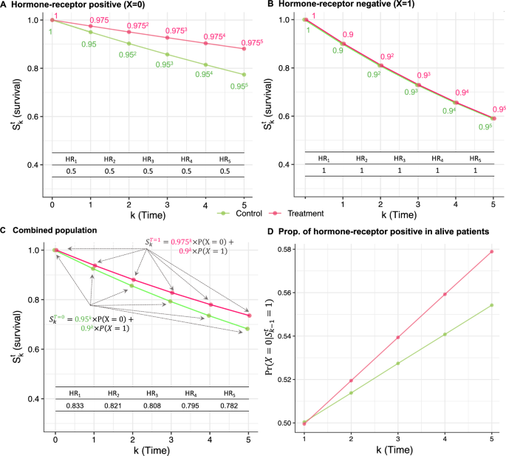
#statstab #543 How hazard ratios can mislead and why it matters in practice

Thoughts: Another *insert effect size measure* has issues paper. If you use HRs you better study up.

#observational #hazardratio #effectsize #misconceptions
#causalinference

https://link.springer.com/article/10.1007/s10654-025-01250-9

How hazard ratios can mislead and why it matters in practice - European Journal of Epidemiology

Hazard ratios are routinely reported as effect measures in clinical trials and observational studies. However, many methodological works have raised concerns about the interpretation of hazard ratios as causal effects. These concerns are often related to three points: (i) depletion of susceptible individuals leads to selection bias and complicates the causal interpretation of the hazard ratio, (ii) the hazard ratio is not collapsible, and (iii) the conventional proportional hazards assumption rarely holds in medical studies. We discuss the relation between these three points. We ground our presentation on an example about effect of endocrine therapy in reducing the risk of recurrence or death in a population of patients with breast cancer. We also describe why survival curves and risk differences do not exhibit any of the undesirable properties of hazard ratios.

SpringerLink

Title: P4: Causal LLM or splitting LLM [2025-09-11 Thu]

- **Economics/Policy:** Assess impacts, clarify causal
pathways, propose policies.
- **Recommendation Systems:** Infer preferences, explain
choices, personalize outputs.

Text of original post: https://try-codeberg.github.io/static/causal-inference.org #causalinference #causality #inference #statistic #observability #llm #reasoning

Title: P3: Causal LLM or splitting LLM [2025-09-11 Thu]

- Lack modular separation, functions are entwined.
- Risk of hallucinated causal links, unreliable for
interventions.
- Formal counterfactuals need extensive external
scaffolding.

**Fields:**
- **Healthcare:** Predict treatment outcomes (reasoner),
explain intervention effects (explainer), recommend
actions (producer). #causalinference #causality #inference #statistic #observability #llm #reasoning

Title: P2: Causal LLM or splitting LLM [2025-09-11 Thu]

Transparency: Modular, explainable // Opaque, explanation
varies
Scalability: Harder (custom/domain) // Easier
(generalizable)
Data types: Model integration required // Prompting in
one model

**LLM Limitations:** LLMs use pattern matching over
explicit causal modeling.
- No explicit causal graphs/mechanisms—only patterns and
correlations. #causalinference #causality #inference #statistic #observability #llm #reasoning

Title: P1: Causal LLM or splitting LLM [2025-09-11 Thu]

needing rigorous, transparent causality.
- Effective for quick prototyping or low-risk tasks where
simulated causal logic suffices.

Causal Inference Neural Networks vs Prompt-Engineered Multimodal LLM
Causality: Explicit, modeled, testable // Pattern-based,
plausible, implicit
Reliability: High (good data/model) // Medium,
errors/hallucinations #causalinference #causality #inference #statistic #observability #llm #reasoning

Title: P0: Causal LLM or splitting LLM [2025-09-11 Thu]

Causal Cooperative Networks (CCNets) - Causal Learnign
Framework - Reasoner, Explainer, Producer.

Causal inference finds causes by showing they covary with
effects, occur beforehand, and by ruling out
alternatives.

LLMs use pattern matching, not explicit causal models or
separate reasoning modules.
- Insufficient for regulated or high-stakes domains #causalinference #causality #inference #statistic #observability #llm #reasoning

I’ve been trying to read more carefully about instrumental variables and make up my mind about when IV arguments are scientifically convincing.

Here's a tension I keep running into:

Should the scientific question alone determine the causal parameter of interest?

Or is it legitimate for the target parameter to reflect an interplay between scientific interest and the identifying assumptions we actually find tenable?

IVs can be difficult to interpret when instruments are weak, who “compliers” are is opaque, exclusion restrictions are debatable, or linear models are used in settings where the true data-generating process may be nonlinear.

On the other hand, when an entire body of (aspirationally causal) literature rests on methods that try to close backdoor paths, IVs offer a genuinely different identification strategy. That seems valuable for evidence triangulation, even if IV analyses have their criticisms.

What do you think? Are you a big IV proponent? Are you an IV critic?

When do you find IV evidence persuasive?

Some literature I've been reading & re-reading:

https://pubmed.ncbi.nlm.nih.gov/16755261/

https://academic.oup.com/ije/article/47/4/1289/3095892

https://pmc.ncbi.nlm.nih.gov/articles/PMC4285626/

https://arxiv.org/abs/2402.09332

https://arxiv.org/abs/2402.05639

#CausalInference #InstrumentalVariables #Econometrics #Statistics #DataScience #HealthPolicy

Instruments for causal inference: an epidemiologist's dream? - PubMed

The use of instrumental variable (IV) methods is attractive because, even in the presence of unmeasured confounding, such methods may consistently estimate the average causal effect of an exposure on an outcome. However, for this consistent estimation to be achieved, several strong conditions must h …

PubMed

Postdoc in Single-Cell and Spatial Multi-Omic Gene Regulatory Networks
UMass Chan Medical School

Decode #GeneRegulatoryNetwork from #SingleCell multiomics with #CausalInference and #MachineLearning as a #postdoc! No biomed bg needed.

See the full job description on jobRxiv: https://jobrxiv.org/job/umass-chan-medical-school-27778-postdoc-in-single-cel...
https://jobrxiv.org/job/umass-chan-medical-school-27778-postdoc-in-single-cell-and-spatial-multi-omic-gene-regulatory-networks/?fsp_sid=11689

Science Jobs - Find science and research jobs - 3,116 jobs

The international job board for scientists, by scientists. Find science jobs in academia or industry: MSc, PhD, Postdoc, Scientist, Faculty and more!

jobRxiv