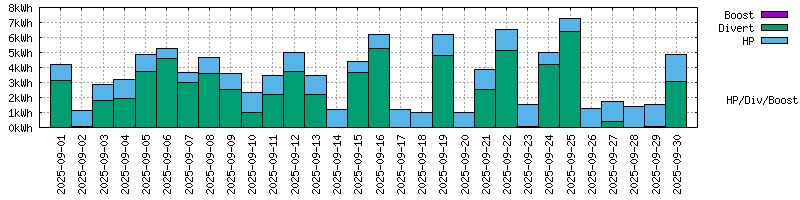
Domestic Hot Water (#DHW) periodic #pasteurisation of storage to prevent #Legionnaires' disease is hard to do with a heat pump (getting up to ~60C), so I do something a bit differerent:

https://www.earth.org.uk/eddi-diverter-dataset.html

When there is sufficient sunshine the system is set up to automagically do it a bit less than weekly by direct diversion from PV; in winter once or twice a month from the #grid when #carbonIntensity is low...

Eddi Solar PV Diverter Top-up Dataset

Various stats for PV diversion and low-carbon-grid top-up of Sunamp Thermino. #heatBattery #microgen #dataset

The Bank of Korea proposes a Korea-style climate benchmark index, which, in pilot tests, outperformed KOSPI returns while significantly reducing carbon intensity, aiming to boost green finance and global competitiveness despite current data and investment limitations.
#YonhapInfomax #BankOfKorea #KOSPI #ClimateBenchmark #GreenFinance #CarbonIntensity #Economics #FinancialMarkets #Banking #Securities #Bonds #StockMarket
https://en.infomaxai.com/news/articleView.html?idxno=83772
GB Electricity Grid Live Carbon Intensity Dataset - GB (Scotland/England/Wales) grid carbon intensity (gCO2/kWh2) as computed from FUELINST data live multiple times per hour. #carbonIntensity #dataset - https://www.earth.org.uk/GB-electricity-grid-CO2-intensity-live-dataset.html
GB Electricity Grid Live Carbon Intensity Dataset

GB (Scotland/England/Wales) grid carbon intensity (gCO2/kWh2) as computed from FUELINST data live multiple times per hour. #carbonIntensity #dataset

This makes interesting reading if you're considering adding a battery to your #SolarPV system. If we assume 1 kWh of #PV-generated electricity has a #CarbonIntensity of 35 gCO2, adding a battery increases this by 84 gCO2/kWh (less if only one inverter is needed).
https://doi.org/10.1016/j.jclepro.2022.132899

This brings the total to 120 gCO2/kWh, which is comparable to the current annual average for the NZ electricity network:
https://www.statista.com/statistics/1299734/new-zealand-emissions-intensity-from-electricity-generation/
(Although, as I type, it's 33 gCO2/kWh, thanks to 96% renewables!)

Life cycle assessment (LCA) of a battery home storage system based on primary data

While the market for battery home storage systems (HSS) is growing rapidly, there are still few well-modelled life cycle assessment (LCA) studies avai…

@jfparis @anxiumer18539 That is very cool, certainly a step up from just eyeballing it, as I do. Unfortunately I don't think there is a #CarbonIntensity forecast available for NZ... yet. I will be suggesting it!
@lightweight Yeah, just a simple #HomeAssistant setup running on a #RaspPi B+. I log the #SolarHotWater and room temps, monitor energy usage using an old Cent-a-meter and scrape #CarbonIntensity data. That's about all my wee Pi can manage!
https://mastodon.social/@stephenharlow/108581795456463976
@lightweight That's what I'm feeding into my #EV at the moment! It must be why the #CarbonIntensity is so low 😉 Can you heat your hot water, effectively using your HWC as a "battery"?
Everyone checks the #CarbonIntensity of their electricity before they charge their #EV, right?
#HomeAssistant

... 🧶
2 concepts:

“Reducing the #carbonIntensity of the economy. In practical terms, this is what we're doing with renewables. Because there's a need for back-up, because they're not completely decarbonized either, because they power an economy that in its very materiality (steel, cement, plastic) will depend on carbon for a long time to come: an electric car, for example, is obviously not decarbonized, even if it reduces the carbon intensity of transport. This is obvious. Why do we have to make it clear? Because it forces us to leave the question of the size of the #economy on the table.

#Degrowth, the dismantling of certain hopes, projects, technical devices. There are things that we're going to have to reduce or even abandon, and organize that. And once we've said that, the question of distribution reappears. If we can't imagine a world where everything will grow without environmental problems, the question of inequality will come back with a vengeance.”

https://legrandcontinent.eu/fr/2024/02/22/une-monde-sans-transition-une-conversation-avec-jean-baptiste-fressoz/
Un monde sans transition ? une conversation avec Jean-Baptiste Fressoz | Le Grand Continent

Dans son nouvel ouvrage, Sans transition : une nouvelle histoire de l’énergie, l’historien Jean-Baptiste Fressoz démontre à quel point les discours contemporains sur la «transition énergétique» sont nourris de récits historiques frauduleux sur de supposées transitions passées, préservant au passage les intérêts des multinationales du secteur. En mettant au jour l’empilement des sources d’énergie dans l’histoire (nous ne sommes jamais sortis de «l’âge du charbon» !), leurs interdépendances (ou symbioses), et la fabrique des récits de la transition, il nous invite à nous débarrasser d’un concept inopérant, qui empêche de se poser les bonnes questions.

Le Grand Continent

I try to be an optimist and also am guilty of posting more positive than negative.

For all of my praise of our Midwest grid’s renewable commitments, it all falls apart on yucky hot days. We must do better 😭

86% fossil fuel, and it’s only 9:30 AM and 85°F.

#SouthwestPowerPool #CarbonIntensity #fossilfuels #renewables