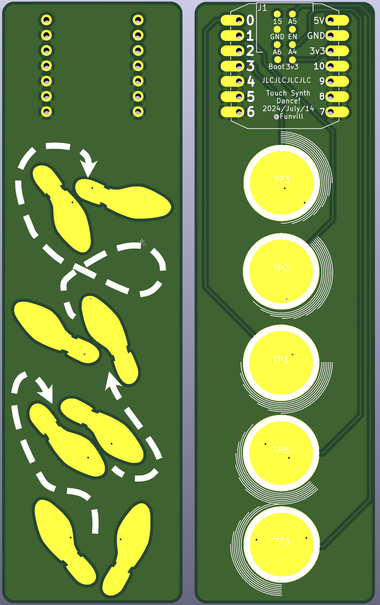
Working on a capacitive touch front plate for a synth project. This top plate is a cheap PCB only board (No components). It connects to a more expensive bottom plate with a #XIAO ESPC6, amp, and headphone jack

I never done capacitive touch before so I am trying several different patterns and designs. Always open to suggestions

This was my idea for the @hackaday 2024 Business Card Challenge but @todbot beat me to it with his picotouch_bizcard

#PCB #PCBArt #CapacitiveTouch #synth #ESP32 kicad

Controlling Bongo Cat with PicoPlanet 🪐 Quick Capacitive Touch HID Keyboard

https://makertube.net/w/xjxxrs32jSjjoPZpgvNZAD

Controlling Bongo Cat with PicoPlanet 🪐 Quick Capacitive Touch HID Keyboard

PeerTube
Tindie Maker Marketplace (@[email protected])

Attached: 1 image Touchwheel0, a Capacitive Touch Wheel https://blog.tindie.com/2024/04/touchwheel0-a-capacitive-touch-wheel/

hackaday.social
Several folks asked if they could get the little capacitive touch wheels I made as a badge add-on giveaway for Hackaday Supercon 2024. Now you can get them in my Tindie store!
Demo video of using two on a breadboard:
https://youtu.be/Db7S75eE-G8
Tinde link: https://www.tindie.com/products/todbot/touchwheel0-capacitive-touch-wheel/
More details on the code and board files if you want to make your own: https://github.com/todbot/touchwheels/
#CircuitPython #CapacitiveTouch #CapSense #Hackaday #Supercon #RaspberryPiPico
touchwheel0 dual demo

YouTube
More CircuitPython capacitive touch sensing madness w/ the Pico. Now I can do touch sliders and touch wheels. Is this board interesting to anyone else, should I put it in my Tindie store?
https://www.youtube.com/watch?v=n9cSR43akds
#CircuitPython #CapacitiveTouch #RaspberryPiPico
picoslidertoy prototype demo

YouTube
Woohoo I am a KiCad master now! Or at least I know enough to default to it instead of Eagle. Finally. Plus I found a neat capacitive touch sensor chip that I got working in CircuitPython and Arduino on a Pico
#KiCad #CircuitPython #RaspberryPiPico #CapacitiveTouch
NEW GUIDE: LCARS-inspired Circuit Board Panel #PCB #AdafruitLearningSystem @adafruit @anne_engineer

A new guide in the Adafruit Learning System today: LCARS-inspired Circuit Board Panel by Anne Barela Making props from your favorite television and film franchises can be very tedious and expensive…

Adafruit Industries - Makers, hackers, artists, designers and engineers!

I have several inexpensive ESP32+LCD devices with capacitive touch sensors, but there are 2 main types of I2C sensors - FT6x36 & GT911. So... I decided to write an Arduino library to auto-detect the sensor type and read the touch values (2-5 touch points). Here's a pre-release version to try before I submit it to the Arduino Library Manager:

https://github.com/bitbank2/bb_captouch

#Arduino
#esp32
#capacitivetouch

GitHub - bitbank2/bb_captouch: An ESP32/Arduino library to talk to CST820, FT6x36 and GT911 capacitive touch sensors (auto-detects)

An ESP32/Arduino library to talk to CST820, FT6x36 and GT911 capacitive touch sensors (auto-detects) - bitbank2/bb_captouch

GitHub

REMOTICON 2021 // Hal Rodriguez and Sahrye Cohen Combine Couture and Circuitry

[Hal Rodriguez] and [Sahrye Cohen] of Amped Atelier focus on creating interactive wearable garments with some fairly high standards. Every garment must be pretty, and has to either be controllable by the wearer, through a set of sensors, or even by the audience via Bluetooth. Among their past creations are a dress with color sensors and 3D-printed scales on the front that change color, and a flowing pantsuit designed for a dancer using an accelerometer to make light patterns based on her movements.

Conductive Melody -- a wearable musical instrument that is the focus of [Sahrye] and [Hal]'s Remoticon 2021 talk -- was created for a presentation at Beakerhead Festival, a multi-day STEAM-based gathering in Calgary. [Sahrye] and [Hal] truly joined forces for this one, because [Sahrye] is all about electronics and costuming, and [Hal] is into synths and electronic music. You can see the demo in the video after the break.

The dress's form is inspired by classical instruments and the types of clothing that they in turn inspired, such as long, generous sleeves for harp players and pianists. So [Hal] and [Sahrye] dreamed up a dress with a single large playable sleeve that hangs down from the mid- and upper arm. The sleeve is covered with laser-cut conductive fabric curlicues that look like a baroque interpretation of harp strings. Play a note by touching one of these traces, and the lights on the front of the dress will move in sync with the music.

[Sahrye] started the dress portion of Conductive Melody with a sketch of the garment's broad strokes, then painted a more final drawing with lots of detail. Then she made a muslin, which is kind of the breadboard version of a project in garment-making where thin cotton fabric is used to help visualize the end result. Once satisfied with the fit, [Sahrye] then made the final dress out of good fabric. And we mean really good fabric -- silk, in this case. Because as [Sahrye] says, if you're going to make a one-off, why not make as nicely as possible? We can totally get behind that.

[Sahrye] says she is always thinking about how a wearable will be worn, and how it will be washed or otherwise cared for. That sequined and semi-sheer section of the bodice hides the LEDs and their wiring quite well, while still being comfortable for the wearer.

Inside the sleeve is an MPRP121 capacitive touch sensor and an Arduino that controls the LEDs and sends the signals to a Raspberry Pi hidden among the ruffles in the back of the dress.

The Pi is running Piano Genie, which can turn eight inputs into an 88-key piano in real time. When no one is playing the sleeve, the lights have a standby mode of mellow yellows and whites that fade in and out slowly compared to the more upbeat rainbow of musical mode.

We love to see wearable projects -- especially such fancy creations! -- but we know how finicky they can be. Among the lessons learned by [Sahrye] and [Hal]: don't make your conductive fabric traces too thin, and silver conductive materials may tarnish irreparably. We just hope they didn't have to waste too much conductive fabric or that nice blue silk to find this out.

#cons #hackadaycolumns #wearablehacks #arduino #capacitivetouch #conductivefabric #couture #raspberrypi #wearable

REMOTICON 2021 // Hal Rodriguez And Sahrye Cohen Combine Couture And Circuitry

[Hal Rodriguez] and [Sahrye Cohen] of Amped Atelier focus on creating interactive wearable garments with some fairly high standards. Every garment must be pretty, and has to either be controllable …

Hackaday

Capacitive Touch Controller for FPGAs

Most projects that interface with the real world need some sort of input device. Obviously this article is being written from a standardized "human interface device" but when the computers become smaller the problem can get more complicated. We can't hook up a USB keyboard to every microcontroller since we often only need a few buttons, but even buttons can be a little bit too cumbersome for some applications. For something even simpler, we would like to turn your attention to capacitive touch controllers.

Granted, these devices are really only simpler from a hardware perspective. Rather than a switch that can be prone to failure either when its moving parts break or its contacts become corroded, a capacitive touch button only needs a certain conductive area on something like a PCB, along with a few passive components, to work. The real difficulty is in the software, so this project aims to make it simpler to bring these sort of devices to any FPGA that needs some sort of interface like this. It can operate in stand-alone mode or in a custom user interface, and was written to be platform-independent in VHDL without the need for any dependencies or macros.

The project's page goes into a great amount of detail on how capacitive touch sensors like these work in general, and describes the operation of this specific code as well. Everything is open source, so it's ready to be put to work right away. If you need capacitive touch capabilities on something like a microcontroller, though, take a look at this tiny Atmel-powered musical instrument instead.

#fpga #button #capacitivetouch #hid #sensor #software #vhdl

Capacitive Touch Controller For FPGAs

Most projects that interface with the real world need some sort of input device. Obviously this article is being written from a standardized “human interface device” but when the comput…

Hackaday