...also 5 Satelliten reichen wohl nicht. Aber selbst falls sie eine globale Abdeckung anstreben würden, bräuchten #BlueWalker dafür anscheinend um Größenordnungen weniger Satelliten als #Starlink.

https://www.perplexity.ai/search/kann-ast-bluewalker-mit-nur-5-vhhoGwT6QPqFMuyLxKlqUA

P.S.: Ich finde Lichtverschmutzung *nicht* gut.

Look at this little cutie ❤️
This #rackmount #ups will keep my #selfhosted #nextcloud instance running in case of blackout and shutdown all the gear gracefully before the #battery runs out of juice!

#rack #selfhost #selfhosters #powerwalker #bluewalker

Ein weiterer Beleg dafür, warum #Außerirdische uns nicht besuchen:

Genau das braucht die Menschheit: Noch mehr #Lichtverschmutzung. Weil das ja so gut ist.

"Der erste von 100: Riesensatellit #BlueWalker 3 heller als fast alle #Sterne

#ASTSpaceMobile will mit riesigen #Satelliten Smartphones online bringen. Nun bestätigt eine ausführliche Analyse die Befürchtungen in der #Astronomie."

https://www.heise.de/news/Studie-zu-Riesensatellit-BlueWalker-3-Bisweilen-heller-als-fast-alle-Sterne-9330965.html

Der erste von 100: Riesensatellit BlueWalker 3 heller als fast alle Sterne

AST SpaceMobile will mit riesigen Satelliten Smartphones online bringen. Nun bestätigt eine ausführliche Analyse die Befürchtungen in der Astronomie.

heise online
Huge new satellite outshines nearly every star in the sky

At times, the enormous telecommunications spacecraft is brighter than some of the most iconic stars visible from Earth.

Proud to be co-author to this just published paper in #Nature, about the high brightness of the prototype satellite, #BlueWalker 3, for a future 243-satellite satellite constellation:

https://www.nature.com/articles/s41586-023-06672-7

Several hundred of magnitude zero satellites in the sky will not only alter the outlook of the sky, but also means astronomical observatories will have to do active mitigation. We call for more attention to such unwanted side-effects as part of launch permit assessments.

The high optical brightness of the BlueWalker 3 satellite - Nature

We report the outcome of an international optical observation campaign of a prototype constellation satellite, AST SpaceMobile’s BlueWalker 3, which features a 64.3 m2 phased-array antenna and a launch vehicle adaptor.

Nature

@JohnBarentine I thought you might be interested in today's front page story on spaceweather.com #bluewalker

https://spaceweather.com/archive.php?view=1&day=31&month=07&year=2023

Spaceweather.com Time Machine

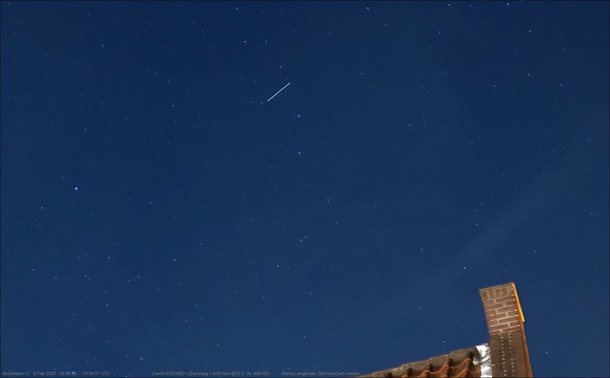
The #BlueWalker-3 satellite, @AST_SpaceMobile's prototype sat for direct cell phone communication, passing over my house in Leiden, the Netherlands earlier this evening, at mag +1.5.
Canon EOS 80D + Samyang 1.4/35 mm at F2, exposure 2 seconds, 800 ISO.
@IAU_CPS @Tregloan_Reed
Voor de ochtendploeg.
---
RT @Marco_Langbroek
Video of a pass of the #Bluewalker 3 satellite, filmed this evening from Leiden, the Netherlands:
https://vimeo.com/779437239
Photometric data:
http://www.satobs.org/seesat/Dec-2022/0021.html
@IAU_CPS
https://twitter.com/Marco_Langbroek/status/1601008427626438657
Bluewalker 3, 8 Dec 2022 17:30 UT

Vimeo
Video of a pass of the #Bluewalker 3 satellite, filmed this evening from Leiden, the Netherlands:
https://vimeo.com/779437239
Photometric data:
http://www.satobs.org/seesat/Dec-2022/0021.html
@IAU_CPS
Bluewalker 3, 8 Dec 2022 17:30 UT

Vimeo

#Bluewalker 3 #satellite is brighter than 99.8 per cent of visible stars

Observations of a huge test satellite that launched in September have fuelled concerns about the impact a planned fleet could have on #astronomy

The 64 square metre reflective array of the Blue Walker 3 satellite for a future space-to-Earth mobile phone network is brighter than 99.8 per cent of stars visible to the naked eye. If a planned fleet of 100 additional satellites is as bright or brighter, astronomers are concerned it could severely impact ground-based astronomy

https://www.newscientist.com/article/2348615-bluewalker-3-satellite-is-brighter-than-99-8-per-cent-of-visible-stars/

Bluewalker 3 satellite is brighter than 99.8 per cent of visible stars

Observations of a huge test satellite that launched in September have fuelled concerns about the impact a planned fleet could have on astronomy

New Scientist