New publication: "Signal and Worker: How Proteins Activate Electrons"

Proteins aren't passive β€” they're programmable phonon sources, tuned by evolution to guide electrons. The paper reveals that photosynthesis & light-induced superconductivity share the same Signal-Worker architecture, and extracts design rules for room-temperature quantum metamaterials.

https://doi.org/10.5281/zenodo.20329448

#QuantumBiology #Photosynthesis #Superconductivity #MaterialsScience #BioInspired #Physics #Research

Signal and Worker: How Proteins Activate Electrons

Proteins are the master choreographers of electron activation in biological systems. This document presents the Signal-Worker ontology β€” a framework in which bosons (photons/phonons) act as informational signals and fermions (electrons/excitons) perform chemical work β€” and shows how the protein scaffold functions as a programmable phonon source. Drawing on photosynthesis, respiration, oxidoreductases, and metalloproteins, we demonstrate that biological electron activation operates through Environment-Assisted Quantum Transport (ENAQT) and manifests an isomorphism with Floquet-engineered superconductivity. Design rules for bio-inspired room-temperature quantum metamaterials are derived from the analysis.

Zenodo

What can we learn from the tiny brains of insects to improve robot navigation? πŸ€– 🐝 🐜

In the latest episode, I chatted to Prof. Andrew Philippides from the University of Sussex about #robot algorithms inspired by ants and bees.

Available wherever you get your podcasts: linktr.ee/robottalkpod

#Robotics #BioInspired #AI

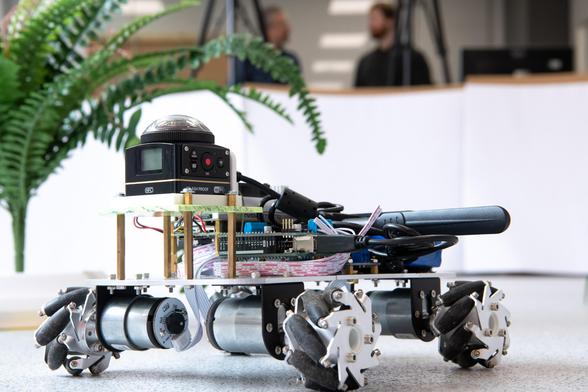
Here's a photo of a mecannum robot with panoramic camera, which Andy uses to test ant-inspired navigation algorithms.

Find out more by listening to Episode 154 of Robot Talk - available on all major podcast providers: https://linktr.ee/robottalkpod

#Robots #Robotics #BioInspired #MachineLearning

πŸ“’ New Episode Alert!

This week, I chatted to Prof. Andrew Philippides from the University of Sussex about what we can learn from ants and bees to improve robot navigation. πŸ€– 🐝 🐜

Listen now: https://www.robottalk.org/2026/05/01/episode-154-andrew-philippides/ #Robots #Robotics #BioInspired #AI

About two inspiring weeks at CASCB in Konstanz β€” fireflies, bats, bees, meerkats, and swarm intelligence. All feeding into new algorithms for musical co-improvisation. Next artistic residency: IRCAM, Paris. #Musikfonds #AI #Music #bioinspired @uni-konstanz.de

https://www.federicovisi.com/residency-at-the-centre-for-the-advanced-study-of-collective-behaviour/?utm_source=mastodon&utm_medium=jetpack_social

fly51fly (@fly51fly)

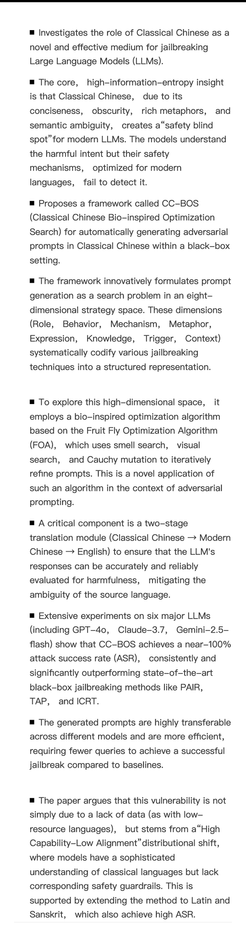
생물학적 탐색 기법을 ν™œμš©ν•΄ κ³ μ „ 쀑ꡭ어 기반의 jailbreak ν”„λ‘¬ν”„νŠΈλ₯Ό μ΅œμ ν™”ν•˜λŠ” μ—°κ΅¬μž…λ‹ˆλ‹€. νŠΉμ΄ν•œ μ–Έμ–΄ ν™˜κ²½μ—μ„œλ„ LLM 우회 곡격이 κ°€λŠ₯함을 보여주며, ν”„λ‘¬ν”„νŠΈ λ³΄μ•ˆκ³Ό μ•ˆμ „μ„± 평가에 μ€‘μš”ν•œ μ˜λ―Έκ°€ μžˆμŠ΅λ‹ˆλ‹€.

https://x.com/fly51fly/status/2038024453985288584

#jailbreak #promptoptimization #llmsecurity #research #bioinspired

fly51fly (@fly51fly) on X

[CL] Obscure but Effective: Classical Chinese Jailbreak Prompt Optimization via Bio-Inspired Search X Huang, S Qin, X Jia, R Duan… [Nanyang Technological University & Northeast University & Renmin University of China] (2026) https://t.co/t0b3EuX1iH

X (formerly Twitter)

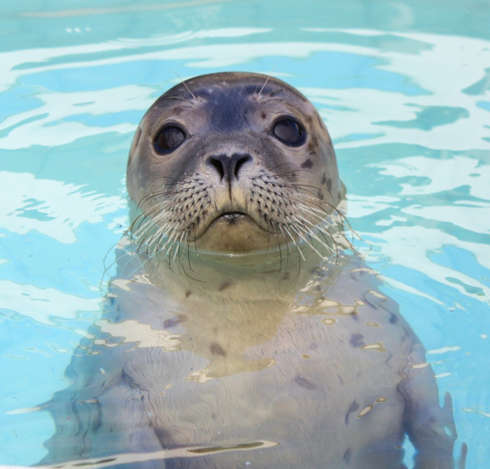
🦭Why do seals "whisk" their whiskers?

New research by PhD student Chinmay Gupta, Prof. Ajay Kottapalli and team @rug.nl shows that active whisking improves sensing, helping seals accurately follow underwater trails.🌊

Curious? Read more πŸ‘‡
πŸ”— https://www.rug.nl/fse/news/highlighted-papers/2026/why-do-seals-whisk-their-whiskers

πŸ§ͺ #SciComm #sciencealert #ScienceNewsroom #bioinspired #biomedical #engineering #mechanics #technology #biology #research #science #scientistsOnMastodon @universityofgroningen

Curious about #robots inspired by insects? πŸ€–

Later this season, I'll be chatting to Prof. Andrew Philippides from the University of Sussex about what we can learn from ants and bees to improve robot navigation.

Send me your questions for Andy in the comments below or on the Robot Talk website: robottalk.org/ask-a-question/

#Robotics #BioInspired

#ICYMI: Last month, I chatted to Dr. Amir Patel from University College London about bio-inspired #robot movement.

Catch up here 🎧 - https://www.robottalk.org/2026/01/16/episode-140-amir-patel/ or wherever you get your podcasts!

#Robots #Robotics #BioInspired #Environment #Wildlife

Ronald van Loon (@Ronald_vanLoon)

Festo의 'From Fins to Wings' 생체λͺ¨λ°© 곡학 ν”„λ‘œμ νŠΈλ₯Ό μ†Œκ°œν•˜λŠ” κΈ€λ‘œ, λ¬Όκ³ κΈ° μ§€λŠλŸ¬λ―Έμ™€ λ‚ κ°œμ˜ 생체ꡬ쑰λ₯Ό λͺ¨μ‚¬ν•œ λ‘œλ΄‡ 곡학 데λͺ¨μ™€ ν•¨κ»˜ λ¨Έμ‹ λŸ¬λ‹Β·μΈκ³΅μ§€λŠ₯ 기반 μ›€μ§μž„ μ œμ–΄Β·ν˜μ‹ μ  섀계 κ°€λŠ₯성을 μ‘°λͺ…ν•œλ‹€. μž‘μ„±μžλŠ” Lukas M. Ziegler둜, λ‘œλ³΄ν‹±μŠ€μ™€ 생체λͺ¨λ°© μ—”μ§€λ‹ˆμ–΄λ§μ˜ μ‘μš© 사둀λ₯Ό 보여쀀닀.

https://x.com/Ronald_vanLoon/status/2020804646558674967

#robotics #machinelearning #bioinspired #innovation

Ronald van Loon (@Ronald_vanLoon) on X

From Fins to Wings: Festo’s Bio-Inspired Engineering in Motion by @lukas_m_ziegler #Robotics #MachineLearning #ArtificialIntelligence #ML #MI #Innovation

X (formerly Twitter)