 Education & Knowledge
The Biggest Ring in the Universe

The Biggest Ring in the Universe
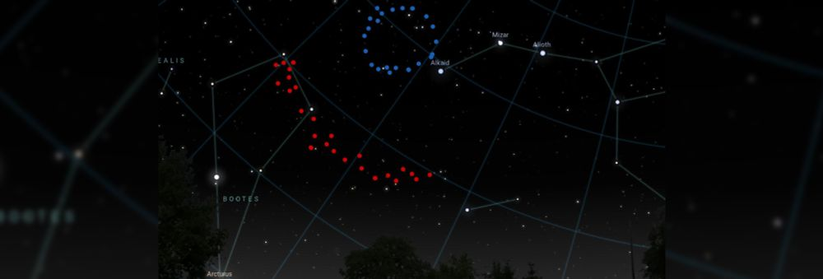
#KnowledgeByte: The #BigRing is a recently discovered ring-shaped large-scale structure composed of galaxies and galaxy clusters. It's located about 9.2 billion light-years away, near the constellation Boötes.
With a diameter of about 1.3 billion light-years, it's an incredibly massive structure that challenges our current understanding of the universe's large-scale structure.
https://knowledgezone.co.in/posts/The-Big-Ring-6739f425b5a6d1107c8516b6
Gigaparsec structures are nowhere to be seen in ΛCDM: an enhanced analysis of LSS in FLAMINGO-10K simulations
by Alexia Lopez @morninglopez and Roger Clowes @rgclowes
https://arxiv.org/abs/2504.14940

Recently, Sawala et al. 2025 claimed to refute the cosmological significance of the Giant Arc based on their analysis of the FLAMINGO-10K simulation data. In our paper here, we highlight several shortcomings of the authors' analysis. We then perform an enhanced analysis on the FLAMINGO-10K simulation data with applications of: the Single-Linkage Hierarchical Clustering (SLHC), the Convex Hull of Member Spheres (CHMS), and the Minimal Spanning Tree (MST) algorithms. Using the full $2.8^3$ Gpc$^3$ FLAMINGO-10K box, with subhaloes at $z=0.7$, and $100$ random realisations (from random subset selections) we find no gigaparsec structures in FLAMINGO-10K, and only a few ultra-large large-scale structures (uLSSs, structures exceeding a maximum pairwise separation of $370$ Mpc). Somewhat surprisingly, we found that the large-scale aspects of the FLAMINGO-10K data could be adequately represented by a Poisson point distribution. The enhanced analysis presented here further supports the remarkable nature of the Giant Arc as a cosmologically-significant structure. Of course, the Giant Arc is also accompanied by a second uLSS, the Big Ring. The analysis presented here builds on the work presented by Sawala et al., but amends the application of their statistical assessments. We do not yet know why there appears to be such a large discrepancy between the FLAMINGO-10K data and the observed LSS in MgII absorbers. Perhaps the results presented here might suggest that the GA, and especially the GA + BR, presents a more direct challenge to $Λ$CDM. In contrast to the conclusion of Sawala et al. that `gigaparsec patterns abound in a $Λ$CDM universe' we find that they are nowhere to be seen.
Big Things in the Universe
About a year ago I wrote a couple of articles (here and here) in response to the discovery of a very large structure (“The Big Ring“) and claims that this structure and others – such as a Giant Arc – were inconsistent with the standard model of cosmology; the work concerned was later submitted as a preprint to arXiv. In my first post on the Big Ring I wrote
To assess the significance of the Big Ring or other structures in a proper scientific fashion, one has to calculate how probable that structure is given a model. We have a standard model that can be used for this purpose, but to simulate very structures is not straightforward because it requires a lot of computing power even to simulate just the mass distribution. In this case one also has to understand how to embed Magnesium absorption too, something which may turn out to trace the mass in a very biased way. Moreover, one has to simulate the observational selection process too, so one is doing a fair comparison between observations and predictions.
Well on today’s arXiv there is a preprint by Sawala et al. with the title aims to assess the significance of structures comparable to the Giant Arc. The title of the paper is The Emperor’s New Arc: gigaparsec patterns abound in a ΛCDM universe from which you can guess the conclusions. The abstract is
Recent discoveries of apparent large-scale features in the structure of the universe, extending over many hundreds of megaparsecs, have been claimed to contradict the large-scale isotropy and homogeneity foundational to the standard (ΛCDM) cosmological model. We explicitly test and refute this conjecture using FLAMINGO-10K, a new and very large cosmological simulation of the growth of structure in a ΛCDM context. Applying the same methods used in the observations, we show that patterns like the “Giant Arc”, supposedly in tension with the standard model, are, in fact, common and expected in a ΛCDM universe. We also show that their reported significant overdensities are an algorithmic artefact and unlikely to reflect any underlying structure.
arXiv:2502.03515
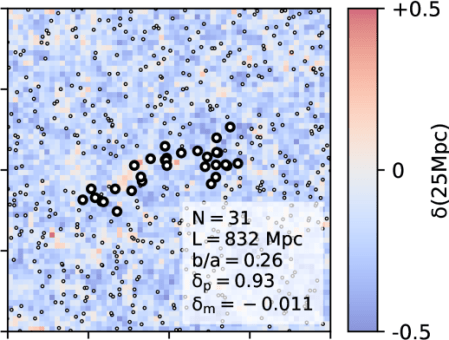
Here’s a picture of a large structure (a “Giant Arc”) taken from a gallery of such objects found in the simulations
I quote from the conclusions:
We hope that our results will dispel the misconception that no inhomogeneity can be found in the standard model Universe beyond some finite size. Instead, any given realisation of the isotropic universe comprises a time- and scale-dependent population of structures from which patterns can be identified on any scale.
I have nothing to add.
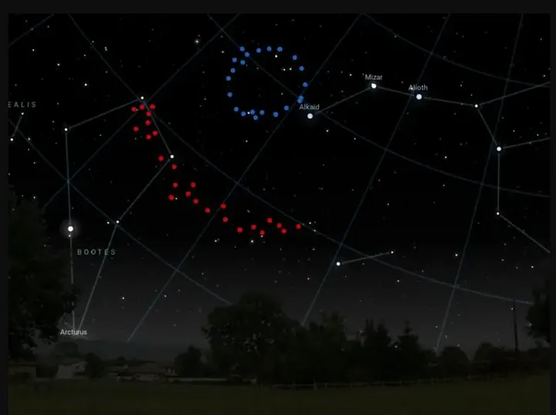
The #BigRing is a recently discovered ring-shaped large-scale structure composed of galaxies and galaxy clusters.
It's located about 9.2 billion light-years away, near the constellation Boötes. With a diameter of about 1.3 billion light-years, it's an incredibly massive structure that challenges our current understanding of the universe's large-scale structure.
https://knowledgezone.co.in/posts/The-Big-Ring-6739f425b5a6d1107c8516b6
Don't call it crisis, call it opportunity! Here is the December edition of the (German-speaking) science magazine "bild der wissenschaft" with a cover story about the challenges of our current #cosmology model: https://www.wissenschaft.de/bdw-hefte-specials/aktuelles-heft/
...including a one-page interview with me on our community paper!
Check it out, it's a great read!! 🤩
#Science #Outreach #Laniakea #BigRing #CosmologicalPrinicple
#KnowledgeByte: The #BigRing is a recently discovered ring-shaped large-scale structure composed of galaxies and galaxy clusters. It's located about 9.2 billion light-years away, near the constellation Boötes.
With a diameter of about 1.3 billion light-years, it's an incredibly massive structure that challenges our current understanding of the universe's large-scale structure.
https://knowledgezone.co.in/posts/The-Big-Ring-6739f425b5a6d1107c8516b6
in the #arXiv
Investigating Ultra-Large Large-Scale Structures: Potential Implications for Cosmology
by Alexia Lopez @morninglopez and co-authors
https://arxiv.org/abs/2409.14894
#cosmology #bigring #giantarc #galaxies #ΛCDM #CosmologicalPrinciple #LSS #LargeScaleStructure #Universe #astrodon #astronomy #astrophysics #science #STEM #RoyalSociety
Large-scale structure (LSS) studies in cosmology map and analyse matter in the Universe on the largest scales. Understanding the LSS can provide observational support for the Cosmological Principle (CP) and the Standard Cosmological Model ($Λ$CDM). In recent years, many discoveries have been made of LSSs that are so large that they become difficult to understand within $Λ$CDM. Reasons for this are: they potentially challenge the CP, (i.e. the scale of homogeneity); and their formation and origin are not fully understood. In this article we review two recent LSS discoveries: the Giant Arc (GA, $\sim 1$ Gpc) and the Big Ring (BR, $\sim 400$ Mpc). Both structures are in the same cosmological neighbourhood -- at the same redshift $z \sim 0.8$ and with a separation on the sky of only $\sim 12^\circ$. Both structures exceed the often-cited scale of homogeneity (Yadav+ 2010), so individually and together, these two intriguing structures raise more questions for the validity of the CP and potentially hint at new physics beyond the Standard Model. The GA and BR were discovered using a novel method of mapping faint matter at intermediate redshifts, interpreted from the MgII absorption doublets seen in the spectra of background quasars.
World’s top cosmologists convene to question conventional view of the universe
Meeting at London’s Royal Society will scrutinise basic model first formulated in 1922 that universe is a vast, even expanse with no notable features.
#cosmology #conference #London #RAS #universe #astronomy #astrophysics #astrodon #science #bigring #galaxies #HubbleConstant
World’s top cosmologists convene to question conventional view of the universe
The principle that ⭐️everything looks the same everywhere⭐️ is a fundamental pillar of the standard model of #cosmology,
which aims to explain the big bang and how the universe has evolved in the 13.7bn years since.
But this week a meeting of some of the world’s leading cosmologists will convene at London’s Royal Society to ask:
what if this basic assumption is wrong?
The meeting comes after a number of high-profile astronomical observations have challenged the conventional view, according to Prof Subir #Sarkar, a cosmologist at the University of Oxford and co-organiser of the meeting.
“We are, in cosmology, using a model that was first formulated in 1922,” he said. “We have great data, but the theoretical basis is past its sell-by date. More and more people are saying the same thing and these are respected astronomers.”
The conference brings together some of the scientists behind the recent anomalous findings.
These include
🌟observations that suggest the universe is expanding more quickly in some regions than others,
🌟hints at megastructures in the night sky and evidence for cosmic flows
– vast celestial rivers of material on a scale that cannot be readily accommodated within conventional theories.
Dr Nathan #Secrest, of the US Naval Observatory and a collaborator with Sarkar, is presenting findings that raise
🌟the possibility that the universe is slightly lopsided. After analysing a catalogue of more than 1m quasars (extremely luminous galactic cores), the team found that one hemisphere of the sky appeared to host roughly 0.5% more sources than the other.
It may not sound like a major discrepancy but, according to Sarkar, if confirmed
🔸 it would undermine the basis for #dark #energy, 🔸which is supposed to be the dominant component of the universe.
“It would mean that two-thirds of the universe has just disappeared,” Sarkar said.
Dr Konstantinos #Migkas, of Leiden University, will share
🌟findings that the Hubble constant – the rate at which the universe is expanding
– appears to vary across space.
“Our results add another problematic piece to the puzzle,” Migkas said. At a local scale, at least, this suggests that observations do not match predictions of the standard model. “We can’t extrapolate that it’s wrong over the full universe,” he added.
Alexia #Lopez, a PhD student at the University of Central Lancashire, has discovered what appear to be
🌟cosmic megastructures, named #BigRing and #GiantArc. These shapes, traced out by galaxies and galaxy clusters, occur on a scale beyond which the universe should be smooth and effectively featureless.
“When we’re finding a list of structures that are exceeding this scale, are they challenging this assumption that is so fundamental in cosmology?” said Lopez. “Maybe there needs to be more of a critical analysis of our standard model.”
Sarkar suggests that belief in the standard model of cosmology has been so deeply ingrained that it is treated as “the religion”. “I find that frankly annoying that this principle hasn’t been checked,” he said,
although not everyone agrees with this characterisation.
Prof George #Efstathiou, an astrophysicist at the University of Cambridge, who is presenting a more sceptical take at the conference, ♦️said it was not true that the model had not been repeatedly interrogated. ♦️“People accuse me of defending the model,” he said. “But what they don’t realise is how much time I’ve spent trying to disprove it. I completely disagree that’s there’s some kind of groupthink.”
Efstathiou said that while intriguing, none of the anomalies being presented were compelling enough to undermine standard theories.
https://www.theguardian.com/science/2024/apr/14/worlds-top-cosmologists-convene-to-question-conventional-view-of-the-universe?CMP=Share_iOSApp_Other
 Knowledge Zone
 Daniel Pomarède
 In the Dark

 Gravity Grinch
 Chuck Darwin