The #LargeHadronCollider Discovers Mysterious #Antimatter #Physics
The #LHCb experiment has observed a new difference between matter and antimatter in particles called #baryons
Our best theories suggest that when universe was born it had equal amounts of matter and antimatter, and when the two made contact, they annihilated one another. For some reason, a small excess of matter survived and went on to create the physical world. Why? No one knows.
https://www.scientificamerican.com/article/the-large-hadron-collider-discovers-antimatter-behaving-oddly-in-new-class/
https://archive.ph/a7VB3
The Large Hadron Collider Discovers Antimatter Behaving Oddly in New Class of Particles

The LHCb experiment has observed a new difference between matter and antimatter in particles called baryons

Scientific American
LHCb observe pour la première fois une violation de la symétrie CP dans les baryons (Λ_b⁰). Désintégrations asymétriques matière/antimatière détectées.
https://www.pourlascience.fr/sd/physique-particules/la-brisure-de-la-symetrie-cp-a-ete-observee-pour-la-premiere-fois-dans-les-baryons-28037.php
#Science #PhysiqueParticules #CPViolation #Baryons #LHCb #Antimatière
One of the Universe’s Biggest Mysteries Has Been Solved, Scientists Say
Scientists have spotted the universe’s “missing matter” hiding in a vast cosmic web with some help from #fastradiobursts from deep #space.
Now, a team has revealed that about 76% of all #baryons—the ordinary #particles that make up planets and stars—exist as gas hidden in the dark expanses between galaxies, known as the intergalactic medium.
https://www.404media.co/one-of-the-universes-biggest-mysteries-has-been-solved-scientists-say/
One of the Universe’s Biggest Mysteries Has Been Solved, Scientists Say

Scientists have spotted the universe’s “missing matter” hiding in a vast cosmic web with some help from fast radio bursts from deep space.

404 Media

CP Violation in Baryons

I was (pleasantly) surprised to learn a few weeks ago that I shall be teaching particle physics again next academic year. That means that I’ll have to update to the notes to reflect the latest news from CERN. Researchers from the LHCb collaboration have published evidence for CP violation in baryons. The paper is published in Nature here.

For those of you not up with the lingo, CP is an operator that combines C (charge-conjugation, i.e. matter versus anti-matter) and P (parity, i.e. inversion of coordinates). Parity has been known since the 1950s to be violated in weak interactions, so the weak nuclear force distinguishes between states of odd and even parity. CP violation was first demonstrated in the 1960s CP in the decays of neutral kaons resulted in the Nobel Prize  in 1980 for its discoverers Cronin and Fitch. CP violation has subsequeuntly been seen in many other meson decays.

But the mesons (consisting of a quark and an antiquark) are only half of the family of particles made from quarks; the others are the baryons which are made of three quarks (c.f. James Joyce’s “Three quarks for Muster Mark” in Finnegans Wake). Antibaryons consist of three antiquarks, but such are not mentioned in Finnegans Wake.

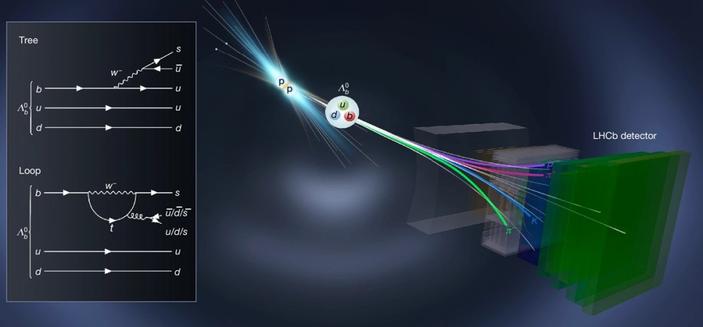
The baryons concerned in the LHCb experiment contain an up quark, a down quark and a beauty quark and were produced in proton–proton collisions at the Large Hadron Collider in 2011–2018. These baryons and antibaryons can decay via multiple channels. In one, a baryon decays to a proton, a positive K-meson and a pair of pions – or, conversely, an antibaryon decays to an antiproton, a negative K-meson and a pair of pions. CP violation should create an asymmetry between these processes, and the researchers found evidence of this asymmetry in the numbers of particles detected at different energies from all the collisions.

Figure 1 from https://doi.org/10.1038/s41586-025-09119-3

A problem with calculating the magnitude of this effect for baryons is that there is a contribution from the strong force – see the curly line indicating a gluon in the lower panel on the left above – and that is much harder to compute than a pure weak force (represented by the wavy lines indicating W– bosons. Yo will see that the tree and loop diagrams involve quark mixing, a process that allows quarks of different generations to couple via weak interactions; there is a buW vertex in the top panel and a tsW vertex in the bottom one. Given the uncertainties, it seems the results are consistent with the level of CP violation predicted in the Standard Model of particle physics.

The big question surrounding this result is whether it can account for the fact that our Universe – or at least our part of it -contains a preponderance of baryons over anti-baryons, so somehow the interactions going on during the Big Bang must have shown a preference for the former over the latter. This problem of baryogenesis is not explained in the Standard Model and, since these results are consistent with the Standard Model, the answer to that question is “no”…

#baryons #CERN #ChargeConjugation #CPViolation #LHCb #mesons #ParityViolation #quarks

Mysterious #Antimatter #Physics Discovered at the Large Hadron Collider
The #LHCb experiment has observed a new difference between matter and antimatter in particles called #baryons

https://www.scientificamerican.com/article/the-large-hadron-collider-discovers-antimatter-behaving-oddly-in-new-class/

The Large Hadron Collider Discovers Antimatter Behaving Oddly in New Class of Particles

The LHCb experiment has observed a new difference between matter and antimatter in particles called baryons

Scientific American
A gas rich cosmic web revealed by partitioning the missing #baryons: https://arxiv.org/abs/2409.16952 -> Scientists have spotted the universe’s “missing matter” hiding in a vast cosmic web with some help from fast radio bursts from deep space: https://www.404media.co/one-of-the-universes-biggest-mysteries-has-been-solved-scientists-say/
A gas rich cosmic web revealed by partitioning the missing baryons

Approximately half of the Universe's dark matter resides in collapsed halos; significantly less than half of the baryonic matter (protons and neutrons) remains confined to halos. A small fraction of baryons are in stars and the interstellar medium within galaxies. The lion's share are diffuse (less than $10^{-3}$ cm$^{-3}$) and ionized (neutral fraction less than $10^{-4}$), located in the intergalactic medium (IGM) and in the halos of galaxy clusters, groups, and galaxies. The quantity and spatial distribution of this diffuse ionized gas is notoriously difficult to measure, but has wide implications for galaxy formation, astrophysical feedback, and precision cosmology. Recently, the dispersion of extragalactic Fast Radio Bursts (FRBs) has been used to measure the total content of cosmic baryons. However, past efforts had modest samples and methods that cannot discriminate between IGM and halo gas, which is critical for studying feedback and for observational cosmology. Here, we present a large cosmological sample of FRB sources localized to their host galaxies. We have robustly partitioned the missing baryons into the IGM, galaxy clusters, and galaxies, providing a late-Universe measurement of the total baryon density of $Ω_b h_{70}$=0.049$\pm$0.003. Our results indicate efficient feedback processes that can expel gas from galaxy halos and into the intergalactic medium, agreeing with the enriched cosmic web scenario seen in cosmological simulations. The large diffuse baryon fraction that we have measured disfavours bottom-heavy stellar initial mass functions, which predict a large total stellar density, $Ω_*$.

arXiv.org

"People, planets & stars are made of #baryons. #DarkMatter, on the other hand, is a mysterious substance that makes up the bulk of the matter in the #universe. We do not know what new particle or substance makes up dark matter. We know exactly what the ordinary #matter is, we just didn't know where it was," Connor said.

#science #astronomy #physics #astrophysics

The researchers found that a smaller slice of the missing #matter resides in the halos of diffuse material surrounding #galaxies….

Ordinary matter is composed of #baryons, which are the subatomic particles protons & neutrons needed to build atoms.

#science #astronomy #physics #astrophysics

Ordinary matter is composed of #baryons, which are the subatomic particles protons and neutrons needed to build atoms. About 76% 📊 resides in #intergalactic space, about 15% in #galaxy halos and the remaining 9% concentrated within #galaxies 🌌, primarily as #stars or gas. https://www.reuters.com/science/astronomers-locate-universes-missing-matter-2025-06-16

#Astronomy

😆 Three #physicists think they've outsmarted the #universe by suggesting dead stars emit Hawking radiation like black holes. They claim it'll make everything vanish faster, but conveniently forget about those stubborn #baryons not playing along. 🚀✨ Maybe next time, they should try solving the mystery of disappearing socks instead! 🧦🔍
https://johncarlosbaez.wordpress.com/2025/05/17/dead-stars-dont-radiate-and-shrink/ #HawkingRadiation #blackholes #humor #disappearingSocks #HackerNews #ngated
Dead Stars Don’t Radiate

Three guys claim that any heavy chunk of matter emits Hawking radiation, even if it’s not a black hole: • Michael F. Wondrak, Walter D. van Suijlekom and Heino Falcke, Gravitational pair…

Azimuth