M.C. Escher and CP Violation

I’ve had these pictures for quite a while and can’t remember where I got them from, but I used to show them in my lectures on Theoretical Particle Physics when I was in Nottingham to illustrate CP-violation and used them in this morning’s lecture at Maynooth.

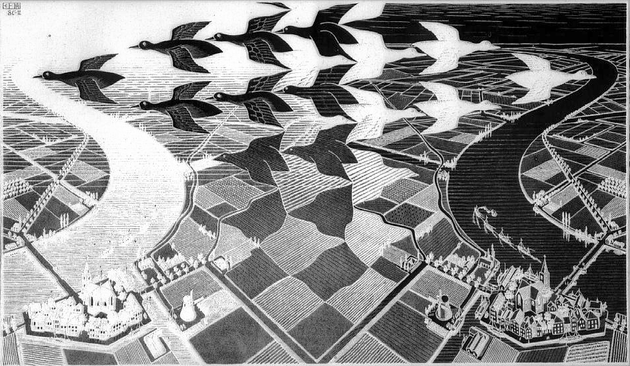
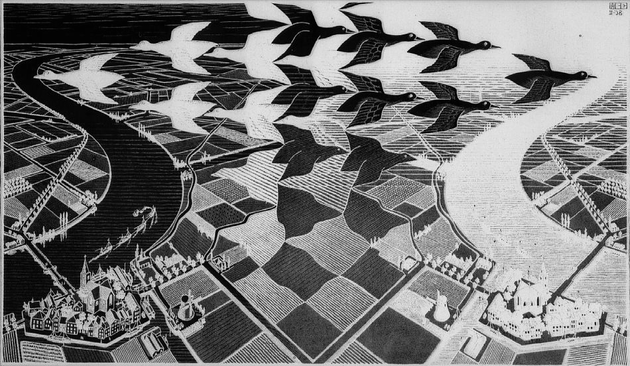
The following picture by M.C. Escher is called Day and Night:

If you look at it you can see two kinds of symmetry emerging. One is a kind of reflection symmetry about a vertical axis drawn through the centre of the picture that applies to shapes but not to colour. The other is between black and white. But it is obvious that the picture doesn’t display these symmetries separately: to get a picture unchanged from the original you would have to do the mirror reflection and change black to white (and vice-versa).

The mirror reflection in the image can be taken to represent parity (P). Strictly speaking parity refers to a reflection through the origin in 3D rather than a mirror reflection, but it’s just for illustration. We know that a parity symmetry is violated in weak interactions just as it is in the picture.

The other possible symmetry, between black and white can be taken to represent charge-conjugation (C), the operation that converts particles into anti-particles and vice-versa.

While P is not an exact symmetry of weak interactions, it was long thought that the combination of C and P (CP) would be. Actually it isn’t. The story of the discovery of CP-violation is fascinating but I don’t have time to go into it here. It suffices to say that the Escher print also displays CP violation.

First lets do `C’, i.e. convert black to white and vice-versa. The result is:

Now reflect about the vertical mid-line to illustrate `P’:

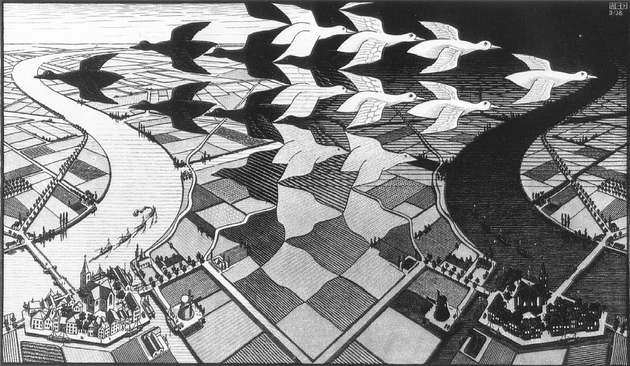
If `CP’ were an exact symmetry then that image would be identical to the original, which I reproduce here:

You can see, however, that while some elements of the picture do look the same after this combined operation (e.g. the birds), others (e.g. the buildings at the bottom) do not. Although CP is not an exact symmetry of this picture, it is almost (just like it is in particle physics).

#CPViolation #DayAndNight #MCEscher #ParticlePhysics
LHCb observe pour la première fois une violation de la symétrie CP dans les baryons (Λ_b⁰). Désintégrations asymétriques matière/antimatière détectées.
https://www.pourlascience.fr/sd/physique-particules/la-brisure-de-la-symetrie-cp-a-ete-observee-pour-la-premiere-fois-dans-les-baryons-28037.php
#Science #PhysiqueParticules #CPViolation #Baryons #LHCb #Antimatière

CP Violation in Baryons

I was (pleasantly) surprised to learn a few weeks ago that I shall be teaching particle physics again next academic year. That means that I’ll have to update to the notes to reflect the latest news from CERN. Researchers from the LHCb collaboration have published evidence for CP violation in baryons. The paper is published in Nature here.

For those of you not up with the lingo, CP is an operator that combines C (charge-conjugation, i.e. matter versus anti-matter) and P (parity, i.e. inversion of coordinates). Parity has been known since the 1950s to be violated in weak interactions, so the weak nuclear force distinguishes between states of odd and even parity. CP violation was first demonstrated in the 1960s CP in the decays of neutral kaons resulted in the Nobel Prize  in 1980 for its discoverers Cronin and Fitch. CP violation has subsequeuntly been seen in many other meson decays.

But the mesons (consisting of a quark and an antiquark) are only half of the family of particles made from quarks; the others are the baryons which are made of three quarks (c.f. James Joyce’s “Three quarks for Muster Mark” in Finnegans Wake). Antibaryons consist of three antiquarks, but such are not mentioned in Finnegans Wake.

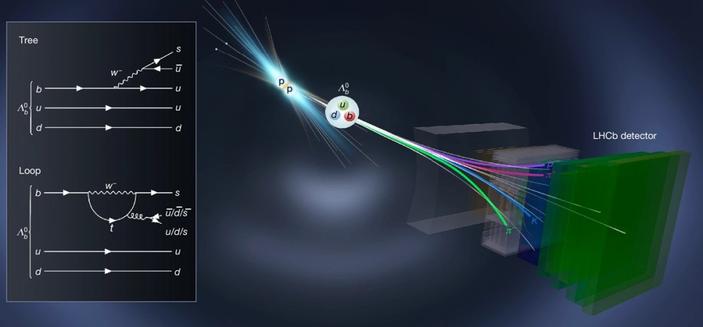
The baryons concerned in the LHCb experiment contain an up quark, a down quark and a beauty quark and were produced in proton–proton collisions at the Large Hadron Collider in 2011–2018. These baryons and antibaryons can decay via multiple channels. In one, a baryon decays to a proton, a positive K-meson and a pair of pions – or, conversely, an antibaryon decays to an antiproton, a negative K-meson and a pair of pions. CP violation should create an asymmetry between these processes, and the researchers found evidence of this asymmetry in the numbers of particles detected at different energies from all the collisions.

Figure 1 from https://doi.org/10.1038/s41586-025-09119-3

A problem with calculating the magnitude of this effect for baryons is that there is a contribution from the strong force – see the curly line indicating a gluon in the lower panel on the left above – and that is much harder to compute than a pure weak force (represented by the wavy lines indicating W– bosons. Yo will see that the tree and loop diagrams involve quark mixing, a process that allows quarks of different generations to couple via weak interactions; there is a buW vertex in the top panel and a tsW vertex in the bottom one. Given the uncertainties, it seems the results are consistent with the level of CP violation predicted in the Standard Model of particle physics.

The big question surrounding this result is whether it can account for the fact that our Universe – or at least our part of it -contains a preponderance of baryons over anti-baryons, so somehow the interactions going on during the Big Bang must have shown a preference for the former over the latter. This problem of baryogenesis is not explained in the Standard Model and, since these results are consistent with the Standard Model, the answer to that question is “no”…

#baryons #CERN #ChargeConjugation #CPViolation #LHCb #mesons #ParityViolation #quarks

CERN scientists detected an asymmetry between matter and antimatter, called a charge-parity (CP) violation, in subatomic baryon particles for the first time ⚛️🔬✨

Read Full Article

#CERN #ScienceNews #ParticlePhysics #CPViolation #Antimatter https://www.sciencealert.com/breaking-major-antimatter-discovery-may-help-solve-mystery-of-existence
Reenviado desde Science News
(https://t.me/experienciainterdimensional/8509)
Breaking: Major Antimatter Discovery May Help Solve Mystery of Existence

We're now a step closer to understanding how the Universe avoided an antimatter apocalypse.

ScienceAlert