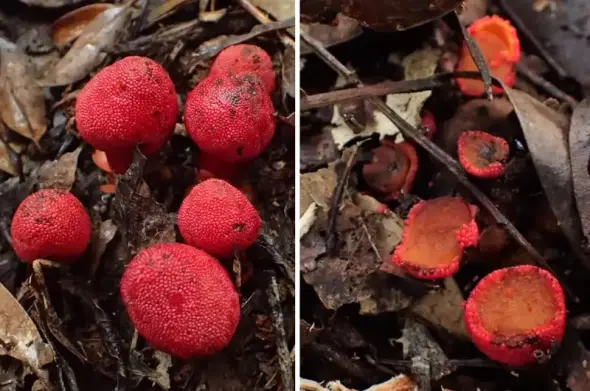
The evolutionary mysteries of a rare parasitic plant https://www.oist.jp/news-center/news/2025/12/10/evolutionary-mysteries-rare-parasitic-plant

#Balanophora #evolution, metabolic retention in reduced #plastids, and the origins of obligate agamospermy: Petra Svetlikova et al. https://nph.onlinelibrary.wiley.com/doi/10.1111/nph.70761

"At the base of mossy trees, deep in the mountains of #Taiwan and mainland #Japan or in the subtropical forests of #Okinawa, grows what most might mistake for a mushroom – a very unique plant with some of the smallest flowers and seeds in the world"
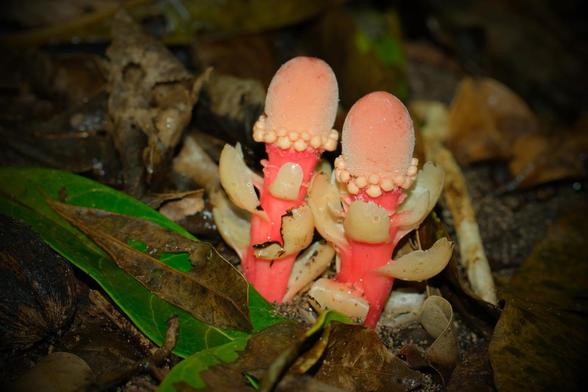
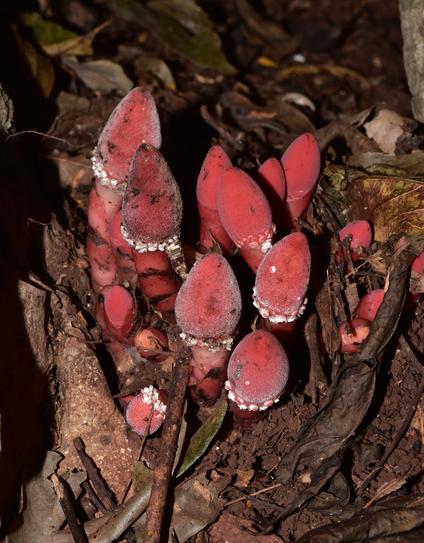
#Parasitic plant convinces hosts to grow into its own fleshβ€”it's also an extreme example of genome shrinkage https://phys.org/news/2023-09-parasitic-convinces-hosts-fleshit-extreme.html

#Balanophora #genomes display massively #ConvergentEvolution with other extreme #holoparasites and provide novel insights into parasite–host interactions https://www.nature.com/articles/s41477-023-01517-7

"unlike some other #ParasiticPlants, Balanophora induces the vascular system of their host plant to grow into a tuber, forming a unique underground organ with mixed host-parasite tissue."

Parasitic plant convinces hosts to grow into its own fleshβ€”it's also an extreme example of genome shrinkage

If you happen to come across plants of the Balanophoraceae family in a corner of a forest, you might easily mistake them for fungi growing around tree roots. Their mushroom-like structures are actually inflorescences, composed of minute flowers.

Phys.org

Endangered #Amami rabbit disperses seeds for non-photosynthetic plant https://phys.org/news/2023-01-endangered-amami-rabbit-disperses-seeds.html

Researchers had previously been puzzled about how the seeds of the #Balanophora #plants, with some of the smallest fruits among angiosperms, were dispersed. B. yuwanensis is a host-specific obligate parasite. Efficient seed transportation likely requires the seed to be deposited near the roots of a host. The #AmamiRabbit may facilitate this through digging, defecating underground in burrows.

Endangered Amami rabbit disperses seeds for non-photosynthetic plant, reveals study

The iconic yet endangered Amami rabbit (Pentalagus furnessi) has been shown to play a key role in seed dispersal for the non-photosynthetic plant Balanophora yuwanensis. This discovery, made by Professor Suetsugu Kenji and graduate student Mr. Hashiwaki Hiromu of Kobe University's Graduate School of Science, sheds light on the previously unknown ecological role of the world's only dark-furred wild rabbit.

Phys.org