 Japan Pop News
https://www.wacoca.com/news/2859659/ 新型コロナ変異株BA.3.2は強い免疫逃避能を示すが重症化の兆候はなく継続的な監視が必要 JAMA #BA32 #SARSCoV2 #オミクロン株 #変異株 #変異株影響 #感染症監視 #新型コロナウイルス
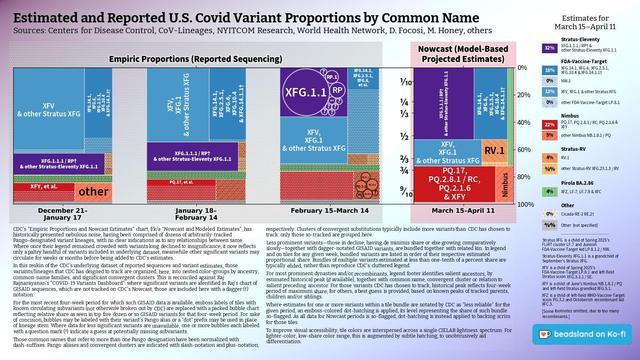
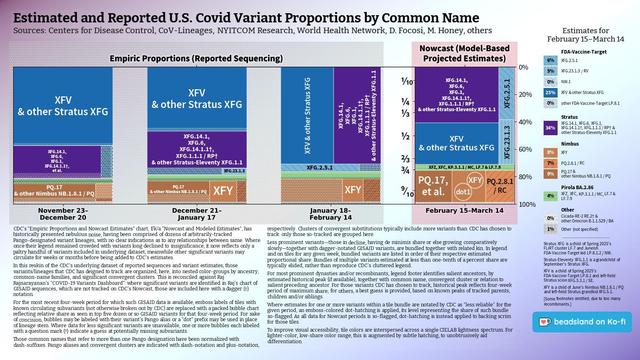
Most recent #CDC dataset, updated Friday, shows two Stratus XFG variants, XFG.1.1 and newcomer XFG.23.1.3 / RV, gaining ground against their dynastic cousins.
Meanwhile, Nimbus 1.8.1 / PQ family also gained share, even as the XFY recombinant was overshadowed by its fellow PQ variants.
Note that, in absence of robust data from states, CDC has given up modeling historical estimates, instead giving only shares of reported sequences.
Raj's dashboard, updated near two weeks ago, showed Stratus-Eleventy XFG.1.1, alone, at a quarter share, for the last half of the most recent reporting period, while Cicada #BA32 grandkid RE.2 made a significant appearance in GISAID data (despite Cicada not yet showing up in CDC estimates.)
That said, said GISAID data was dominated by paltry submissions from New York (171), Minnesota (85), Maryland (84), Nebraska (53), and Arizona (17).
❖ #ThisIsOurPolio #variants #CovidIsNotOver #dataviz #datavis
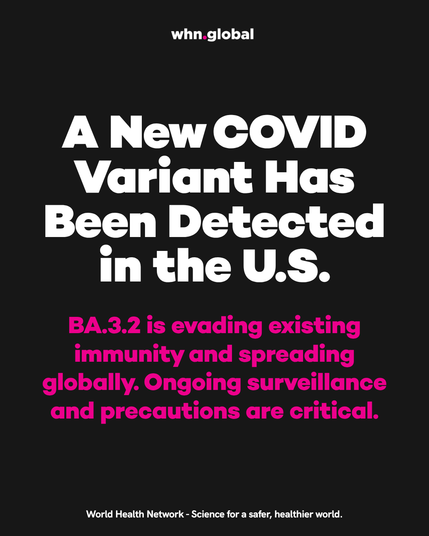
🚨 A new COVID variant, BA.3.2 ("Cicada"), has been detected in the U.S. and internationally.
With 50+ spike mutations relative to BA.3, significant immune evasion is expected. Continued precautions matter.
How to protect yourself and others:
- Improve indoor air quality (ventilation + filtration)
- Wear a respirator-quality mask in shared spaces
- Stay up to date on vaccination
- Test if symptomatic or after exposure
- Avoid in person meetings and stay home when sick
I have been worrying about this for days but don't have the spoons to dig in:
BA.3.2 lost its ability to bind tightly to ACE-2 receptors on cells [1]
Remember that Long COVID rates were much higher during Delta? Remember that Delta was much more prone to syncytia (not needing ACE2 at all) in part because it had reduced ACE-2 affinity?
syncytia formation via the highly fusogenic Delta spike promotes cellular senescence and extracellular cytokine release [2]
and I know I read (skimmed) a paper suggesting that this method of direct contact cell-cell transmission was driving Long COVID - aha here:
We propose the hypothesis that SARS-CoV-2 transitions to persistent infection, facilitated by syncytia formation [3]
[1] https://archive.md/HWOHt#selection-3205.38-3205.105
[2] https://pmc.ncbi.nlm.nih.gov/articles/PMC10785701/
[3] https://pubmed.ncbi.nlm.nih.gov/40535019/
#COVID #COVID19 #SARSCoV2 #CovidIsNotOver #BA32 #syncytia #syncytial
#covid19 #covid #sarscov2 #cancer #variant #BA32 #CDC
Original open access article
Shakya et al. March 19, 2026, MMWR Morb Mortal Wkly Rep 75(10);130–137
Early Detection and Surveillance of the SARS-CoV-2 Variant BA.3.2 — Worldwide, November 2024–February 2026
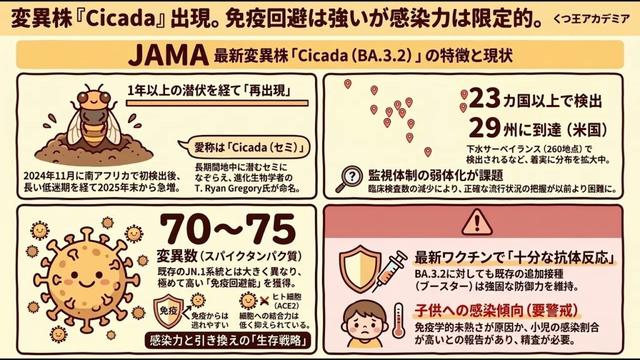
"approximately 70–75 substitutions and deletions in the gene sequence of the spike protein "
"... have the potential to reduce protection from a previous infection or vaccination."
Raj's dashboard, updated Tuesday, shows Stratus-Eleventy XFG.1.1, alone, at a quarter share, for the last half of the most recent reporting period, while Cicada #BA32 grandkid RE.2 makes an appearance in GISAID data.
That said, said GISAID data was dominated by paltry submissions from New York (171), Minnesota (85), Maryland (84), Nebraska (53), and Arizona (17).
Most recent #CDC dataset, updated over two weeks ago, showed two Stratus XFG variants gaining ground against their dynastic cousins.
Meanwhile, Nimbus 1.8.1 / PQ family also gained share, lead by the XFY recombinant with XFG.5.1.
Note that, in absence of robust data from states, CDC has given up modeling historical estimates, instead giving only shares of reported sequences.
❖ #ThisIsOurPolio #variants #CovidIsNotOver #dataviz #datavis
 香港01
香港01 sport of sacred spherical cows
 WHN
WHN datum (n=1)
 Ivi Choc
 Ivi Choc
 Bezpečnostní portál